


Rebel Moon: Part One – A Child of Fire (2023)
Director: Zack Snyder
Screenwriters: Zack Snyder, Kurt Johnstad, Shay Hatten
Starring: Sofia Boutella, Djimon Hounsou, Ed Skrein, Michiel Huisman, Doona Bae, Ray Fisher, Charlie Hunnam, Staz Nair, Fra Fee, Cleopatra Coleman, Ingvar Sigurdsson, Carey Elwes, Corey Stoll, Jenna Malone, Anthony Hopkins
Zack Snyder’s Rebel Moon began life as a pitch for a Star Wars film, but when that opportunity didn’t materialize he reworked the idea into an original space opera now available on Netflix. The movie is explicitly indebted to classic ensemble-rescue tales — most obviously Akira Kurosawa’s Seven Samurai and its many adaptations — and it blends those influences with the conventions of modern blockbuster science fiction.
The film opens with Anthony Hopkins delivering the necessary exposition about a conquering regime called the Motherworld that overthrew a royal family and now dominates a fractured galaxy. Rumors of a prophesied princess with special powers and a growing resistance movement set the stage. The central conflict focuses on Veldt, a remote, resource-rich world whose villagers refuse to hand over grain to the Imperium. Instead, they look to hire mercenary defenders and make a stand against overwhelming odds.
Sofia Boutella plays Kora, a soldier-turned-farmer who becomes the film’s emotional anchor. Snyder aims for striking visual moments — silhouettes against twin suns and stylized horizons — but some of these moments are undermined by obvious blending between practical sets and CGI backdrops. When the foreground and the digital sky don’t integrate cleanly, the intended sense of mythic scale can feel artificial rather than immersive.
The movie makes odd stylistic and casting choices. It mixes strong, culturally specific actors such as Ingvar Sigurdsson with more caricatured performances and inconsistent accents that occasionally distract. Charlie Hunnam’s scoundrel character adopts a wavering Belfast cadence that doesn’t always sit comfortably with the dialogue, while Corey Stoll’s Admiral Noble wears a militaristic uniform and delivers a sneering performance meant to telegraph authoritarian menace. These choices sometimes turn character presentation into a shorthand of “good” and “evil” rather than nuanced figures.
About halfway through, the story improves when the group journeys to an industrial, Blade Runner–like world and recruits Doona Bae’s formidable Nemesis. Her introduction includes a visually satisfying fight sequence and some of the most effective moments in the film. From there the ensemble collects familiar archetypes: a guilty ex-soldier, a fallen leader, a near-silent assassin and the obvious betrayer. The narrative builds toward the traditional crescendo where disparate talents unite to defend the village.
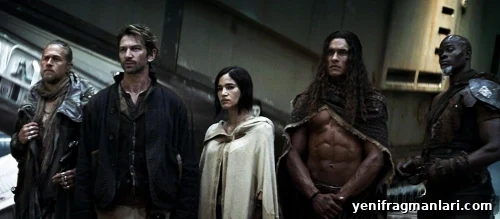
A recurring problem is the screenplay, which often reduces the cast’s committed performances to clumsy, stilted lines. No matter how convincing the actors are physically or how invested they seem, the dialogue frequently reads like a translation that lost nuance along the way. This makes it hard to care deeply about character dynamics or the emotional stakes, and it undermines many potentially gripping scenes.
The film is unabashedly referential. It includes familiar beats — an alien cantina, a hooded warrior confronting a thug, a powerful villain consulting an even darker mastermind — and these echoes of better-known works sometimes feel less like homage and more like imitation. The visuals and sound design borrow liberally from a wide variety of genre films, which can be enjoyable in isolated moments, but the overall effect is a collage rather than a fully realized new world.
Snyder’s strengths remain evident in the action sequences. He stages kinetic shootouts and close-quarters brawls with visual flair, and Tom Holkenborg’s propulsive score often elevates those scenes. At the same time, the film’s handling of violence feels inconsistent: some brutal moments are heavily implied instead of shown, suggesting this release is restrained compared to what might appear in later versions. That editorial choice undercuts the sense that the story has fully committed to its harsher elements.
There are flashes of originality — a robotic scorpion device that packs captured targets away like luggage and unsettling sequences that reveal the strange private habits of some villains. But these moments are rare and scattered amid a sea of borrowed imagery. The production design and effects are frequently impressive, yet they rarely coalesce into a memorable, distinct aesthetic for the franchise.
Ultimately, Rebel Moon: Part One is a competent spectacle that struggles to assert its own identity. It can be entertaining in bursts — largely when action, design and score align — but it never truly convinces as a new cinematic universe. The characters remain thinly realized, the dialogue often betrays intention, and the film leans heavily on familiar templates rather than offering fresh thematic or tonal surprises.
If you appreciate sweeping visuals, muscular action sequences and the comfort of recognizable genre beats, Rebel Moon will deliver those elements. If you hoped for a bold, original reimagining of the Seven Samurai template in space, however, this Part One will feel safe and derivative. Snyder clearly has material to expand on, and Part Two will need stronger characterization, sharper dialogue and a more distinct voice to elevate the series beyond cinematic pastiche.
Score: 11/24
Rating: 2 out of 5.
Recommended for you: Zack Snyder Movies Ranked