
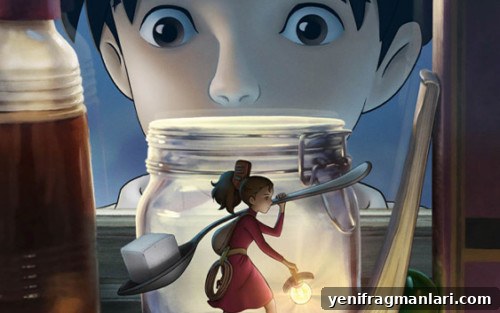

Arrietty (2010)
Director: Hiromasa Yonebayashi
Screenwriters: Hayao Miyazaki, Keiko Niwa
Starring: Mirai Shida, Ryunosuke Kamiki, Shinobu Otake, Tomokazu Miura, Kirin Kiki, Keiko Takeshita
Studio Ghibli’s Arrietty (released as The Secret World of Arrietty in the United States) is a visual delight that balances a faithful adaptation of Mary Norton’s classic novel The Borrowers with the distinctive warmth and craftsmanship that define the studio. From the opening moments to the final frame, the film invites viewers into a miniature world rendered with loving detail and emotional clarity.
The story centers on Shō (Ryunosuke Kamiki), a fragile teenage boy who moves to a countryside home with his aunt while awaiting heart surgery. Hidden within the house is a family of tiny people—Borrowers—who survive by borrowing small items from the human inhabitants. When the adventurous young Borrower Arrietty (Mirai Shida) is discovered on her first borrowing mission, the lives of both families change. The encounter sets up a gentle but affecting exploration of friendship, trust, and the fragile boundaries between very different lives.
Hiromasa Yonebayashi, directing with a sensitivity that recalls classic Ghibli productions, brings a clear visual imagination to the material. With Hayao Miyazaki contributing to the screenplay, Arrietty carries the studio’s characteristic concerns—respect for nature, the importance of family, and the emotional milestones of growing up—without feeling didactic. Instead, the film’s environmental themes and coming-of-age elements are woven into the characters’ relationships and the lived-in texture of their surroundings.
Visually, Arrietty is sumptuous. The film frequently adopts a Borrower’s-eye view, transforming mundane household objects into towering landscapes and dramatic obstacles. A kitchen sideboard becomes a mountain; a jam jar, a prison; everyday odds and ends are repurposed into tools, shelters, and weapons. That sense of scale is one of the film’s greatest strengths, allowing ordinary items to become sources of wonder and danger in equal measure. The animation team’s attention to small details—the stitching of fabric, the sheen on a leaf, the creak of floorboards—gives the world depth and authenticity.
The inventive use of household objects is a constant pleasure. Pod and Homily, Arrietty’s parents, construct their domestic life from repurposed items: double-sided tape becomes climbing gear, upturned flower pots form makeshift furniture, and a simple pin can serve as both a sword and a symbol of the Borrowers’ resourcefulness. These touches feel imaginative without ever straining credibility within the story’s rules.
Voice performances enhance the film’s emotional core. Mirai Shida’s portrayal of Arrietty is curious, brave, and vulnerable in equal measure; she embodies a heroine who is independent yet easily unsettled. Kirin Kiki provides memorable support as Haru, the housekeeper whose obsession with the Borrowers adds tension and a dash of dark humor. The supporting cast rounds out the family dynamics, giving the tiny household a grounded, believable sense of history and care.
Arrietty is also notable for its quiet, effective score by Cécile Corbel. The folk-inflected music blends with the film’s intimate visuals, adding lyrical warmth and an emotional resonance that amplifies key moments without overwhelming them. The soundtrack complements the story’s mood—gentle, wistful, and occasionally urgent—helping to create an immersive experience.
If the film occasionally feels a touch long, that sense comes from how fully it inhabits every small scene. Because the Borrowers’ world is so detailed and vast from their perspective, moments that might be brief in another film are given space to breathe here. That unhurried approach allows relationships to develop organically and makes the stakes feel real for characters who inhabit a very different scale of existence.
Arrietty is an accessible, affecting animation for viewers of all ages. It offers enough whimsy and adventure to engage children while delivering emotional depth and visual sophistication that older audiences will appreciate. In an era of fast-paced spectacle, Arrietty is a reminder that quiet, lovingly crafted stories can be just as powerful. It celebrates curiosity, the bonds of family, and the small acts that keep communities—no matter how tiny—alive.
For anyone who loves thoughtful animation, Arrietty stands as a modern Studio Ghibli classic: gentle, beautifully made, and refreshingly sincere.
22/24