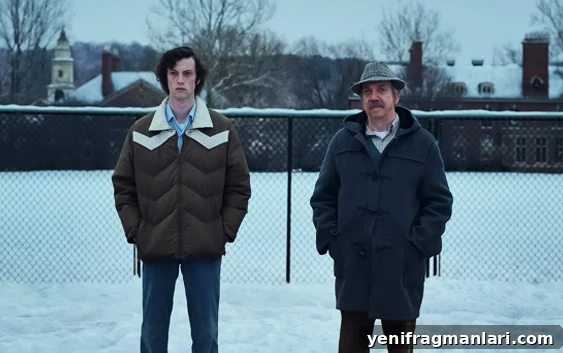
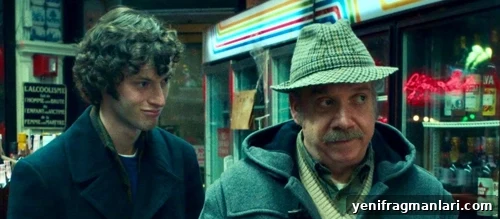
The Holdovers (2023)
Director: Alexander Payne
Screenwriter: David Hemingson
Starring: Paul Giamatti, Da’Vine Joy Randolph, Dominic Sessa, Carrie Preston, Brady Hepner, Ian Dolley, Jim Kaplan, Michael Provost, Andrew Garmon, Naheem Garcia, Stephen Thorne, Gillian Vigman, Tate Donovan, Juanita Pearl
Nearly two decades after their collaboration on Sideways, Alexander Payne and Paul Giamatti reunite in The Holdovers, a character-driven drama that leans into slow-burning emotion and dark humor. The film centers on an acerbic prep school teacher, Paul Hunham (Giamatti), who is tasked with supervising the small handful of students who remain at Barton Academy over the Christmas break. Rather than a traditional holiday movie, this is a study of awkward intimacy, wounded people, and the small, sometimes clumsy ways they try to care for one another.
Set during Christmas of 1970, the story follows Paul as he reluctantly looks after the “holdovers”—students who, for one reason or another, have nowhere else to go. As classmates depart for holidays, the group dwindles until only Paul, the school’s kitchen manager Mary (Da’Vine Joy Randolph), and a defiant seventeen-year-old named Angus Tully (Dominic Sessa) remain. The trio’s uneasy coexistence develops into an unexpected bond as they share a bleak holiday and, eventually, a trip that forces each of them to confront their losses and choices.
Payne’s direction deliberately evokes the era: from period-accurate studio ephemera to subtle post-production touches such as film grain and audio texture that reinforce the film’s time and tone. The pacing is measured and unhurried, favoring quiet exchanges and character beats over overt action. That restraint makes every small scene matter—the film’s tension often comes from a look, a comment, or a clumsy attempt at kindness rather than from dramatic plot turns.
Paul Hunham is drawn with bitter precision. He is mean-spirited, resentful and socially blunt—an outcast whose physical ailments, including a lazy eye and a glandular condition, have hardened him rather than softened him. He holds students to high standards, showing no favoritism even toward those whose families wield influence at the school. Underneath his harshness, though, the film allows glimpses of injury and loneliness that help explain his behavior without excusing it. His cruelty is sometimes pointed and petty—at one point he grades a student’s paper an F+—but it’s balanced by moments that reveal a complicated, if closed-off, humanity.
Mary and Angus provide counterpoints to Paul’s prickliness. Mary, carrying the grief of losing a son in combat, operates with a quiet dignity that masks deep pain. Angus, abandoned emotionally by his mother and facing the specter of military service, is defiant in ways that both protect and isolate him. Both characters are desperate for connection and for someone to see them; Paul, for his part, is both incapable and unwilling to play the conventional role of nurturer. Yet their interactions, strained and often awkward, gradually build a fragile, real bond.
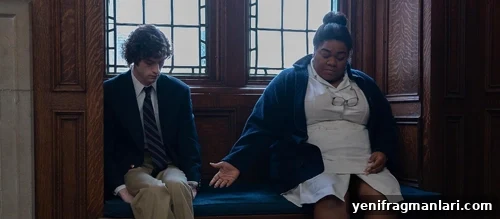
Where Payne excels is in grounding the film in specific, lived-in details: the shabby dormitory heating systems, the re-sold Christmas tree, and the mixture of hymns, holiday standards and early 1970s pop that underscore scenes with a sometimes jarring but effective emotional counterpoint. The setting—largely unchanged New England schools filmed in mid-winter—gives the movie an austere authenticity that enhances the characters’ isolation and the film’s melancholic humor.
The movie’s structure keeps most of the drama confined to the school, allowing extended exploration of the three central characters. Later, the film opens up as they attend a Christmas party and undertake an impromptu road trip to Boston. Those later scenes are effective in moving the story forward and revealing new facets of the characters, though some viewers may feel the final act is less tightly constructed than the rich, intimate scenes set at the academy. Still, the small, human moments—siblings supporting one another, shared laughter and awkward attempts at celebration—are consistently well observed.
Performance anchors the film. Giamatti is compelling as the stubborn, prickly Paul, managing to make the character both infuriating and oddly sympathetic without softening him into sentimental cliché. Da’Vine Joy Randolph delivers emotional steadiness and warmth as Mary, providing a moral and emotional center. Dominic Sessa’s portrayal of Angus captures youthful anger and vulnerability in convincing measure. Together, the trio provides some of the most striking performances of the year, allowing the film to be both funny and quietly devastating.
The Holdovers is not a conventional Christmas movie; it resists the trappings of holiday cheer and instead offers a bittersweet, humane portrait of people who do not fit the demands of their era or environment. It interrogates themes of class, expectation, grief and isolation while remaining intimate and accessible. The result is a sharply written, well-acted character study—wry, humane and often darkly funny—that lingers after the credits roll.
Score: 19/24
Rating: 4 out of 5.