
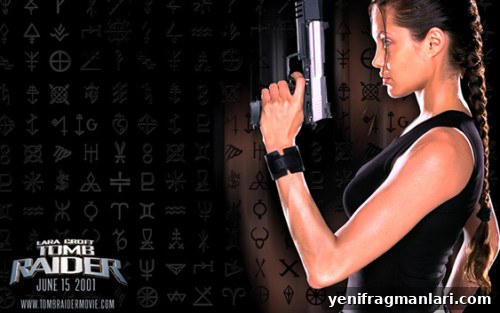
Lara Croft: Tomb Raider (2001)
Director: Simon West
Screenwriters: Patrick Massett, John Zinman
Starring: Angelina Jolie, Jon Voight, Iain Glen, Noah Taylor, Daniel Craig
Lara Croft: Tomb Raider is an action-adventure film that leans into spectacle and high-energy set pieces rather than intricate plotting or logical consistency. The film frames its central conflict around an ancient artifact, the Triangle of Light, an object described as having the power to manipulate time. The film’s hero, archaeologist-adventurer Lara Croft (Angelina Jolie), races against a shadowy Illuminati faction who intend to reassemble the Triangle and exploit its power during a rare planetary alignment. The antagonist, Manfred Powell (Iain Glen), serves as the Illuminati’s determined enforcer, and the chase spans several striking international locations, from temple ruins in Cambodia to the canals of Venice and the frozen expanses of Siberia.
From a visual standpoint, Tomb Raider offers a steady stream of memorable production design and vivid locations. The sets, costumes, and action choreography reflect the film’s video game origins: bold, operatic, and unapologetically exaggerated. Angelina Jolie embodies the central character with the blend of athleticism, charisma, and attitude that made Lara Croft a cultural icon. Her performance is a clear highlight — she delivers the cocky charm, physicality, and pinpointed facial expressions that the role demands. Supporting cast members add texture, with familiar faces appearing across key beats to keep the narrative moving.
Where the film falters is in narrative depth and internal logic. Plot mechanics are often rudimentary and character motivations can feel thin, which leaves audiences relying on spectacle to remain engaged. Certain elements — such as mysterious ghost children that appear in the background or abrupt leaps in geography and motivation — are introduced and then never fully explained. Action sequences frequently prioritize momentum and visual impact over the laws of physics or coherent staging. If you prefer carefully plotted thrillers with tightly woven thematic threads, this film will likely frustrate you.
That said, there is genuine entertainment value in Tomb Raider for viewers who approach it as popcorn cinema. The movie functions much like a fast-paced video game level: it trades subtlety for immediacy, invites you to watch stunts and fights unfold in rapid succession, and rewards an audience ready to surrender to its rhythm. The editing alternates between high-octane set pieces and quieter, character-driven moments, giving Jolie opportunities to show both action prowess and dry wit. Costume and set designers deserve credit for creating an immersive universe that feels close to the spirit of the source material.
As a cinematic adaptation of a popular video game, the film faces the common dilemma of translating interactive thrills into a passive medium. In many instances it opts for spectacle over story, producing sequences that are fun to watch but don’t always land emotionally. The film’s pacing can be uneven — scenes that should build suspense occasionally collapse under the weight of convenient plot devices — yet the production rarely loses its sense of momentum. If the goal is escapism and kinetic entertainment, Tomb Raider delivers in spades.
For viewers considering whether to watch: manage expectations. If you seek a faithful, nuanced adaptation that deepens the original game’s narrative, this may not satisfy. If you want an energetic action picture anchored by a charismatic lead and decorated with exotic locations and inventive set pieces, Lara Croft: Tomb Raider will likely hit the right notes. Treat it as a guilty pleasure or a weekend diversion, switch off the impulse to overanalyze, and enjoy the ride.
Final thoughts: the film never quite transcends its video-game roots to become a truly great action-adventure, but it does succeed as an entertaining, visually vibrant piece of summer-style cinema. Angelina Jolie’s performance and the film’s willingness to embrace grand, unapologetic spectacle provide enough enjoyment for viewers willing to accept its flaws.
11/24