Black Dog (2024)
Director: Hu Guan
Screenwriters: Rui Ge, Hu Guan
Starring: Eddie Pang, Tong Liya, Jia Zhangke, Zhang Yi, Zhou You, Yuan Hong, Vision Wei, Wang Yanhui, Hu Xiaoguang
Winner of the 2024 Cannes Film Festival Un Certain Regard award, Black Dog is a quietly powerful piece of social realism that interweaves everyday hardship with moments of striking visual poetry. Director Hu Guan, who previously contributed to larger-scale films, here demonstrates a deft hand for intimate storytelling, shaping a small, human-centered drama that still feels cinematic and resonant.
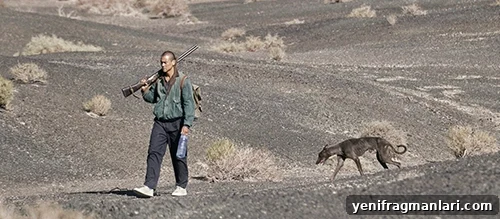
The film opens with a slow, contemplative pan over the Gobi desert: a wide, desolate landscape under a cavernous grey-blue sky. That stillness is immediately broken by the sight of many dogs running free, a chaotic presence that prompts a bus to swerve and overturn. This early image—of human technology, transport and progress clashing with the untamed natural world—returns as a recurring motif throughout the film, underscoring the tension between development and what is left behind.
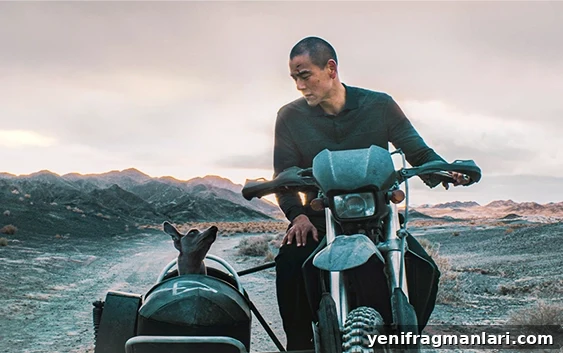
Set in June 2008, in the run-up to the Beijing Olympics, the story follows Lang (played by Taiwanese star Eddie Pang), a former rockstar and stunt rider recently released from prison on probation. He returns to his decaying hometown seeking a fresh start. Instead, he is assigned to help clear the streets of a persistent population of stray dogs. What begins as a task becomes a complicated bond when Lang crosses paths with a fierce black greyhound—a dog marked by fear, bite marks and the label of a local menace.
Lang’s town is essentially a ghost town: crumbling buildings wedged between lingering old ways and the push toward modern infrastructure. With Olympic-driven redevelopment on the horizon, residents are pressured to leave and landmarks fall silent. The town’s near-empty zoo is emblematic of this decay—caged animals sit in neglect while stray dogs roam the open streets in far greater numbers. That contrast between confinement and freedom repeatedly informs the film’s emotional core.
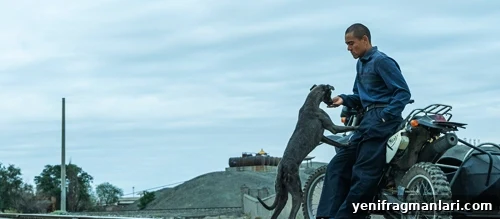
Lang’s approach to the dog is surprising. When a reward is offered for capturing the notorious black greyhound said to be rabid, Lang deliberately baits it and pays the price: he is bitten. Yet after capturing the animal and surviving a violent dust storm that overturns his truck, Lang does something unexpected—he rescues the dog from the elements, tending to its wounds and offering shelter. The animal, initially kept chained in the yard, gradually moves into the house, then into the entryway chair, and finally into bed beside him. Their evolving companionship becomes the emotional anchor of the film, and it’s touching to learn that the bond extended beyond the set.
Lang is a man with a violent past. When he reluctantly joins the team tasked with rounding up strays, he cannot bring himself to be cruel. He refuses to harass animals that bite only in self-defense, refuses to seize family pets when owners cannot or will not register them, and even turns away from killing a rabbit for food. His ethics create a contrast between him and the harsh demands of the town and its officials.
When Lang is forced into violence, the film stages it in a restrained, unconventional way: the most conventional action beat happens largely offscreen, implied through muffled sounds and the locked doors that hide the struggle. This directorial choice intensifies the moral complexity of what Lang faces and keeps the focus on character rather than spectacle.
A central source of tension comes from Butcher Hu (played by Hu Xiaoguang), a local gangster with a kebab restaurant and a snake-breeding side business. Hu believes Lang is responsible for the accidental death of his nephew—a past incident that sent Lang to prison. Their antagonism is personal and unresolved, and it looms over much of Lang’s attempts to rebuild his life.
Among the supporting cast is the film’s version of a patron figure, played by acclaimed filmmaker Jia Zhangke in a deliberate cameo. That presence underscores the film’s kinship with a tradition of contemporary Chinese cinema that examines social change, dislocation and personal survival in a rapidly transforming country. Other characters—including Lang’s father, who resides in the nearly abandoned zoo and slowly succumbs to drink—remain more suggestive than fully developed, sketched primarily to illuminate Lang’s circumstances and choices rather than to receive full arcs of their own.
The narrative avoids heavy-handed plot mechanics and instead relies on small, carefully observed moments: the patient development of a bond between man and animal, the quiet dignity of a man who refuses cruelty, and the visual compositions that linger on landscapes and tableaux. One particularly memorable sequence late in the film gathers dozens of animals into a single, statuesque image against the open land—a striking achievement of staging and cinematography that feels earned rather than gimmicky.
Although some plot beats are predictable in broad outline, the film’s power lies in its execution: the performances—especially Pang’s central turn and the dog’s expressive presence—its evocative visuals, and the director’s subtle handling of violence and compassion. The result is a compassionate, visually arresting film that feels both specific to its setting and universally human in its themes of redemption, belonging and the fragile ties that connect people to their places and to one another.
Score: 20/24
⭐⭐⭐⭐
Rating: 4 out of 5.