
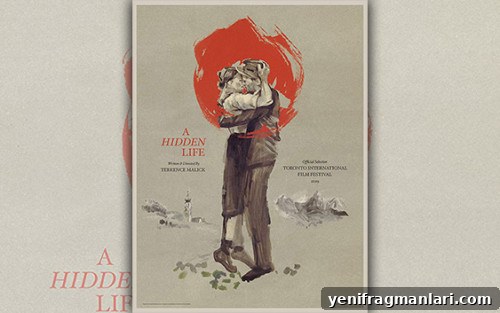
A Hidden Life (2019)
Director: Terrence Malick
Screenwriter: Terrence Malick
Starring: August Diehl, Valerie Pachner, Michael Nyqvist, Matthias Schoenaerts, Jürgen Prochnow, Bruno Ganz
Terrence Malick, the Palme d’Or-winning director known for his poetic, philosophical cinema and transcendent visual style, returns to a more classical narrative approach with A Hidden Life. This World War II drama centers on the true story of Franz Jägerstätter, an Austrian farmer who refused to fight for the Nazi regime. While the film reengages with a clearer storyline reminiscent of Malick’s early works such as Badlands, Days of Heaven and The Thin Red Line, it retains the spiritual resonance and luminous visual design that have defined his later, more experimental phase.
August Diehl gives a quietly commanding performance as Franz Jägerstätter. Malick’s screenplay and direction study the moral and spiritual dimensions of Jägerstätter’s refusal, framing his resistance as both a deeply personal conviction and an act of conscience with wider implications. The film resists sensationalizing wartime violence; instead it concentrates on family life, inner conflict and the ethical questions that arise when state power demands compromise. In doing so, Malick presents righteousness as a force that endures beyond the immediate cruelty of totalitarian regimes—an idea underscored by the film’s recurring natural imagery and the Alpine landscapes that place individual struggles against a vast, indifferent horizon.
Like The Thin Red Line, A Hidden Life privileges contemplation over spectacle. Malick slows narrative momentum to allow intimate moments to breathe, favoring visual storytelling and quiet observation over expository dialogue. The film does not aim to debate who is right in a geopolitical sense; it positions the Nazi regime clearly as a moral wrong while focusing on the singular ethical challenge facing its protagonist. This focus narrows the scope from broad wartime philosophy to the urgent, human question: what would you do when conscience conflicts with duty?
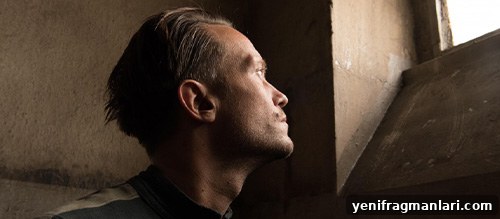
August Diehl as Franz Jägerstätter in A Hidden Life.
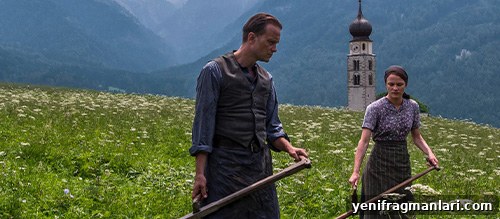
Visually, the film is striking. Malick returns to the luminous, painterly compositions that have long been associated with his best work. The Austrian mountains and pastoral scenes are photographed with a reverence that elevates everyday life to the realm of the sublime—comparable in scale and beauty to classic epics though much quieter in tone. The cinematography and production design serve the film’s central thesis: human choices ripple outward and remain, while regimes and historical events eventually pass.
Actors throughout the cast are given space to express interiority through gesture and gaze rather than speech. Valerie Pachner, as Jägerstätter’s devoted wife, grounds the emotional life of the film; her presence emphasizes the domestic stakes of Franz’s moral decision. Malick’s trust in his performers—especially Diehl—creates a narrative anchored by character rather than plot mechanics. That trust allows the film to unfold slowly, rewarding patient viewers with sustained emotional and philosophical insight.
Some viewers may find the film’s deliberate pacing and long runtime challenging. A Hidden Life demands attention and reflection; it is an experience that reveals itself gradually and benefits from contemplation after the credits roll. Those accustomed to faster, plot-driven films may be tested by Malick’s preference for layered images, overlapping voiceovers and elliptical storytelling. Yet for those receptive to its rhythm, the film offers a richly textured meditation on conscience, faith and the costs of moral courage.
Critically, A Hidden Life represents a synthesis of Malick’s career: the narrative clarity and humanism of his earlier films combined with the lyrical visual language of his later work. It will not satisfy every viewer, and it is unlikely to convert skeptics who view Malick as overly ornate or self-indulgent. Still, the film is a significant statement about the endurance of personal integrity in the face of systemic evil. Its images and themes feel distinctively timeless, likely to resonate for decades as an example of cinematic poetry committed to ethical inquiry.
The film is not merely a historical biopic; it is a portrait of conscience and an argument for the importance of individual moral witness. For viewers interested in thoughtful World War II dramas, spiritual themes in cinema, or the evolution of Terrence Malick’s stylistic range, A Hidden Life is essential viewing. Its combination of performance, landscape and moral seriousness makes it one of Malick’s most accessible and affecting works in years.
Score: 19/24
Recommended for you: Terrence Malick Films Ranked