
An Ostrich Told Me the World Is Fake and I Think I Believe It (2022)
Director: Lachlan Pendragon
Screenwriter: Lachlan Pendragon
Starring: Lachlan Pendragon, John Cavanagh, Michael Richard, Jamie Trotter
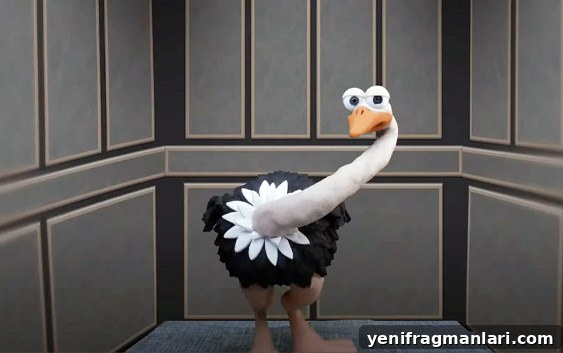
This 11-minute stop motion short is a delightful burst of creativity and craft. An Ostrich Told Me the World Is Fake and I Think I Believe It brings together a keen sense of humour, precise animation, and a playful meta-awareness that turns the film’s constructed nature into its central theme. As one of the rare stop motion pieces nominated in the Animated Short category at the Oscars, the film demonstrates how small-scale, inventive filmmaking can feel grand in imagination even when modest in budget and duration.
The film opens with a striking visual choice: we see a camera filming the stop motion action, while human hands work quickly out of focus in the background. Through the monitor we observe the miniature world in real time, and this dual perspective immediately announces the film’s self-reflexive intent. Rather than hiding its artifice, the work exposes it, inviting the audience to consider the relationship between creator and creation, actor and puppet. By foregrounding the making of the film itself, Lachlan Pendragon both honours and teases the stop motion craft, allowing form and content to inform one another.
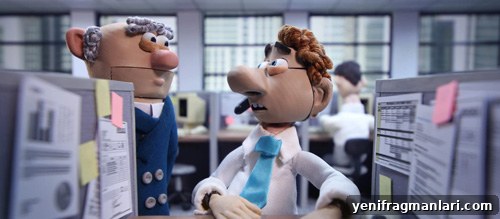
Pendragon appears as Neil, an office worker whose tedious routine and apparent underperformance place him on the brink of being fired. The office scenes are deliberately paced, the dialogue delivered with a muted, almost flat cadence that accentuates the bleak mundanity of corporate life. This restrained tone makes the film’s later jolts into the uncanny all the more effective. Observant viewers will notice small disturbances in the set: a co-worker missing legs, a keyboard absent from a desk, or a dysfunctional green screen — cues that signal the world’s synthetic quality and prepare us for Neil’s gradual awakening to his status as an artificial being.
When Neil begins to perceive the animator’s hand as an intrusive force, the film shifts from observational whimsy to a more existential curiosity. The narrative evokes familiar themes — the search for meaning in a manufactured world, the rupture between routine and awareness — yet it does so through tangible, tactile imagery unique to stop motion. Neil’s descent through the set, finding spare parts and replica pieces of his own face, is both visually inventive and thematically resonant. It recalls classic stories of awakening and escape — a puppet discovering autonomy, an everyman unmooring from a constructed reality — but always returns to its particular, handcrafted logic.
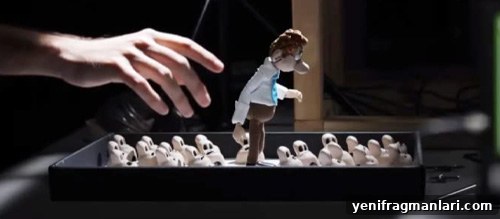
What makes this short remarkable is its economy: in eleven minutes it establishes character, world, and a compelling conceptual turn, all while showcasing delicate animation work. The stop motion medium itself becomes an argument about cinema, demonstrating how visible craft can enrich narrative and emotional impact rather than distract from it. Pendragon’s choice to reveal hands manipulating the environment is both a formal flourish and a thematic anchor: the film asks us to contemplate authorship, control, and what it means to be real when reality can be so carefully assembled.
The story also strikes a rare balance between thoughtful introspection and genuine warmth. The humour is sharp yet affectionate, often arising from small details and the oddities of the office setup. This combination of wit and empathy keeps the film from becoming merely clever; instead it feels alive, curious, and humane. It’s a reminder that animation — and stop motion in particular — remains a powerful medium for exploring philosophical and emotional ideas in ways that live action sometimes cannot replicate.
Creator Lachlan Pendragon brings a distinct voice to the project. Working within the constraints of short-form storytelling, he finds room for both invention and clarity. The film’s success is not only a result of technical skill but also of imaginative risk-taking: it embraces an unusual premise and fully commits to its visual and narrative choices. That commitment yields moments that are visually arresting and emotionally satisfying, leaving a strong impression long after the credits roll.
Films like An Ostrich Told Me the World Is Fake and I Think I Believe It are reminders that cinema’s power does not rest solely on scale or spectacle. Fresh ideas, careful execution, and an evident love for the craft can produce works that resonate widely. This short may not be a blockbuster, but its inventiveness and heart are precisely what make it memorable. It encourages viewers to look closely at how films are made and to appreciate the artistry behind even the smallest cinematic gestures.
Score: 24/24
The film is available to watch in full on Vimeo. For anyone interested in short-form animation or the possibilities of stop motion, Pendragon’s film offers an accessible, delightful entry point that celebrates the creative spirit of independent filmmaking.