
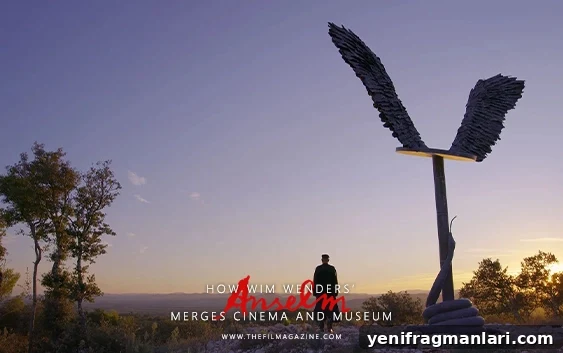
New German director Wim Wenders and contemporary Neue Wilde artist Anselm Kiefer — two West German creators who probe similar themes of anguished post-war recovery and collective denial — first met and forged a lasting friendship during Kiefer’s 1991 exhibition at the Neue Nationalgalerie. From early on, both sensed a creative partnership was likely: Wenders later recalled that Kiefer “knew that I had always wanted to be a painter,” and Wenders himself acknowledged that Kiefer harbored a private desire to work in film; together they agreed to explore a cinematic collaboration someday.
Their long-standing artistic pledge culminated in Wenders’ 2023 film Anselm, a hybrid work that blends documentary, portraiture and homage to both Kiefer’s life and the friendship between the two artists. The film relies on mutual admiration while remaining judiciously restrained: Kiefer appears onscreen at eighty years old, interacting with depictions of his younger selves — a ten-year-old played by Wenders’ grandson Anton and a middle-aged figure played by Kiefer’s son Daniel — yet Wenders largely permits the artwork itself to convey Kiefer’s emotional and intellectual depths.
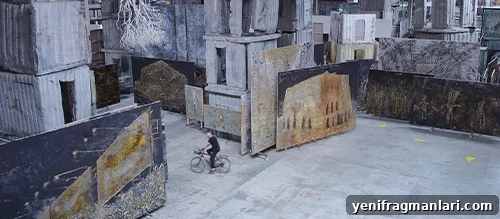
Wenders organizes Anselm not chronologically but iconographically, adopting an approach akin to an art historian’s visual analysis. Rather than offering a linear biography, he arranges images and motifs around recurring themes and symbols, privileging associative resonance over narrative progression. One illustrative sequence opens with the carved-out floor of a well-ordered gallery space inside Kiefer’s La Ribaute studio complex. The camera holds on some of Kiefer’s Femmes Martyres sculptures — mannequins in white dresses whose heads are replaced by emblematic objects — set among piles of collapsed plaster and ceiling fragments. A second image dissolves in: grainy, monochrome home footage of German women clearing the vast rubble left by World War II, intercut with shots of children playing among ruins.
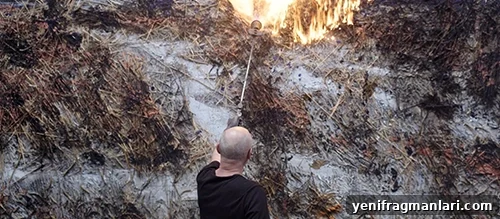
This extended one-minute superimposition is the first among many layered images Wenders employs. Superimposition, an evolution of the classic cross-dissolve, allows multiple images and textures to coexist within a single frame. It can indicate simultaneous actions, interior states, or symbolic resonances. Here, Wenders overlays scenes photographed decades apart — a contemporary installation and wartime archival footage — to illuminate how Kiefer’s fraught upbringing in post-war Germany feeds his visual vocabulary. Other juxtapositions include filmed sunflower fields that bleed into Kiefer’s painted sunflowers, footage of the U.S. Army demolishing a swastika at Nuremberg Stadium matched with Kiefer setting one of his own canvases alight, and a map of Kiefer’s childhood bedroom labeled “The Bad Children’s Cell” dissolving into the artist’s present-day studio.
Wenders keeps distinct shots visible together for unusually long durations, transforming superimposition into a contemplative device. By sustaining coexistent images for nearly thirty seconds at times, he induces a meditative, almost hypnotic effect. The scenes that layer Kiefer’s installations with wartime rubble are rendered largely in monochrome, emphasizing tonal relationships and allowing subtle camera movement to shape the viewer’s perceptual focus.
The film’s play of layered light and shadow recalls the sensibility articulated in Jun’ichiro Tanizaki’s 1933 essay In Praise of Shadows, which celebrates subtle illumination and the mysterious recesses created by shadow in Japanese interiors. Wenders has not explicitly cited Tanizaki as an influence, yet the filmmaker’s use of veiled values and textured gray scales echoes that aesthetic. In Wenders’ other 2023 release, Perfect Days, the protagonist Hirayama cultivates his own shadowed visual world through long, trance-like photographic sequences of sun-dappled trees — an analogue to the dreamy superimpositions Wenders stages in Anselm.
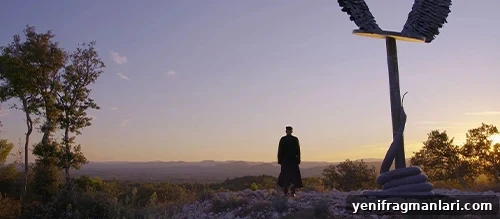
Philosopher Jacques Derrida later reworked Tanizaki’s ideas in his 1993 essay “Aletheia,” calling monochrome photography “skiagraphy — the writing of light as the writing of shade.” Derrida distinguishes the photograph’s “light” as objective depiction and its “darkness” as the subject’s interiority, shaped by both maker and observer. Once an image is fixed on paper, it simultaneously preserves and transforms memory: subjects become spectral presences capable of generating multiple identities and recollections. This dual character — haunting yet consoling — mirrors how Kiefer’s art both preserves and unsettles historical memory.
Derrida’s reading also resonates with Paul Celan’s poem “Ashglory” (1967), which asserts, “No one / bears witness for / the witness.” In Celan’s usage, “the witness” denotes victims and survivors of the Holocaust, while “witness for” suggests those who can meaningfully testify about such events. Kiefer, born shortly before the end of World War II to a Wehrmacht father, has long drawn inspiration from Celan’s poetry. His paintings and installations continue Celan’s urgent work of memory: they testify to Germany’s post-war obfuscation, the culture of denial surrounding wartime atrocities, and the persistence of antisemitism.
If Kiefer’s practice enacts Celan’s notion of bearing witness, then Wenders’ film enacts Derrida’s reflection on witnessing and interpretation. Wenders’ layered sequences “bear witness” by juxtaposing Kiefer’s oeuvre with its visual, historical, theological and philosophical allusions. This approach mirrors how viewers encounter art in museums: an initial formal response evolves as biographical and contextual information is integrated, deepening understanding. Like Tanizaki’s shadows, a work of art invites quiet reflection; like Derrida’s reading, its interpretation combines the viewer’s perception with the artist’s intent, producing complex and shifting meanings.
Anselm runs ninety-three minutes and favors sensation and associative resonance over exhaustive chronicle. It does not map every milestone of Kiefer’s five-decade career. Instead, it achieves a more ambitious aim: it conveys the intimate, sometimes unsettling relationships viewers form with Kiefer’s work and demonstrates how art can function as a form of bearing witness. In doing so, Wenders honors the shared promise between filmmaker and artist — a promise fulfilled in images that transform memory, history and friendship into a cinematic meditation.
Written by Joanna Seifter
Joanna Seifter is a writer, artist and museum professional based in New York City and a recent graduate of NYU’s Museum Studies MA program.
More of her exhibition and film writing is available at jseifter.com
Instagram: @joannaseifterart