
Away (2019)
Director: Gints Zilbalodis
Screenwriter: Gints Zilbalodis
Atmosphere, immersion, and emotion form the heart of Gints Zilbalodis’ debut feature, Away. Rather than foregrounding a complex plot or detailed character study, the film prioritizes mood and sensory experience. Its minimalist story and restrained dialogue-free approach create a calm, contemplative journey that invites viewers to inhabit the film’s world rather than simply follow a conventional narrative.
Zilbalodis is responsible for nearly every creative decision in the production—direction, animation, editing, and even the score—making Away a true labor of auteurship. That focused creative control gives the film a distinctive, personal voice. The result is not merely a movie but an immersive environment, where visual choices, camera movement, and sound design are aligned to evoke feeling more than to explain plot.
The film’s visual language shares affinities with several introspective video games and modern visual media: the low-poly color fields and minimal geometric forms evoke titles like The Witness; the drifting, meditative passages recall Journey; the alien monuments, obelisks, and wide-open horizons suggest the exploratory scale of No Man’s Sky; and the imposing, elemental threats bring to mind the monumental stakes of Shadow of the Colossus. These similarities underline how Away blends game-like exploration and cinematic framing to build emotional momentum.
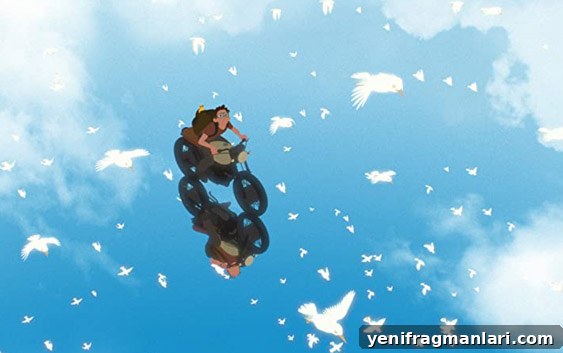
Set after a solitary plane crash, the protagonist navigates an enigmatic island armed with a few survival items—a telescope, a map, a motorbike, a canteen—objects that echo survival-adventure games and instantly signal a journey with checkpoints and waypoints. The central conflict is simple: traverse the island’s diverse biomes while evading a looming, shadowy behemoth that pursues him across terrains both tranquil and dangerous. This clean, stripped-back narrative structure keeps the film focused on mood and pacing rather than plot mechanics.
Away is divided into named chapters—“Forbidden Oasis,” “Mirror Lake,” “Dream Well,” “Cloud Harbour”—each offering a distinct visual and emotional palette. These title cards help the film transition smoothly between drastically different environments without disrupting its calm rhythm. Rather than jarring the viewer, each chapter functions like a new stanza in a meditative poem, maintaining cohesion through tone and consistent pacing.
The visual style is deliberately gentle: cel-shading, soft gradients, and a dynamic color palette combine to create luminous, contemplative landscapes. A floating, sweeping camera often follows from behind, emphasizing scale and the protagonist’s isolation within vast natural forms. These expansive perspectives underscore the film’s reverence for space; the island’s scale becomes a character in itself. A small bird that joins the protagonist adds warmth to the journey—once the bird learns to fly, it takes over certain camera moments, deepening audience engagement and framing the island like a series of living postcards.
With no spoken dialogue, sound design and music carry much of the emotional weight. Zilbalodis’ electronic score, which at times feels orchestral, balances wonder and menace with sparse, evocative motifs. Ambient details—the crunch of footsteps on snow, water droplets echoing in a cavern—become more pronounced and meaningful without dialogue to compete with them. The result is a meticulous, layered soundscape that complements the visuals and heightens immersion.
Comparisons to films such as The Red Turtle and the work of filmmakers like Terrence Malick and Hayao Miyazaki are natural and fair: Away embraces a restrained, contemplative approach that prizes mood and natural imagery. Those influences are visible, yet Zilbalodis brings a distinctly modern, minimal aesthetic that sets the film apart. That said, certain stylistic choices occasionally create dissonance. Character models can feel lightweight against the richly rendered environments, sometimes lacking the grounded physicality mainstream audiences expect from large-studio animations. This feather-light quality can be briefly distracting but does not substantially diminish the overall effect.
Creating Away was an extended, intensive commitment—three years of largely solo production that reinforce its identity as a passion project. The film’s open-ended narrative, which Zilbalodis admits he did not fully plan from start to finish, suits its meditative tone: the ambiguity and aimless wandering reflect the film’s core idea that the journey itself matters more than a neatly resolved ending. When the credits close with a single line, “A film by Gints Zilbalodis,” the statement feels wholly appropriate—personal, focused, and quietly ambitious.
16/24
Purchase this film now via iTunes and Apple TV.
Written by Tommy James
You can support Tommy James in the following places:
Twitter – @TommyJames__
Portfolio – tommy-james.com
Note: This review emphasizes Away’s immersive audiovisual design, minimalist storytelling, and auteur-driven production. It highlights the film’s strengths in atmosphere and scale while acknowledging minor stylistic inconsistencies in character rendering. For viewers who value mood-driven animation and contemplative pacing, Away offers a rewarding, sensory cinematic experience.