
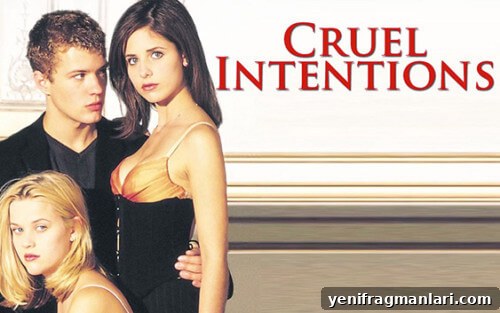

Cruel Intentions (1999)
Director: Roger Kumble
Screenwriter: Roger Kumble
Starring: Sarah Michelle Gellar, Ryan Phillippe, Reese Witherspoon, Selma Blair, Louise Fletcher, Joshua Jackson
Review:
Released in 1999 and adapted from Pierre Choderlos de Laclos’s 18th-century novel Les Liaisons Dangereuses, Cruel Intentions reimagines a classic tale of manipulation and desire within the insulated world of an elite Manhattan prep school. Roger Kumble’s screenplay and direction lean into glamour, youthful cruelty, and the power games that define privileged social circles, producing a film that is as stylish as it is morally uncomfortable.
The central players are step-siblings Kathryn and Sebastian, played respectively by Sarah Michelle Gellar and Ryan Phillippe. Their pastime is reputation sabotage: a sadistic sport of wagers, seduction, and revenge. The plot turns when Sebastian takes a bet to seduce Annette, the headmaster’s unassuming daughter (Reese Witherspoon). If he fails, Kathryn will take his car; if he succeeds, he claims an intimate prize. At the same time, Kathryn is asked to supervise Cecile, an innocent new arrival whose naiveté and romantic entanglement with Kathryn’s ex create further opportunities for manipulation.
Kumble’s adaptation captures the venom and calculation of its source material but frames it in a glossy, millennial-era aesthetic — lined blazers, plaid skirts, and an evocative soundtrack that cements the film in its time. The production design and wardrobe help sell the film’s world: a playground of wealth where consequences exist mostly as threats rather than genuine deterrents. That sheen is part of the movie’s appeal; it makes the moral rot feel seductive and immediate.
Performances are a key strength. Gellar’s Kathryn is ruthless and precise, a character who wields social currency like a weapon. Phillippe’s Sebastian is charismatic and reckless, providing the charm necessary to make the seduction subplot believable. Reese Witherspoon brings a bright, fragile sincerity to Annette that makes the audience root for her even as the film funnels her toward heartbreak. Selma Blair as Cecile offers a softer counterpoint, and supporting turns add texture to a tightly focused story about control and consequence.
Where Cruel Intentions falters is in its attempt to translate 18th-century moral corruption into a contemporary teen setting without fully interrogating the implications. At times the film seems content to shock rather than to probe: sexual provocation, scandalous behavior, and transgressive imagery are presented more as sensational plot mechanics than as opportunities for deeper commentary. Kathryn’s monologue about a double standard for women and men gestures toward a critique of gendered criticism, yet the film rarely expands that idea beyond the moment, preferring the momentum of plot over philosophical depth.
Still, the screenplay builds momentum effectively, escalating schemes and betrayals in a way that keeps viewers engaged. The pacing allows the central relationships to fray believably, and the film’s final sequences resonate because the emotional consequences, when they arrive, feel earned. The ending—paired with The Verve’s “Bittersweet Symphony” in the film’s most indelible scene—remains culturally resonant and emotionally striking, a closing note that lingers long after the credits roll.
Viewed today, Cruel Intentions reads as a product of its era: its soundtrack choices, fashion, and shorthand for teenage rebellion anchor it firmly in the late 1990s. Some elements that once seemed daring have, over time, become routine in teen cinema. That aging is not purely a defect; it also exposes where the film aimed high and where it settled for style over substance.
In short, Cruel Intentions is a provocative, stylish adaptation that excels in mood and performance while occasionally skimming the surface of its thematic potential. Fans of savvy teen dramas will appreciate its dark charm and memorable scenes, even if those seeking a deeper modern reinterpretation of de Laclos’s novel may find it wanting.
10/24