
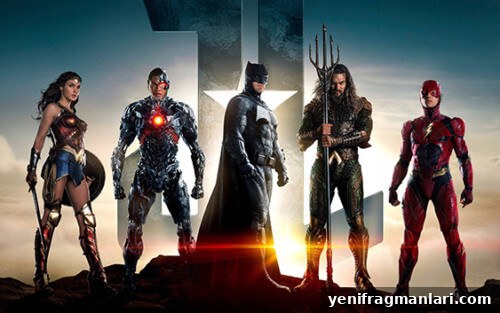
Justice League (2017)
Director: Zack Snyder
Screenwriters: Chris Terrio and Joss Whedon
Starring: Ben Affleck, Gal Gadot, Henry Cavill, Ray Fisher, Ezra Miller, Jason Momoa, Amy Adams, Amber Heard, Ciarán Hinds, Jeremy Irons, Diane Lane, Joe Morton, Connie Nielsen, J.K. Simmons
Overview
After the turbulent 2016 releases that left Warner Bros. rethinking its approach to the DC Extended Universe—most notably the divisive Batman v Superman: Dawn of Justice and the misfiring Suicide Squad—the studio sought to reclaim audience trust with Justice League. Riding some of the positive momentum generated by Wonder Woman, a film that earned both strong box-office returns and critical appreciation, the studio assembled a marquee ensemble to unite DC’s flagship heroes on screen. Production, however, was beset by creative upheaval: original director Zack Snyder stepped away, Joss Whedon shepherded significant reshoots, and the finished film bears the marks of a project that went through multiple creative revisions.
Story and Structure
At its core, Justice League follows the familiar template of a superhero team-up: disparate heroes must come together to confront an existential threat. That premise, while serviceable, is undermined by a bloated first act that spends too long on individual introductions. The film invests heavily in setting up six principal heroes within a single running time, rather than allowing those characters to be established progressively in separate films. The result is a sluggish opening that disrupts pacing and delays the main narrative momentum.
The screenplay oscillates between attempts at levity and the darker tone of previous DCEU entries, producing a tonal unevenness that never quite settles. Several interactions feel shoehorned in—likely the consequence of reshoots—while the film’s attempts at humour and warmth often clash with its stakes, diminishing the sense of peril the story requires.
Villain and Visuals
Steppenwolf, the film’s primary antagonist, is presented as a cosmic warlord intent on retrieving mysterious artifacts that could annihilate humanity. The character’s motivations and the mythology surrounding the artifacts are thinly developed, leaving the villain less threatening than intended. Coupled with computer-generated visuals that frequently look artificial, the film fails to deliver a satisfying central menace. The decision to stage major action set pieces—most notably the destruction of a key Amazonian stronghold—diminishes previously established achievements in the franchise and, in execution, feels emotionally hollow.
The visual effects are a recurring problem across the picture. For a film with a reported production budget in the hundreds of millions, several sequences suffer from inconsistent CGI quality, which undermines immersion and the impact of action beats.
Characters and Performances
Despite the film’s structural and visual problems, many of the principal characters emerge as the movie’s strongest assets. Ben Affleck’s Batman returns as a brooding strategist, while Henry Cavill’s Superman is given a slightly lighter, more hopeful portrayal after his resurrection. Gal Gadot continues to be a highlight as Diana/Wonder Woman, bringing clarity and dignity to her role.
Notably, Ray Fisher’s Cyborg, Jason Momoa’s Aquaman, and Ezra Miller’s Flash provide fresh energy and distinct personalities that help the film avoid total collapse. Cyborg’s arc offers an emotional core rooted in identity and loss; Aquaman brings a brash, elemental charisma; and the Flash supplies brisk comic relief and human vulnerability. These characterizations—when allowed to breathe—remind the viewer why these heroes matter and they hint at creative directions the franchise could pursue more confidently.
Creative Shortcomings and Franchise Impact
The film’s problems can largely be traced back to a fractured creative process: multiple directors, extensive rewrites, and competing tonal aims all contributed to an uneven final product. The script sometimes assumes audiences possess prior knowledge of DC lore, which is a shortcut that weakens narrative clarity for casual viewers. The end result is a movie that struggles to balance spectacle, character development, and emotional stakes.
Still, the film isn’t without value. The stronger character moments—especially those involving Aquaman, Flash, and Cyborg—suggest paths forward for more focused, auteur-driven entries. If Warner Bros. refocuses on tightly written, character-led films and resolves recurring visual-effects issues, the DCEU can recover and build on the promise shown here.
Conclusion
Justice League is an uneven spectacle. It contains memorable performances and promising character work, but its bloated structure, undercooked villain, and inconsistent visuals prevent it from achieving the cohesion and emotional punch expected of a major franchise tentpole. As an ambitious attempt to unite DC’s heroes, it falls short—but the film’s strongest elements offer useful lessons for future installments.
Score: 6/24
Recommended for you: DCEU Movies Ranked