
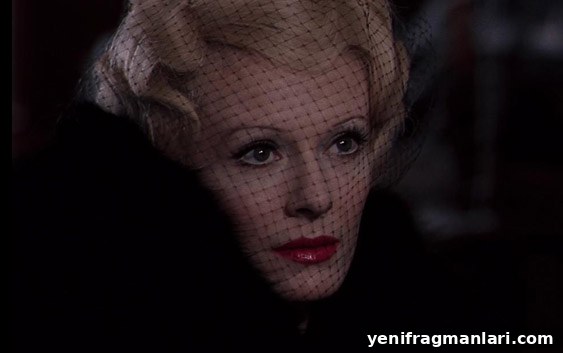
This article was written exclusively for The Film Magazine by Eve O’Dea of eveonfilm.com.
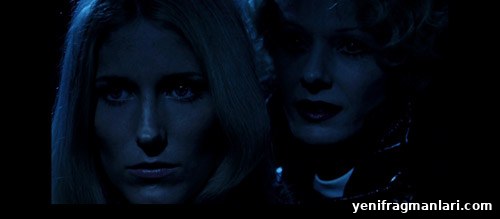
Daughters of Darkness (1971)
Director: Harry Kümel
Screenwriter: Harry Kümel
Cast: Delphine Seyrig, John Karlen, Daniella Ouimet, Andrea Rau
Harry Kümel’s Daughters of Darkness occupies a deliberately uncertain space between styles and genres. That uncertainty becomes part of the film’s power: its liminality—never wholly one thing—creates an undercurrent of unease that anchors it in horror. Yet the same refusal of tidy definition also leaves the film feeling incomplete at times, as if sections were sketched in atmosphere while other narrative elements remained unfinished.
The story centers on a newlywed couple, Valerie and Stefan, who stay at a seaside hotel in Ostend, Belgium. While there they encounter the enigmatic Countess Elizabeth Bathóry and her quiet companion Ilona. As the nights progress, tensions and strange forces rise to the surface, with grave and fatal consequences.
From the opening credits, which list the picture as a Belgian-French-German co-production, the film presents a pan‑European identity. The cast reflects this: Daniella Ouimet (French-Canadian) plays Valerie, John Karlen (American) plays Stefan, Delphine Seyrig (French) is Elizabeth, and Andrea Rau (German) is Ilona. The characters converse in English with varied fluency, which adds to the film’s sense of dislocation. At times the dialogue is cryptic and elliptical, useful for mood but occasionally hollow when clearer motivation would have helped the drama.
Performances are uneven across the board. Seyrig’s Countess is, unsurprisingly, the film’s centre of gravity. Her presence is magnetic; she inhabits the role with an assuredness that makes every scene with her feel vital. When she is absent the film loses some of its charge, and the audience waits for her return. The other leads give serviceable work—Karlen convincingly plays a volatile, unpleasant husband—yet their portrayals often lack the clarity and depth that Seyrig supplies naturally.
Visually the film is striking. Bold, saturated colour dominates each frame, and scenes often dissolve in hues rather than fade to black. That emphasis on colour lends the movie a painterly quality and intensifies its theatricality. The juxtaposition of bright, almost glamorous cinematography with a dark, gothic narrative generates a productive tension: the story’s morbidity is dressed in lavish surfaces. Costumes are lavish and period-ambiguous—fur-lined leather, sequins, feathers—favoring spectacle over realism. On Seyrig, the extravagant wardrobe reads as an extension of character rather than performance affectation; she makes the opulence feel intrinsic to the Countess’s identity.
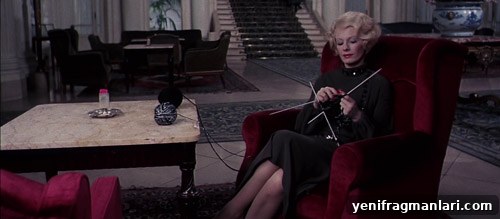
Seyrig’s styling contributes to the film’s temporal ambiguity. Though the action takes place in the early 1970s, the Countess often appears channeling 1930s glamour—finger waves, strong lipstick, plucked brows—while also signifying an agelessness beyond any single decade. That collapsing of time reinforces the character’s otherworldliness: she reads as both modern and ancient, a preserved relic who never quite belongs to the present.
The film’s soundtrack favors new‑wave synth textures, used to underline key dramatic beats. This electronic score heightens the sense of artifice and theatricality, aligning the film with camp sensibilities. Much of the movie’s lasting charm stems from its excess—big performances, costume flamboyance, intrusive editing, and softly diffused cinematography all combine into something that can feel indulgent but also intoxicating. Stripped of these flourishes, the film might lose the very personality that makes it memorable.
At the same time, the film’s portrayal of queer characters is ambivalent. For its time, the appearance of explicitly queer figures is notable, but the narrative ultimately links queer desire to danger and violence. The Countess and her companion Ilona prey on young women for blood and desire, reinforcing a familiar cinematic trope that equates queerness with corruption and threat. The story’s resolution—where the queer antagonist meets an undignified end—echoes an older pattern in vampire narratives that treats non‑normative desire as a condition to be eliminated for the status quo to survive.
Historically, vampire fiction has long carried sexualized undertones: from Sheridan Le Fanu’s “Carmilla” to Bram Stoker’s “Dracula,” the figure of the vampire has served as an allegory for transgressive desire. Daughters of Darkness participates in that lineage, and in doing so it both benefits from the genre’s dramatic energies and becomes complicit in its less progressive tendencies.
Ultimately, the film feels incomplete in places—plot motivations are sometimes thin, and the narrative can drift into cool, aestheticized surfaces rather than emotional depth. Yet that very elusiveness is part of its identity. The ambiguity, the sumptuous style, and Seyrig’s unforgettable performance make Daughters of Darkness a film that continues to fascinate: an uneasy, beautiful artifact that remains both alluring and unsettling.
15/24
Written by Eve O’Dea
You can support Eve O’Dea in the following places:
Website – eveonfilm.com
Twitter – @EveOnFilm