
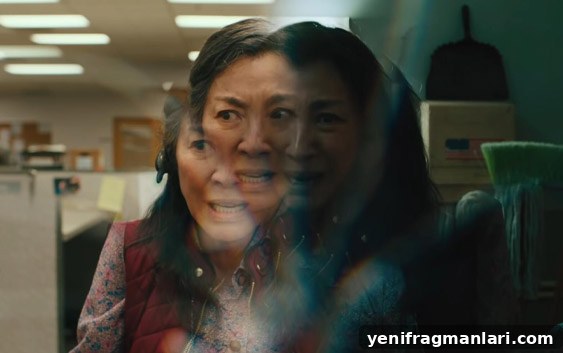

Everything Everywhere All at Once (2022)
Directors: Dan Kwan, Daniel Scheinert
Screenwriters: Dan Kwan, Daniel Scheinert
Starring: Michelle Yeoh, Stephanie Hsu, Ke Huy Quan, James Hong, Jamie Lee Curtis, Jenny Slate, Harry Shum Jr, Tallie Medal
Dan Kwan and Daniel Scheinert, collectively known as the Daniels, follow their strikingly original debut with a far more ambitious work. Where their earlier film leaned into grotesque black comedy, Everything Everywhere All at Once expands into an interdimensional family drama that still delights in crude humor while delivering complex ideas, sincere emotion, and exhilarating martial arts sequences.
Evelyn Wang (Michelle Yeoh) runs a struggling laundromat with her gentle husband Waymond (Ke Huy Quan). On the personal front, Evelyn is dealing with a tense relationship with her daughter Joy (Stephanie Hsu), who arrives with her girlfriend Becky (Tallie Medal) for Chinese New Year. Adding to the stress, Evelyn’s stern and traditional father (James Hong) comes to stay, and an impending IRS audit conducted by the intimidating Deidre (Jamie Lee Curtis) threatens to destroy their business. As ordinary problems pile up, Evelyn is suddenly approached by an alternate version of Waymond from another universe who reveals that countless parallel versions of herself must unite to stop a catastrophic threat to the multiverse.
One of the sharpest insights the Daniels offer is that everyday failures—faltering at work, struggling in relationships, or facing humiliating personal moments—often feel more terrifying than an abstract, global catastrophe. The film explores how human beings tend to prioritize immediate personal anxieties over bigger-picture dangers, highlighting our inward focus and the ways regret shapes our lives.
This film speaks to anyone who feels like the most disappointing version of themselves. It examines how every small choice branches into alternate lives where things might have turned out differently—lives shaped by bravery, eccentricity, or different priorities. That haunting sense of “what if” fuels the film’s emotional core and motivates Evelyn’s journey across infinite possibilities.
The Daniels capitalize on the creative potential of a multiverse premise in ways that outshine many mainstream treatments of the idea. Humorous throwaway gags in one reality gain meaningful resonance in another, and the sheer inventiveness—such as an absurd universe where people have hotdogs for fingers—demonstrates a fearless imagination. Even moments that could have become dry exposition are reworked into comedic set pieces, including scenes where Evelyn must absorb complex multiverse rules while simultaneously enduring an audit interview.

Ke Huy Quan, who returned to acting after a long break, delivers a standout performance by embodying multiple versions of Waymond with striking physical and emotional differences. In one sequence, the film channels the mood and visual textures of Hong Kong auteur cinema—neon-lit streets, blurred motion, and poetic lines—casting a romantic, contemplative light on a version of Evelyn and Waymond’s life that could have been. Quan’s transformation across universes showcases his range and contributes deeply to the film’s emotional stakes.
The action choreography is inventive and often playful, blending slapstick with martial artistry in a style that feels reminiscent of Jackie Chan’s comedic physicality but pushed into even more surreal territory. The stunt work—reportedly assembled from unconventional sources—supports dynamic set pieces that continually surprise. Larkin Seiple’s cinematography captures the film’s visual variety with clarity and impact, while Son Lux’s score energizes and underscores emotional beats.
Michelle Yeoh anchors the film with luminous presence. The Daniels cleverly reference Yeoh’s extensive career to justify the protagonist’s sudden access to an astonishing array of skills across universes: by drawing on alternate versions of herself, Evelyn borrows talents that prove essential in high-stakes moments. A memorable montage showcasing dozens of different Evelyns illustrates the film’s playful character work and rewards repeated viewings.
At its heart, the film is a deeply affecting family drama that foregrounds a mother-daughter relationship rarely examined with such nuance. The narrative positions familial tension against the absurd literal stakes of a collapsing multiverse, using genre spectacle to amplify familiar emotional conflicts. The Daniels pose a clear thesis: parents must balance connection and acceptance, learning when to hold on and when to let go. The film frames thoughtless cruelty or neglect as capable of causing real damage—both emotionally and, in the film’s mythology, cosmically.
With Everything Everywhere All at Once, the Daniels confirm themselves as a major filmmaking partnership to watch. The film is imaginative, technically accomplished, and emotionally precise—more confident and fully realized than their debut while retaining that same offbeat voice. Accomplishing so much on a comparatively modest budget, the movie is frequently hilarious, often breathtaking, and genuinely moving. It leaves viewers smiling, teary-eyed, and forever likely to glance at ordinary objects with fresh, strange wonder.
Score: 22/24