
Directors: Joel Coen, Ethan Coen
Screenwriters: Joel Coen, Ethan Coen
Starring: William H. Macy, Frances McDormand, Steve Buscemi, Peter Stormare, Harve Presnell, Kristin Rudrüd, Larry Brandenburg, John Carroll Lynch
When Fargo opens with the Coen brothers’ now-famous claim, “This is a true story,” it sets a tone that mixes documentary sobriety with absurdity. The line convinced many viewers that the bizarre, unsanitized events unfolding were factual, and that uneasy blending of realism and invention is central to the film’s power. The Coens later admitted the tale was fictional, but the film’s smart flirtation with truth—its mockumentary cadence and forensic detail—remains one of its greatest strengths.
The plot centers on Jerry Lundegaard (William H. Macy), a desperate car salesman trapped by debt and bad choices. Hoping to solve his problems quickly, Jerry hires two small-time criminals—Carl (Steve Buscemi) and the silent, menacing Gaear (Peter Stormare)—to kidnap his wife, Jean (Kristin Rudrüd), and extort a ransom from his wealthy father-in-law (Harve Presnell). The plan is meant to be neat and simple, but soon unravels into violence and chaos. As bodies pile up and stories contradict each other, Police Chief Marge Gunderson (Frances McDormand) quietly begins to peel back the layers of deceit.
The script is a Coen brothers masterclass in dialogue and rhythm. Their ear for regional cadence—those Minnesotan turns of phrase—gives the language a musical, recognizable quality: small exchanges that reveal characters’ motives and the film’s moral contours. Lines like “The little guy was kinda funny-lookin’” followed by deadpan clarification capture both comedy and cruelty in a few words.
Steve Buscemi’s Carl is talkative and unnerving; he insists on doing the legwork while making every situation worse with misguided bravado. Opposite him, Peter Stormare’s Gaear is a study in cold indifference, a menacing contrast that fuels the film’s dark humor. The Coens have long excelled at pairing mismatched characters whose interactions produce both comedy and dread, and Carl and Gaear form one of their most memorable duos.
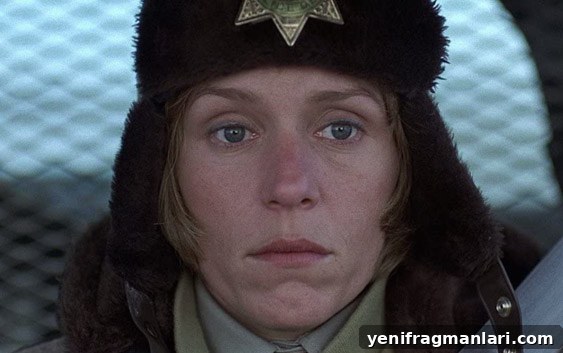
Macy’s Jerry is a quietly repellent central figure—ordinary, selfish, and morally small. The film asks us, uncomfortably, to follow a protagonist who is far from sympathetic, and that choice is part of the movie’s challenge. Marge Gunderson, by contrast, combines genial warmth with steady competence. Frances McDormand’s performance makes her an anchor: affable and human, yet unflinching in the face of brutality. Her moments of gentle domesticity—pregnancy and all—stand in stark contrast to the crime she is investigating.
The film’s dark, grounded humor helps sell its apparent authenticity. The criminals’ incompetence, the mundane details that become crucial evidence, and the way ordinary people describe shocking events in casual, roundabout ways all feel true to life. Scenes that might seem incidental—neighbors shoveling snow, a witness recounting a long conversation—add texture and credibility rather than padding. The result is a world that feels lived-in and believable, even when the behavior is outrageous.
Fargo’s technical craft elevates its narrative. Roger Deakins’ cinematography captures the bleak, snowy landscape with a clarity that emphasizes both isolation and the film’s stark humor. Carter Burwell’s score underscores the film’s tonal shifts, balancing menace and melancholy. Together with the Coens’ precise direction and tightly controlled script, these elements create a distinct atmosphere: bleakly comic, morally complex, and quietly devastating.
The film’s influence extended into television, where the anthology series Fargo adopted the same “This is a true story” framing for each season. The TV show echoes the film’s blend of moral ambiguity and dark comedy, sometimes pushing into more surreal territory, but always keeping that uneasy relationship with truth at its center.
Ultimately, Fargo remains remarkable for how it presents human folly as both ordinary and extreme. It shows how small crimes can spiral into catastrophe, how seemingly banal characters can commit monstrous acts, and how a calm, competent investigator can restore a measure of order and decency. The Coen brothers’ film continues to be a compelling study of crime, consequence, and the strange, often funny ways people justify their choices.
23/24
Recommended for you: Where to Start with The Coen Brothers