

For his 2003 film, Dogville, Danish director Lars von Trier tried a bold experiment. Known for creating deeply flawed, often reprehensible male characters, von Trier decided to give his next protagonist a conscience. That man is Tom Edison (Paul Bettany). The film functions as a searing critique of American classism, depicting a small town whose apparent kindness toward a stranger is rooted in exploitation. Von Trier borrows from Bertolt Brecht’s theatrical techniques: there are almost no physical sets, and chalk outlines on the floor indicate props and locations—“gooseberry bushes,” “house,” “dog.” Actors mime opening doors; snow falls from invisible clouds. The minimalism becomes invisible, however, revealing the raw mechanics of performance and human behavior. At the center of this stripped-back parable is Tom, and his presence turns Dogville into a provocative study of conscience, self-interest, and moral failure.
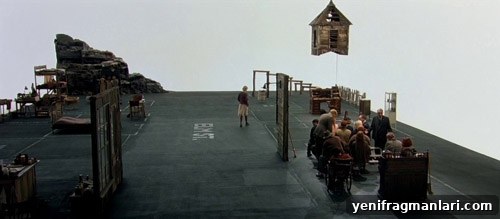
The town’s residents are archetypal and oddly specific: Vera, a mother of four married to farmer Chuck; Ben, the mechanic (Željko Ivanek); Ma Ginger, the store owner (Lauren Bacall); and Tom Edison himself, an earnest, self-important philosopher who struggles to translate ideas into action. Dogville has only about twenty inhabitants, each playing a role that keeps the town functioning. When Chuck harvests apples, the town eats; when he fails, they go hungry. Tom believes his intellect and moral teaching should do more than enliven occasional town hall lectures; he wants to demonstrate philosophy in practice. To that end he offers refuge to a young woman on the run from a gangster father—Grace (Nicole Kidman)—confident the town will protect her. When townspeople hesitate, Tom proposes a two-week trial: Grace will stay on the condition that the town accepts her after assessing whether she fits in. Her life becomes an experiment, and Tom’s desire to illustrate his theories blinds him to her humanity.
Tom’s plan involves having Grace perform manual labor as proof of her worth. His argument is simple: the town has sheltered her, so she must contribute in return. Grace protests that this is a game with her life at stake; Tom replies, “Isn’t saving your life worth a little game?” His rhetoric reduces Grace to a living demonstration. Initially, work is minimal—she plays checkers with Bill (Jeremy Davis) and keeps lonely Mr. McKay (Ben Gazzara) company—but gradually the town identifies endless tasks she can perform. What begins as accommodation steadily turns into exploitation. The townspeople do not extend care from the heart; they leverage Grace’s vulnerability to extract labor. There is little real need for her work, yet they justify increasing demands by framing labor as the test of a person’s character. Grace, a refugee with nowhere else to go, lacks the power to negotiate, and her willingness to help becomes the very reason the town asks for more.

Tom’s supposed moral authority is uncertain from the start. A narrator (John Hurt) informs the viewer that many in Dogville are not impressed by Tom’s lectures, hinting that the town’s plain appearance masks deeper moral failings and that Tom himself may not be the virtuous teacher he imagines. When a wanted poster for Grace appears, anxiety spreads. Those who had clung to their caution now feel justified; those who supported her grow silent, fearful of violent retribution. Tom’s solution is predictably pragmatic: raise Grace’s workload to compensate for the perceived danger she poses. He believes this quid pro quo will settle the town. Grace recognizes how dangerous the arrangement is—she warns that it sounds like something a gangster would demand—but Tom continues, convinced his method will prove his theory correct.
As the town’s expectations escalate, Grace’s responsibilities balloon. Simple favors become overwhelming obligations: cleaning, weeding, fieldwork, and emotional labor for neighbors who rely on her presence. The townspeople interpret her inevitable failures as proof of her inferiority, using those failures to rationalize harsher treatment. Children and adults alike contribute to this cruelty. Grace becomes overworked, underpaid, and increasingly demoralized—exactly the outcome Tom should have anticipated. When she confides her exhaustion to him, Tom responds with little more than delay—“Let me think”—refusing to intervene or reduce her burden. His refusal to challenge the town’s demands reveals his true priority: maintaining the experiment and his reputation rather than protecting the vulnerable person at its center.
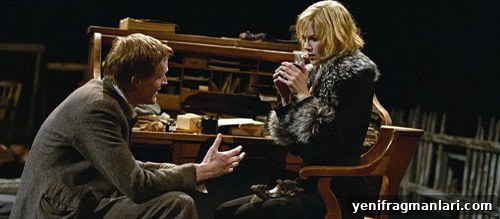
Over time the town’s behavior grows criminal. After Grace attempts to flee and is punished by being fitted with a collar chained to an iron wheel, her labor doubles while her pay is slashed; she endures repeated sexual violence at night. When the townspeople occasionally offer small acts of kindness—a door opened, a crust of bread—Tom reads those gestures as signs of general decency rather than as strategic manipulation. The charity is conditional and calculated, intended to preserve the flow of labor while masking the town’s exploitation. Tom fails to see that his illustrative experiment has become an engine of oppression. He flirts with Grace and clings to a fragile romantic pretense, yet he ultimately betrays her: using a card he claimed to have burned, he calls her father, setting in motion the climax of the film.
Grace finally understands the stakes Tom asked her to accept. As scholar Jan Simons observes in “Playing the Waves,” Grace treats the relationship with villagers as a “game” of symbolic exchange—labor for inclusion—but the terms have become literal and deadly. When her father arrives, Grace convinces him and his gang to act on her behalf. The result is ruthless: the gang guns down the town, annihilating the society that turned kindness into commerce. In the final moments, Grace hears the chalk outline of a dog—Moses—seem to bark as they leave. When asked whether to shoot the outline, she declines: “He’s just angry because someone’s taken his bone.” It is a chilling coda that underlines the collapse of moral accountability: the town’s cruelty has rendered it irredeemable.
Von Trier’s film suggests that one way to end a discriminatory, exploitative status quo is to remove the incentive for exploitation. The townspeople of Dogville learned how to manipulate and harm because the structure rewarded them; once the reward disappears, so does their justification. Tom, who could have acted to protect Grace, instead framed her suffering as a philosophical illustration and lost his moral center. In the final exchange he admits, “Your illustration, it beat the hell out of mine… frightening, but clear.” His words make clear that for him, like for the town, theory was always more important than the life it affected.
Written by Cole Clark
You can support Cole Clark in the following places:
Twitter – @colelclark