
Jurassic Park (1993)
Director: Steven Spielberg
Screenwriters: Michael Crichton, David Koepp
Starring: Sam Neill, Laura Dern, Jeff Goldblum, Richard Attenborough, Ariana Richards, Joseph Mazzello, Wayne Knight, Samuel L. Jackson
Jurassic Park arrived in 1993 and quickly became a cultural landmark, thrilling audiences of all ages. For a time it stood as the highest-grossing film in history, only to be surpassed years later. What makes Spielberg’s adaptation endure is a potent mix of wonder, humour, an iconic John Williams score, and a memorable ensemble cast that brings larger-than-life characters to vivid life. The film remains one of the rare adaptations often judged superior to the novel that inspired it.
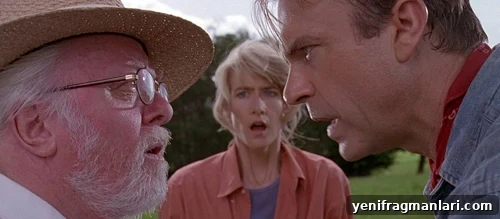
The premise is deceptively simple: billionaire John Hammond (Richard Attenborough) has created a revolutionary wildlife attraction—an island theme park populated by living dinosaurs. Before opening to the public, Hammond invites a group of acclaimed experts to evaluate safety after a troubling incident with one of the park’s attractions. He brings paleontologist Dr. Alan Grant (Sam Neill), paleobotanist Dr. Ellie Sattler (Laura Dern), and mathematician Dr. Ian Malcolm (Jeff Goldblum), along with his grandchildren, to tour the facility. What follows is a suspenseful exploration of scientific hubris and the unpredictable power of nature.
Casting Richard Attenborough as Hammond was inspired. Attenborough’s warm, grandfatherly presence initially sells Hammond’s vision as benevolent and grandly ambitious. As the story unfolds, however, Hammond’s zeal reveals itself as obsession and vanity; his single-minded pursuit of legacy blinds him to ethical and practical dangers, even to the point of risk to his own family. That contradiction makes Hammond compelling—he is a visionary undone by his ego.
At the film’s heart are the three visiting experts. Drs. Grant, Sattler, and Malcolm drive the emotional and intellectual core of the narrative. Their reactions—Grant’s mixture of professional fascination and paternal protectiveness, Sattler’s pragmatic intelligence and determination, and Malcolm’s sardonic scepticism—anchor the film and provide multiple perspectives on the moral questions raised by resurrecting extinct animals. Grant’s rapport with Hammond’s grandchildren supplies warmth and humour, while Malcolm’s eloquent warnings about chaos theory inject philosophical tension that undercuts Hammond’s confidence.
Ellie Sattler deserves particular praise as a strong, capable female lead. She combines scientific expertise with grit and compassion, unafraid to get her hands dirty in pursuit of answers. Her portrayal set a template for intelligent, proactive female characters in big-budget genre films and remains influential decades later.
Jurassic Park is less a straightforward monster movie and more a character-driven meditation on human ambition and the consequences of trying to control nature. It interrogates themes of hubris, technological overreach, and responsibility. The film ultimately champions humility: when systems fail and nature asserts itself, human effort can feel inadequate and fragile. Spielberg stages this philosophical message through thrilling set pieces and suspenseful pacing, making the ideas accessible without sacrificing entertainment value.
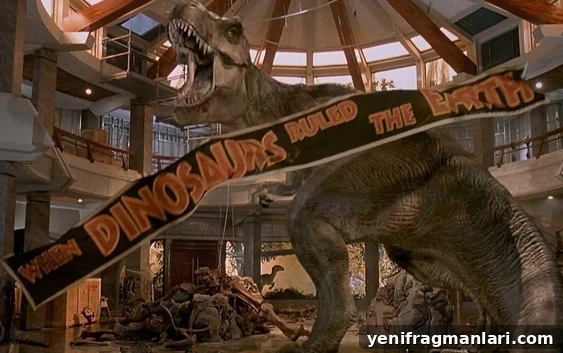
Of course, the dinosaurs themselves are an essential part of the film’s legacy. The T. rex provides the franchise’s most iconic set pieces, but the velociraptors are the film’s true sources of sustained tension—intelligent, coordinated, and terrifying. Spielberg and author Michael Crichton prioritized cinematic impact over strict paleontological accuracy, and in doing so they created a version of dinosaurs that lodged firmly in the public imagination. Whether or not these creatures match modern scientific reconstructions, their role as antagonists and symbols of nature’s unpredictability is undeniable.
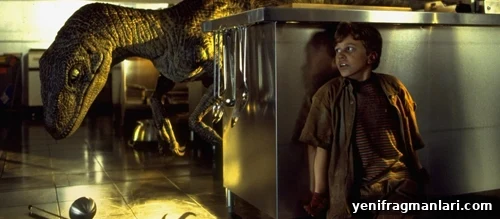
A notable and effective choice in Spielberg’s direction is restraint: despite the prominence of dinosaurs in the film’s marketing and cultural impact, the creatures appear on screen for only a fraction of the runtime. That scarcity builds suspense in the same way Spielberg perfected in earlier films—implying danger offscreen heightens tension and makes each appearance more dramatic. The blend of practical animatronics and CGI also holds up well, reinforcing the film’s realism and making action sequences feel tangible even decades later. This careful balance helped the movie earn a family-friendly rating while preserving thrills that resonated with both children and adults.
The influence of Jurassic Park is twofold: it inspired a wave of sequels and merchandise, and it reshaped how blockbuster filmmakers approach spectacle and character. While its many spin-offs have varied in quality, the original film remains the benchmark: a genre-defining, character-led blockbuster that balances awe, intellect, and suspense. Its moments—from the first reveal of living dinosaurs to tense, intimate confrontations with raptors—are indelibly seared into film history.
Today, the film’s themes feel especially relevant. As human actions continue to affect global ecosystems and as technological power grows, the cautionary elements of Spielberg and Crichton’s story retain a sharp resonance. The film reminds us that scientific achievement without humility risks unintended consequences, and that the spectacle of progress should not distract from ethical responsibility.
Ultimately, Jurassic Park endures because it blends spectacle with thoughtful character work and moral inquiry. It is a rare blockbuster that entertains and provokes in equal measure, delivering iconic moments while prompting reflection on science, power, and the natural world.
Score: 24/24
Note: While popular depictions suggest T. rex had limited vision, recent research indicates varied sensory capabilities; in any case, if you encounter a T. rex in fiction, running is generally sound advice.