
Killers of the Flower Moon (2023)
Director: Martin Scorsese
Screenwriters: Eric Roth, Martin Scorsese
Starring: Leonardo DiCaprio, Robert De Niro, Lily Gladstone, Jesse Plemons, Tantoo Cardinal, John Lithgow, Brendan Fraser, Cara Jade Myers, Janae Collins, Jillian Dion
Is there a deeper betrayal than the betrayal of someone who claims to love you? That question anchors Martin Scorsese’s expansive new film Killers of the Flower Moon. Based on David Grann’s investigative book, the film examines a dark chapter in American history when sudden oil wealth on Osage land triggered a wave of exploitation, violence and murder. Scorsese adapts the material not as a straight procedural but as a human story—one that looks through intimacy and trust to reveal systemic greed and cruelty.
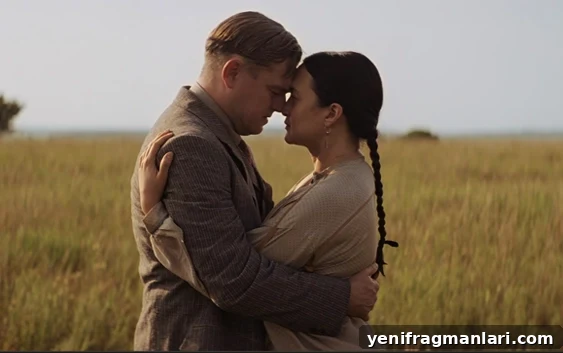
Set in 1920s Osage County, Oklahoma, the story centers on Ernest and Mollie Burkhart. Ernest (Leonardo DiCaprio) arrives as an outsider, encouraged by his powerful uncle William Hale (Robert De Niro) to take advantage of opportunities in the oil-rich region. Mollie (Lily Gladstone) is an Osage woman who, like many of her relatives, has become wealthy due to the oil discovered on tribal land. Despite outward signs of prosperity—fine clothes, chauffeured cars—the Osage people are legally constrained: control of their money often requires approval from white guardians or trustees, creating a dangerous dependency.
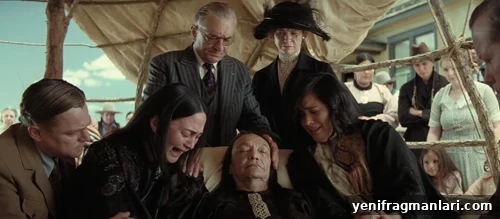
Ernest presents himself as a simple, good-natured man, yet his repeated, offhand proclamations—”I just love money”—slowly reveal a willingness to compromise his morals. Hale, a respected local figure who styles himself as “King,” quietly orchestrates a scheme to seize the Osage “headrights”—the legal entitlements to oil revenue—by encouraging his relatives and associates to marry into Osage families and then profit from any misfortunes that befall them. One by one, Mollie’s relatives suffer unexplained illnesses, accidents and deaths, until the headrights concentrate in Mollie and Ernest’s hands.
DiCaprio delivers one of his most compelling performances as a man who oscillates between genuine affection and moral blindness. His soft Southern drawl and a face that carries both love and uncertainty make Ernest a tragic figure: someone who loves the woman he is complicit in destroying. Opposite him, Lily Gladstone anchors the film with a powerful, restrained performance. Mollie reads the people around her from the beginning; her composed exterior and subtle expressions convey intelligence, resilience and a growing suspicion that love and trust are being weaponized against her.
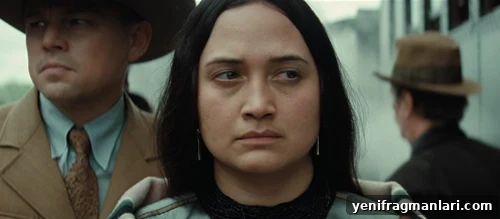
As the crimes escalate, the film traces Mollie and Ernest’s relationship in parallel with the mounting losses around them. Tender moments of family life—learning language and traditions, raising children, offering comfort amid grief—are intercut with the growing suspicion and horror as trusted people fall ill or die. Ernest’s pleas for Mollie to accept a new treatment for her diabetes are heartbreaking and full of irony when we understand how danger has been introduced into the very care he provides. Scorsese uses these interpersonal details to deepen the emotional stakes, making the eventual betrayals land with devastating force.
Robert De Niro’s William Hale is quietly terrifying. He moves through the community as both benefactor and predator, presenting himself as a protector while masterminding a campaign of manipulation and violence. De Niro creates a figure who embodies entitlement and moral bankruptcy—someone who has positioned himself above scrutiny and the law. His presence looms over the film like a persistent, corrosive influence.
Visually and narratively, the film demonstrates Scorsese’s command of the medium. At roughly three and a half hours, the runtime allows the story to unfold with patient detail: character moments, procedural developments and historical context are balanced so the drama grows organically. Scorsese’s camera placement and pacing show a filmmaker confident in when to linger and when to accelerate, and the result is a film that feels both intimate and epic.
Crucially, Scorsese frames the crimes through the perspective of those most affected. By centering Mollie’s experience and the intimate bonds that are violated, the film avoids exploitative sensationalism and instead conveys the human cost of greed. The result is not only a powerful crime drama but a mournful, precise portrait of cultural dispossession: it reminds viewers that these events were not isolated incidents but part of a larger pattern of injustice toward Native American communities.
The performances, particularly from DiCaprio, De Niro and Gladstone, are uniformly strong, supported by a cast that enriches the film’s world. Scorsese’s collaboration with his actors yields moments of genuine emotional clarity, and the storytelling choices—rooted in love, betrayal and the banality of evil—make the film resonate beyond its historical setting.
Score: 24/24
Rating: 5 out of 5.