
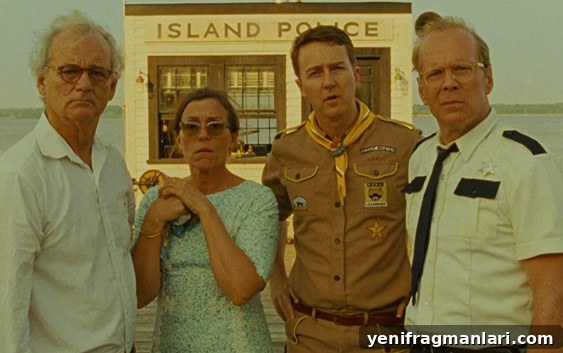

Moonrise Kingdom (2012)
Director: Wes Anderson
Screenwriters: Wes Anderson, Roman Coppola
Starring: Bruce Willis, Edward Norton, Frances McDormand, Bill Murray, Tilda Swinton, Harvey Keitel, Jared Gilman, Kara Hayward
Moonrise Kingdom marked a clear return to form for Wes Anderson after a few uneven entries in the mid-2000s. Following the renewed praise he received for Fantastic Mr. Fox, this 2012 feature re-established Anderson as a singular voice in contemporary cinema. Drawing on elements of classic coming-of-age stories and filtered through Anderson’s unmistakable visual and narrative sensibility, Moonrise Kingdom became one of the year’s most talked-about films and earned Oscar nominations for Anderson and his co-writer Roman Coppola.
The story centers on two young outsiders, Sam Shakusky, a resourceful Boy Scout, and Suzy Bishop, an introspective girl with a habit of carrying a suitcase of books. Both children decide to run away from their respective homes on a New England island, and much of the film follows their small, secret adventure in the wilderness. As Sam and Suzy explore their fledgling relationship, the adult world—composed of their anxious families, the local scoutmaster, and island officials—scrambles to find them. Anderson balances whimsy and melancholy, turning a familiar premise into a fresh and bittersweet meditation on childhood, belonging, and the messy business of growing up.
Performances are a major strength. Jared Gilman and Kara Hayward, the young leads, bring surprising depth and chemistry to roles that could easily have felt caricatured. Their portrayals anchor the film emotionally, allowing audiences to invest in the pair’s earnest desire for connection. The veteran ensemble offers steady support: Bill Murray and Frances McDormand convey parental frustration and bewilderment with dry humor, Edward Norton provides a nervy, exacting presence as the scout leader, and Bruce Willis delivers a notably gentle turn as the island’s police captain. Tilda Swinton, as a child services official, adds the sharp edge of institutional authority that contrasts with the children’s fragile world.
Visually, Moonrise Kingdom is quintessential Wes Anderson. The long-standing collaboration with cinematographer Robert Yeoman results in a precise, painterly composition: careful symmetry, saturated hues, and deliberate framing define nearly every shot. The film’s palette tends toward warm yellows and oranges balanced by cooler blues, and many images—lighthouses, camp clearings, and island vistas—linger as striking stills. Production design and costumes support the film’s period-tinged atmosphere, creating a world that feels both specific and slightly removed from reality, a hallmark of Anderson’s best work.
The film’s tone blends deadpan comedy with genuine tenderness. Anderson’s dialogue, at times clipped and stylized, can be frenetic, yet the emotional beats land clearly because of the strong central performances and precise editing. At around 90 minutes, Moonrise Kingdom is compact and deliberately paced, packing character detail and visual invention into a concise runtime without feeling rushed.
Critics widely praised Moonrise Kingdom upon release, often noting its affinity with classic coming-of-age films. François Truffaut’s The 400 Blows is a frequently cited influence—both directors share a sympathy for young protagonists navigating confusing adult worlds—and Anderson’s homage to that tradition is evident in his tender, sometimes rueful treatment of childhood. The film’s success lies in how it marries reverence for those earlier works with Anderson’s own idiosyncratic storytelling.
Beyond its critical reception, Moonrise Kingdom remains one of Anderson’s most beloved films for its blend of humor, heart, and visual craft. It showcases the director’s strengths—meticulous design, a strong ensemble cast, and a very personal take on adolescence—while confirming his ability to render small human moments into memorable cinematic sequences. For viewers seeking a film that is both whimsical and emotionally grounded, Moonrise Kingdom continues to reward repeated viewings.
21/24