
Nomadland (2020)
Director: Chloé Zhao
Screenwriter: Chloé Zhao
Starring: Frances McDormand
In 1957, Jack Kerouac published On the Road, a defining work of the Beat Generation that turned the American highway into a metaphor for freedom, discovery and life lived on the margins. Kerouac’s wanderings celebrated the journey itself rather than any destination, and his belief that “the road must eventually lead to the whole world” captured the restless spirit of those who prefer motion to permanence. Decades later, in her third feature film, Chloé Zhao revisits that idea and shows that the road—and the people who depend on it—still endure.
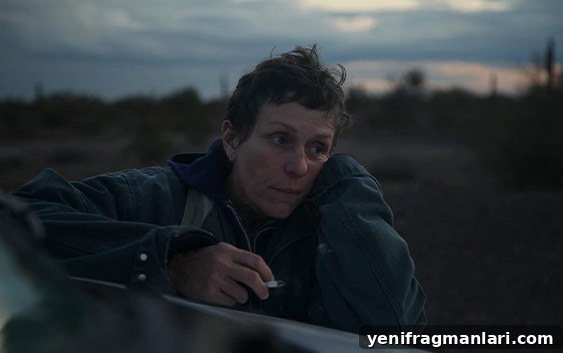
Nomadland, adapted from Jessica Bruder’s investigative book, observes a contemporary American movement of people who have become effectively houseless after financial disaster. The film centers on Fern (Frances McDormand), a widowed woman in her sixties who has converted a worn van, affectionately named Vanguard, into her home. Fern once lived in Empire, Nevada—a town that, the film warns us, no longer exists. The real closure of the local gypsum mine left the place hollowed out, and with jobs gone, residents drifted away until the town became nearly a ghostly shell. Zhao uses this loss as the point of departure for Fern’s life on the road.
Fern supports herself with seasonal work wherever it is available: warehouse shifts at an Amazon distribution center in Nevada, a brief stint as a campground host in the Badlands, and flipping burgers in a town close to Mount Rushmore. These jobs provide enough money for food and fuel, but the notion of settling down again never fully fits. The road represents both escape and survival. Fern grieves what she lost, yet her new existence is not portrayed solely as tragedy—instead Zhao frames this life as a deliberate, sometimes joyful, alternative to conventional home ownership.
The film blends narrative drama with documentary observation. Zhao populates the story with nonprofessional actors who play themselves, including seasoned nomads like Linda May and Swankie, who share practical skills and life lessons with Fern: how to fix a flat, keep a van functional, and navigate the routines of long-term travel. They introduce Fern to a wider community of itinerant workers, wanderers and free spirits, including Dave Wells, who appears as himself. Around campfires the film offers intimate, confessional moments in which people explain their reasons for choosing the road—loss, economic necessity, a preference for solitude, or simply the freedom to live by different rules. Those conversations gradually reveal the dignity and logic behind a lifestyle that many might dismiss at first glance.
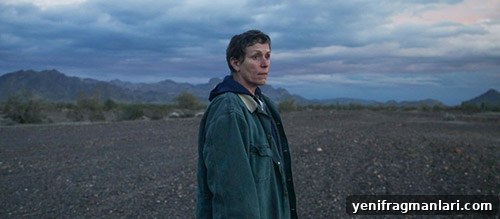
Cinematographer Joshua James frames these lives within monumental landscapes. His wide shots make the American West feel enormous and elemental, with Fern often appearing small against sweeping canyons, open plains and endless sky. At the same time the camera lingers on weathered faces and tiny, meaningful details: a patched curtain, a carefully stored cup, a map marked with routes and stops. James balances grandeur with intimacy, so the world feels both awe-inspiring and deeply personal. Yet Zhao does not romanticize hardship. She shows the cold nights, the physical toll of temporary labor, bouts of illness and moments of piercing loneliness. When Vanguard suffers engine trouble and lands in a repair shop, the film starkly reminds us how fragile this way of life can be—the van is not just transport, but the thin boundary between self-sufficiency and destitution.
Frances McDormand brings a lived-in authenticity to Fern. She conveys resourcefulness, stubbornness and vulnerability in equal measure, building a character whose history and grief are embedded in every gesture and hesitant smile. The performance is layered: Fern’s practical competence is offset by quiet moments of sorrow and reflection, making her both resilient and human. McDormand inhabits the role with understated power, crafting a portrait of someone who has lost much yet continues to find meaning on the move.
As a road movie, Nomadland is contemplative rather than plot-driven. It unfolds as a series of encounters and landscapes, an exploration of community and solitude that values small details over dramatic peaks. Zhao’s film works as both an elegy for what has been lost in certain American towns and a celebration of the unexpected communities that arise when people refuse conventional boundaries. It asks viewers to reconsider assumptions about home, work and freedom, and it does so with compassion and observational clarity.
23/24