
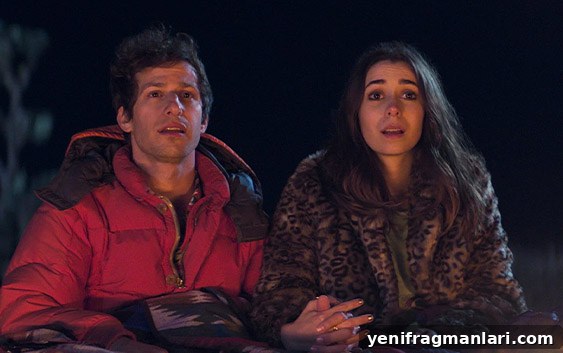

Palm Springs (2020)
Director: Max Barbakow
Screenwriter: Andy Siara
Starring: Andy Samberg, Cristin Milioti, J.K. Simmons, Peter Gallagher, Meredith Hagner, Camila Mendes, Tyler Hoechlin
Palm Springs opens with a deceptively light tone that quickly reveals a more thoughtful premise: two wedding guests trapped in a repeating day. The film balances romantic comedy beats with a philosophical undercurrent about routine, choice and consequence. Under Max Barbakow’s direction and Andy Siara’s sharply written script, the film turns a high-concept time loop into a character piece driven by chemistry and quiet observation.
One of the film’s most effective sequences arrives early on, a montage where the central pair experiment with the freedoms that come from living the same day over and over. This sequence functions both as a narrative shortcut—showing how quickly the characters adapt—and as an emotional hinge that asks the audience to decide whether they want to commit to this particular take on a looped-romance. If you accept the movie’s premise, the remainder deepens the relationship between the leads; if you don’t, the film risks feeling like a retread of stronger films in the genre.
Andy Samberg and Cristin Milioti carry the story with warm, grounded performances. Samberg’s uneasy charm and Milioti’s sensitive energy create a believable central pairing, while J.K. Simmons and the supporting cast add occasional jolts of humor and humanity. The film’s production company, Party Over Here, might be associated with broad sketch comedy, but Palm Springs avoids broad gags and instead leans into small, character-driven moments that reveal how repetition shapes personality and connection.
Stylistically, the movie starts with the polished look of a contemporary streaming romantic comedy: bright palettes, slick editing and a modern soundtrack. That surface gives way to a more introspective second half that borrows emotional strategies from films like Safety Not Guaranteed and The One I Love. While those films are darker or stranger in their own ways, Palm Springs chooses a softer path, combining genre playfulness with a focus on how people cope when their choices are erased and repeated.
The film’s strength lies in its ability to be both entertaining and quietly contemplative. It delivers laugh-out-loud moments and shareable visual beats while also posing questions about meaning, responsibility and the search for connection when time has no consequence. The screenplay sometimes falls back on rom-com conventions—predictable riffs and tidy resolutions—but it offsets those tendencies with thoughtful dialogue and a willingness to let scenes breathe.
Where Palm Springs occasionally disappoints is in its reluctance to push its central conceit to darker or more surprising places. Lines and ideas hint at deeper philosophical terrain—echoes of films like Eternal Sunshine of the Spotless Mind—but the movie rarely commits fully to the emotional risk those comparisons imply. Instead, it remains a highly watchable, often moving diversion: an enjoyable piece that prioritizes comfort and charm over true subversion.
That approach will please many viewers. For people seeking a clever, heartfelt, rewatchable film with solid performances and a smart premise, Palm Springs is likely to become a longtime favorite for relaxed viewing. For others hoping for a more radical or unconventional exploration of time-loop mechanics and existential angst, it may feel safe or familiar.
Ultimately, Palm Springs succeeds as a modern romantic comedy that borrows science-fiction motifs to deepen its emotional stakes. It isn’t the most daring film about repetition and meaning, but it delivers warmth, wit and enough introspection to make the concept feel fresh for mainstream audiences. Whether viewed as a comfort watch or a film that nudges you to think more about life’s patterns, it stands as an enjoyable entry in the time-loop subgenre.
Score: 12/24