
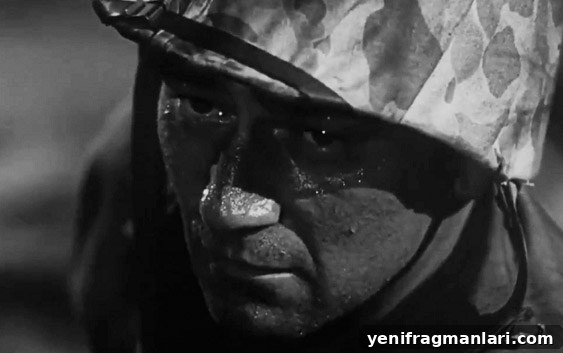
John Wayne is remembered for many films, and Sands of Iwo Jima ranks among his most enduring work. Released just four years after World War II, the film’s climactic flag-raising remains etched in the public imagination, and the movie earned multiple Academy Award nominations, including one for Wayne. Yet tucked into the film’s middle is a quieter, darker sequence that often goes unnoticed: a trench scene in which Sgt. Stryker, played by Wayne, and his men confront a wrenching moral dilemma when a voice calls out for help. That scene strips war down to its human core, forcing a leader to weigh duty against compassion when there is no clear right answer.
To set the stage: Stryker and his squad have been ordered to hold a thin, exposed line until reinforcements arrive. They are told not to move, not to talk, and not to reveal their position; any unnecessary action risks discovery and annihilation. The film shows the men spread along the trench in a graceful tracking shot, with Stryker positioned at one end—a visual decision that allows us to observe how each man reacts before the camera reaches their commander.
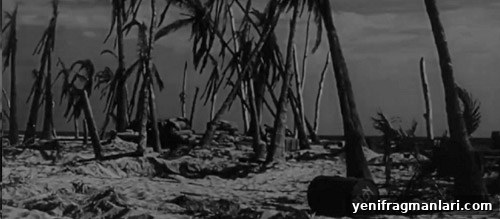
The sequence opens on a static, haunting image of palm trees under a night sky, smoke curling from nearby fires, and distant artillery punctuating the silence. Victor Young’s score strips away the era’s typical martial fanfare and replaces it with a high, sustained ringing tone and a repetitive heartbeat motif. This understated, unnerving music amplifies the scene’s moral tension and places it in a kind of twilight zone where familiar rules no longer feel sufficient.
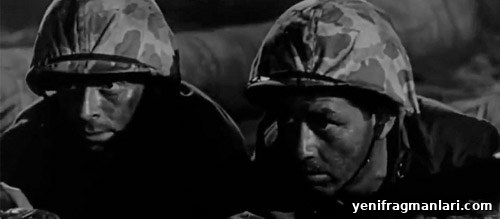
Back in the trench, two mud-smeared faces peer into the darkness. Then a voice rises across the battlefield: not the frantic scream of an instant casualty but a slow, deliberate call—a name, repeated over and over. The soldiers listen. The camera follows the line of men, pausing at each pair as they register the plea. Someone murmurs, “That’s a Marine,” and the next group urges action. But Stryker’s order holds: “You had your orders; don’t move.”
The dilemma is immediate and brutal. A single wounded man calls for help, and every impulse in the squad says to respond. Yet the order to hold their position means leaving the caller to his fate. By placing Stryker at the far end of the camera’s sweep, director Allan Dwan lets us witness the unit’s collective urge to help before confronting the man who must decide. The repeated requests to rescue the fallen soldier build moral pressure: it’s nine men against one, and the desire to act grows stronger with each voice.
When the voice calls a name—“Stryker”—the tension intensifies. Pfc. Conway, played by John Agar, insists it must be their man Bass; who else would know his name? Conway’s belief in the certainty of identification clashes with Stryker’s caution. Stryker suspects a trap. Any movement in the open could expose them all. The exchange becomes a study in opposing instincts: Conway, morally driven and visibly lit by moonlight, wears his conscience on his face; Stryker, wary and shadowed beneath his helmet, suppresses his emotions to maintain command.
Conway threatens to go get the man himself, declaring that if Stryker attempts to stop him, he’ll shoot him. The camera frames Conway with Stryker’s rifle ominously present in the foreground, a stark, impersonal instrument that reduces the possibility of rescue to a cold calculation. Stryker, expression hardened, cocks the rifle—an action that underlines the gravity of his responsibility. The exchange escalates and then holds: the two men stand at odds, mired between compassion and survival.
Conway ultimately backs down, leaving Stryker to face the decision alone. The cries resume, and the camera returns to a single, extended close-up on Stryker. His helmet casts a shadow over his eyes; only two small reflections betray the intensity behind his gaze. He looks away, looks back, swallows, each subtle movement conveying a battle without words. The shot lingers—nearly twenty-five seconds—allowing Wayne to inhabit the inner torment of a leader who must choose to follow orders at the cost of another man’s life. That uncut moment is the emotional apex of the scene, a raw, measured performance that captures how war corrodes ordinary moral certainty.
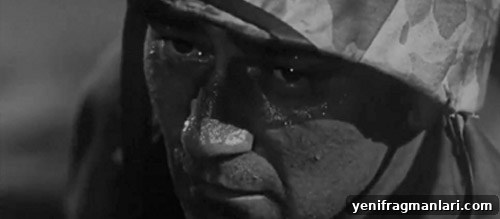
Crucially, the scene ends without a tidy moral resolution. The camera fades from Stryker’s haunted expression and leaves the question unresolved, mirroring the ambiguity of wartime choices. Whether or not the voice belongs to someone known to the unit ultimately matters less than the wrenching experience of being forced to decide under impossible conditions. That lingering uncertainty and Wayne’s performance combine to make the sequence one of the film’s most powerful moments, a reminder of the human cost hidden behind orders and strategy.
Recommended for you: Shot-for-Shot – Safe-Theft Scene in Hitchcock’s ‘Marnie’ (1964)