
Tangerine (2015)
Director: Sean Baker
Screenwriters: Sean Baker, Chris Bergoch
Starring: Kitana Kiki Rodriguez, Mya Taylor, Karren Karagulian, Mickey O’Hagan, Alla Tumanian, James Ransone, Louisa Nersisyan
Nearly a decade after its release, Tangerine remains far from a conventional holiday classic, but its urgency and relevance have only increased. Sean Baker’s dramedy about transgender sex workers in Los Angeles delivers a sharp, humane portrait of marginalised lives set against the bright, contradictory backdrop of Christmas Eve. In a cultural moment when identity and belonging are under intense scrutiny, this film still feels essential.
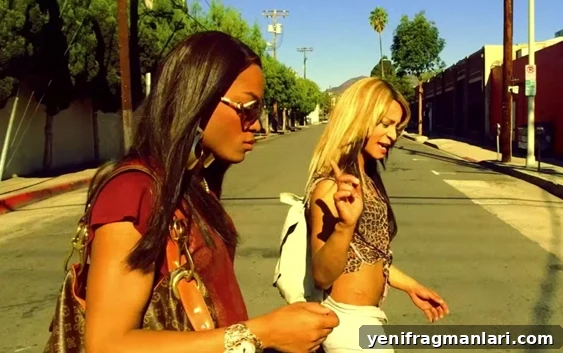
The story follows Sin-Dee Rella (Kitana Kiki Rodriguez), a transgender sex worker who spends Christmas Eve roaming Hollywood streets determined to confront the woman her pimp boyfriend has been seeing. Alongside her is Alexandra (Mya Taylor), Sin-Dee’s best friend, who spends the day working and preparing to perform as a lounge singer that night. Their friendship is the emotional core of the film: loud, volatile, protective and tender in equal measure.
The film opens with a playful parody of Classical Hollywood title cards — calligraphic text on a sunny yellow background — but the yellow is quickly revealed to be worn Formica from a donut-shop tabletop. It’s a clever visual cue that signals the film’s attitude: a movie that riffs on cinematic tradition while grounding itself in the everyday grit of a specific place and community.
Baker and co-writer Chris Bergoch approached the project with a commitment to authenticity. They consulted local people, met regulars at an LGBT center and listened to those who had lived the life depicted onscreen. That research led them to Mya Taylor, who introduced them to her former roommate Kitana Kiki Rodriguez. Casting the two nonprofessional actors proved decisive. Rodriguez and Taylor bring an extraordinary, natural presence to the film: candid, energetic and fully alive. Their performances are unpolished in the best possible way — messy, funny and emotionally honest.

Tangerine is structured around two intersecting storylines. Sin-Dee’s urgent search for answers moves through the city, encountering a string of chaotic encounters. Intercut with her journey are conversations inside Razmik’s taxi, played by Karren Karagulian. Razmik is an Armenian immigrant trying to support his family while navigating his own personal frustrations and desires. These vignettes illuminate another under-represented community in Los Angeles and broaden the film’s scope beyond a single queer storyline.
One of the film’s most talked-about innovations is its production method: Baker and cinematographer Radium Cheung shot the movie on iPhones, using clever adapters and lightweight rigs. The choice was both practical and artistic. Limited budgetary resources made conventional production difficult, but the mobile technology also gave the film a spontaneous, unobtrusive energy. The camera moves with the actors, blending staged moments with improvised interactions among real people in public settings. The result is an immediacy that reinforces the film’s documentary-like authenticity.
With a modest budget of roughly $100,000, Tangerine exemplifies what small, resourceful independent projects can achieve. The film’s technical choices — natural lighting, handheld camerawork and intimate framing — all serve its primary goal: to present the characters as fully dimensional human beings rather than stereotypes. Baker’s casting strategy, mixing professionals with first-time performers and nonactors, contributes to a textured, organic portrayal of a city and its subcultures.
Although set during Christmas, the film never veers into easy sentimentality. Baker juxtaposes holiday imagery — decorations, neon lights and seasonal rituals — with struggles over dignity, money and identity. The holiday setting underscores a central theme: for many people, the season amplifies feelings of isolation or longing, but it can also highlight the importance of chosen family and solidarity. The film’s climactic confrontation takes place not in a living room but in the same donut shop where the story began, which reinforces the circular, public nature of the characters’ lives.
There are minor production trade-offs. The soundtrack relies at times on stock beats and online tracks, which can feel repetitive and occasionally intrude on quieter moments. The production also did not use ADR, meaning some on-location audio had to be supplemented. These are small blemishes on an otherwise vibrant film that thrives on its raw energy and specificity.
Tangerine is both an intimate character study and a socially aware statement. It centers people often relegated to the margins and presents their ambition, humor and heartbreak without patronizing or sensationalizing. The film affirms the value of found family and enduring friendship while reaching for a broader human truth: when a movie focuses closely on a specific community with honesty and respect, it can reveal universal themes about resilience and belonging.
Score: 22/24
Recommended for readers interested in contemporary independent cinema examining identity and community.