
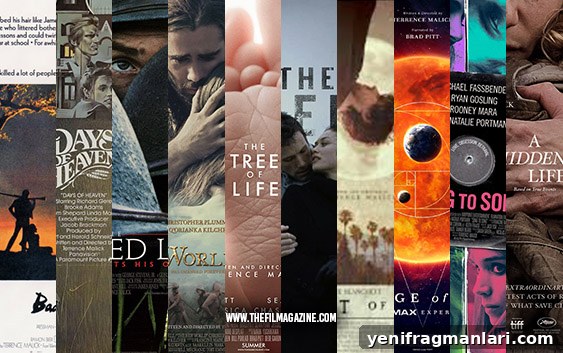
The 1970s remain one of cinema’s most influential decades. A new generation of directors, inspired by art-house sensibilities, reshaped American film—moving away from studio-driven spectacle and formulaic star vehicles toward more personal, daring storytelling. Among those voices was Terrence Malick. Less immediately famous than contemporaries like Lucas, Coppola, Scorsese, and Spielberg, Malick nonetheless emerged as one of the era’s most distinctive talents. A philosophy graduate and one of the first film-studies alumni in the United States, he brought a reflective, literary sensibility to his early features. His debut, Badlands—a loose retelling of a 1950s crime spree through the eyes of a young girlfriend—remains one of the finest first films in American cinema.
Malick’s early promise was followed by a long absence from filmmaking—an interval that spawned myths and rumors about his whereabouts—before he returned in 1998 with the sweeping, contemplative war film The Thin Red Line. Over the following decades his work increasingly emphasized existential, spiritual, and impressionistic approaches to cinema. That path led to the Palme d’Or win for The Tree of Life in 2010 and a late-career turn toward experimental, visually driven films that have divided critics and audiences alike.
New to Malick? We recommend: Where to Start with Terrence Malick
In this edition of Ranked, we examine all ten of Terrence Malick’s feature films—from Badlands (1973) to A Hidden Life (2019)—and rank them based on artistic merit, distinctiveness, and their place within Malick’s body of work. We consider the director’s intentions as well as critical and audience responses to each film.
Tell us your favourite Terrence Malick film in the comments and follow us on Twitter for more articles.
10. Voyage of Time: Life’s Journey (2016)
Voyage of Time: Life’s Journey is Malick’s most explicitly experimental IMAX piece: a visual and meditative exploration of cosmic and natural history rather than a conventional story. It offers breathtaking imagery and the contemplative tone familiar to his work, yet its lack of a clear narrative makes it feel less like a traditional Malick film. It’s essential for dedicated fans interested in his visual experiments, but less accessible for mainstream viewers seeking conventional drama.
9. Song to Song (2017)
Song to Song stands among Malick’s most polarizing films. Set amid the Austin music scene, it relies heavily on evocative cinematography and impressionistic montage, with romance and ambition depicted more in mood than in plot. The film’s star-studded cast and gorgeous images can dazzle, but many viewers find its intentions opaque. For newcomers it offers arresting visuals, though its narrative elusiveness can be frustrating.
8. Knight of Cups (2016)
Knight of Cups Review
Knight of Cups shares the fragmentary approach of Malick’s recent work but remains grounded in character. With Emmanuel Lubezki’s fluid camera work, the film follows an emotionally adrift protagonist through a series of encounters that reflect themes of regret, desire, and spiritual searching. It may not reach the heights of Malick’s greatest work, but its intimacy and strong performances keep it compelling.
7. To the Wonder (2013)
To the Wonder explores the fragile, luminous realms of love and faith. Featuring Ben Affleck, Olga Kurylenko, Rachel McAdams, and Javier Bardem, the film favors natural light and intimate close-ups, capturing emotional complexity through visual nuance. Its fragmented structure and frequent voiceover divide opinion, but its quiet, introspective mood delivers a tender meditation on attachment and spiritual longing.
6. A Hidden Life (2019)
A Hidden Life Review
A Hidden Life tells the true story of Franz Jägerstätter, an Austrian farmer who refused to serve the Nazi regime. Anchored by powerful performances from August Diehl and Valerie Pachner and a moving score by James Newton Howard, the film blends Malick’s spiritual concerns with luminous cinematography by Jörg Widmer. Shot against the rugged beauty of the mountains, it’s a moral and visual triumph that many saw as a return to the director’s strengths.
5. Days of Heaven (1978)
Days of Heaven is both a visual masterpiece and a career turning point. Its pastoral, twilight-lit images—many shot by Néstor Almendros and Haskell Wexler—create a mythic American landscape for a tragic tale of love, jealousy, and ambition. Despite production conflicts that contributed to Malick’s two-decade hiatus, the film’s Ennio Morricone score and transcendent photography established it as one of the essential films of the 1970s and a cornerstone of Malick’s early legacy.
4. The New World (2005)
The New World revisits Malick’s early concerns—intimacy, myth, and the natural world—this time reframing the founding myths of America. Focusing on the encounters between John Smith and Pocahontas, the film rejects heroic simplification in favor of ambiguity and human frailty. Its extended runtime allows for a slow, immersive rhythm, and Malick’s poetic camera finds surprising intimacy amid historical spectacle.
3. The Thin Red Line (1998)
The Thin Red Line is one of the great war films of modern cinema. Returning after a long absence, Malick crafted an ensemble-driven, philosophical meditation on combat, nature, and morality. The film juxtaposes the brutality of battle with moments of human tenderness, underlined by Hans Zimmer’s haunting score. Its contemplative tone marked a clear evolution in Malick’s work and remains a touchstone for filmmakers interested in cinematic poetry applied to epic subject matter.
2. Badlands (1973)
Malick’s debut, Badlands, introduced his signature pairing of lyrical imagery and moral ambiguity. Martin Sheen and Sissy Spacek deliver memorable performances as a young couple on the run, and Spacek’s innocent, detached voiceover contrasts chillingly with the violent acts the pair commit. Shot often in golden-hour light and featuring a hypnotic, spare rhythm, Badlands remains a remarkable and influential first film.
1. The Tree of Life (2011)
Winner of the Palme d’Or, The Tree of Life represents the fullest synthesis of Malick’s cinematic interests: personal memory, spiritual inquiry, and cosmic scale. With Emmanuel Lubezki’s luminous cinematography and a structure that moves between family drama and sweeping metaphysical sequences, the film stands as a singular achievement in contemporary art cinema. For many, it is the director’s masterpiece—an ambitious, deeply felt work that cements Malick’s status as a leading American auteur.
Recommended for you: Cameron Crowe Movies Ranked
Share your favourite Terrence Malick film in the comments below. Follow us on Facebook and Twitter for more lists, essays, reviews, and film news from The Film Magazine.