
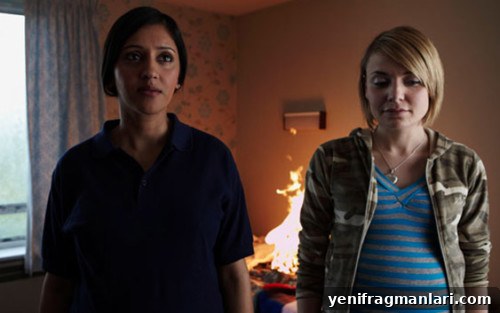

The Arbor (2010)
Director: Clio Barnard
Starring: Manjinder Virk, Christine Bottomly, Natalie Gavin
Andrea Dunbar, born and raised in Yorkshire, emerged in the 1980s as one of Britain’s most promising young playwrights. Her raw, uncompromising voice produced work that spoke candidly about life on the margins, and she went on to write the screenplay for the film adaptation Rita, Sue and Bob Too (1987) — a controversial and influential drama of its time. Dunbar died in 1990 at the age of 29, leaving behind three children and many unresolved questions about the social conditions and personal struggles that shaped her life and art.
Clio Barnard’s feature debut, The Arbor (2010), undertakes a delicate, imaginative examination of Dunbar’s life, her legacy and the community that produced her. Barnard’s film is at once a portrait, an investigation and a piece of theatre, and it approaches its subject with a sorrowful empathy that never lapses into sentimentality. The result is an original documentary experience that respects Dunbar’s work while interrogating the wider social landscape that informed it.
One of the film’s most striking formal devices is its use of actors lip-syncing to recorded interviews with Dunbar’s family, friends and neighbours. This choice creates a controlled distance between speaker and performance while also drawing attention to the act of telling — to the ways memory, language and identity are mediated. The lip-synced performances, intercut with scenes of a community theatre production of Dunbar’s early play “The Arbor,” allow Barnard to blur boundaries between documentary and drama. That blending feels thematically appropriate: Dunbar’s plays themselves often straddled real life and theatrical representation, and Barnard’s film mirrors that tension to powerful effect.
As the film moves between these staged performances and testimony, it gradually shifts focus from Andrea herself to members of her family, most notably her eldest daughter, Lorraine. The documentary takes a sharp narrative turn when it reveals Lorraine’s conviction for the manslaughter of her own child. From that point the film interrogates the intergenerational consequences of neglect, poverty and addiction, exploring how environments shape behaviour and destiny. Although the center of gravity moves away from Dunbar the person, the film never loses sight of how her life and art were shaped by the same social forces that affected her children.
Barnard’s approach feels careful rather than sensational. She neither sanitises Dunbar nor reduces her to a stereotype; instead, the film presents a layered portrait that acknowledges both creative brilliance and human vulnerability. Scenes of neighbours talking candidly about Dunbar and her family are filmed with an intimacy that resists voyeurism. The theatre sequences, meanwhile, function as a kind of public rehearsal for private histories, opening space for reflection on how stories are performed, remembered and reshaped across generations.
At its core, The Arbor is an exploration of class, place and the overlooked corners of British life. The film situates Dunbar within the estate where she grew up and later raised her children, showing how daily realities — economic hardship, limited opportunities, a fractured support system — informed her work and, tragically, the trajectories of her family. In focusing on ordinary voices and small, specific details of community life, Barnard foregrounds broader social questions without resorting to polemic. The documentary becomes a quiet indictment of systemic neglect while remaining rooted in personal testimony.
Stylistically, the film balances sensitivity and invention. The lip-sync technique can feel disorienting at first, but it becomes a clarifying device: it foregrounds language and allows Barnard to orchestrate emotional beats with the precision of a playwright or theatre director. Interweaving archival material, staged scenes and contemporary interviews, the film builds a cumulative impression rather than offering a straightforward chronology. That structure mirrors how memory works — associative, partial and often refracted through performance.
Beyond its portrait of Andrea Dunbar and her family, The Arbor stands as an argument for the artistic value of stories rooted in marginalised communities. Barnard treats Dunbar’s writing with respect, showing how a voice born of hardship can yield both sharp social commentary and deep human insight. The film positions Barnard herself as a filmmaker attuned to the rhythms and realities of working-class northern England — an artistic continuity that can be felt in her later work.
For viewers interested in British social realism, documentary innovation, or the life of a complicated and talented writer, The Arbor offers a moving, thought-provoking experience. It invites reflection on how environment and art interact, how family histories reverberate across generations, and how cinema can both document and dramatise truth without sacrificing empathy.
16/24