
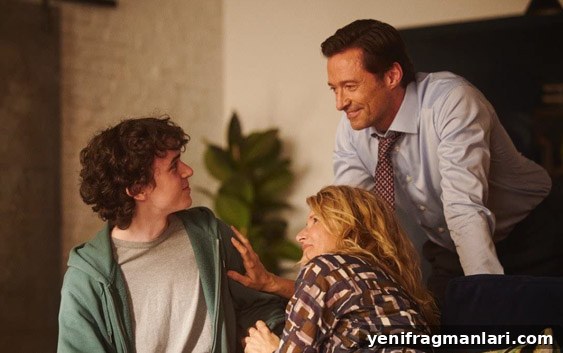

The Son (2022)
Director: Florian Zeller
Screenwriter: Christopher Hampton
Starring: Hugh Jackman, Laura Dern, Vanessa Kirby, Zen McGrath, Anthony Hopkins
Following the international success of The Father (2020), French novelist and playwright Florian Zeller returned to cinema with The Son, again collaborating with screenwriter Christopher Hampton to adapt Zeller’s own stage play “Le Fils.” While The Father drew praise for its inventive structure and intimate portrayal of dementia, The Son takes on the far more delicate subject of adolescent depression and suicidal ideation. The film aims for emotional depth, but often relies on more obvious dramatic cues rather than subtle character work.
The story follows 17-year-old Nicholas (Zen McGrath), who struggles with persistent feelings of abandonment and neglect in the aftermath of his parents’ divorce. His father, Peter (Hugh Jackman), has established a new family life with his second wife (Vanessa Kirby) and their infant son. When Nicholas begins skipping school and wandering the streets of New York, his mother, Kate (Laura Dern), can no longer manage his care alone. Nicholas decides to move in with his father, believing a change of environment and paternal attention might help him recover from the emotional void he’s been experiencing.
At first, Peter welcomes Nicholas with conviction, eager to take on a meaningful parental role and confident he can help his son recover. But Peter’s life is also changing: his career is gaining momentum and his commitment to a newborn and a new marriage competes for his attention. As small but alarming signs of Nicholas’s declining mental health emerge, Peter is slow to read them. Nicholas’s increasingly desperate attempts to communicate his pain are often met with hope that he will simply “snap out of it,” rather than concrete intervention.
In its themes, The Son bears resemblance to films like Beautiful Boy, which address addiction, mental illness, and familial helplessness. Where Beautiful Boy often feels quietly authentic—drawing on a memoir that grounds the father-son dynamic—The Son sometimes substitutes nuance for overt emotional signaling. The film repeatedly pushes the audience toward a specific emotional response, rather than allowing the characters’ interior lives to unfold with complexity and restraint.

One frequent criticism is the film’s use of Hans Zimmer’s score. Zimmer delivers moments of stirring orchestration, but at times the music feels overpowering—almost directive—trying to steer audience feeling instead of supporting it. Even in lighter moments, such as a rare scene where Nicholas briefly loosens up, the soundtrack and directorial choices push the sequence back toward melancholy before it can breathe. Director Zeller often asks McGrath to hold distant, blank expressions, which can limit our access to Nicholas’s interior anguish and reduces the character to a vessel for the adults’ reactions.
Hugh Jackman gives a committed performance, portraying Peter’s mixture of genuine concern, guilt, and denial. Vanessa Kirby, though given limited screen time, brings warmth and emotional clarity in her role. Laura Dern is tasked with conveying a weary but loving mother, and while her performance has sincere moments, it sometimes feels muted by the screenplay’s focus on Peter’s perspective. Anthony Hopkins appears in a brief cameo as Peter’s father; his presence underscores the film’s preoccupation with generational patterns but does little to expand the central emotional focus.
The casting and performances highlight an important shortcoming: the film often centers Nicholas mainly as a catalyst for exploring Peter’s conscience rather than fully inhabiting the teenager’s lived experience. This choice restricts Zen McGrath’s ability to develop a nuanced, independent character. As a result, the film can feel more like a study of a father’s response to crisis than a simultaneous portrait of a young person’s internal struggle.
Structurally, The Son is meticulously staged and polished, but it leans toward emotional pressure rather than quiet revelation. Scenes designed to shock or overwhelm risk dulling the viewer’s empathy instead of deepening it. That said, the film still raises necessary questions about parental responsibility, the limits of good intentions, and how families respond to mental health crises.
Florian Zeller’s debut feature showed his capacity to translate theatrical invention into cinematic intimacy. With The Son, his ambition is evident, but the approach is more heavy-handed, sacrificing some subtlety for immediacy. Zeller’s next project—a television adaptation of Stefano Massini’s theatrical work “The Lehman Trilogy”—offers him a different storytelling format that may allow for broader character development and a recalibrated approach to sensitive material.
Score: 6/24
Written by Jake Gill
Support the author:
Twitter – @Jake95Gill