Return of the Jedi: Blockbuster Craft Meets Commercial Strategy
Return of the Jedi, the final film of the original Star Wars trilogy, opens with a high-stakes rescue sequence. R2-D2 and C-3PO join Leia Organa, Chewbacca, Lando Calrissian, and Luke Skywalker in an effort to free Han Solo from the clutches of the crime lord Jabba the Hutt. The sequence exemplifies the dual nature of Star Wars: a polished achievement of blockbuster filmmaking that simultaneously functions as a broadly commercial product designed to maximize audience engagement across media.
Film scholar Thomas Schatz argues that the rise of the blockbuster saved the American commercial film industry, transforming Hollywood into an increasingly hit-driven business since the 1950s. According to Schatz, directors such as Stanley Kubrick, Sam Peckinpah, and Francis Ford Coppola helped create an environment that allowed Steven Spielberg and George Lucas to become cultural superstars. Lucas’s original Star Wars was, in Schatz’s view, a model of commercial filmmaking that blended nostalgia, concentrated action, and spectacular visual effects to achieve mass appeal.
Music plays a central role in how Star Wars evokes classic Hollywood. Composer John Williams rejected the modernist and electronic scoring common to earlier science fiction and instead drew on the lush, orchestral tradition exemplified by composers like Erich Wolfgang Korngold. As critics note, this approach links the space opera to the action-adventure scoring of earlier eras and helps anchor the film’s nostalgic tone.
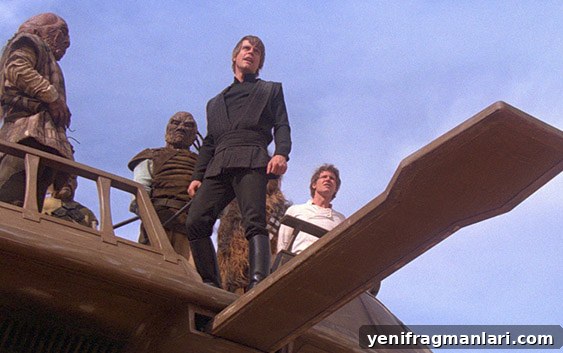
In the rescue scene the film blends diegetic and nondiegetic music to shape the audience’s emotional experience. Sounds from Jabba’s barge dissolve into the diegetic wind of Tatooine; then Williams’s darker orchestration signals a shift in mood. Brass punctuations mark key visual edits as Luke checks his allies and prepares for action, and the triumphant Star Wars theme makes a decisive return the moment Luke leaps into combat, underscoring his heroic reversal and launching the scene into full momentum.
The sequence also taps into classic pirate imagery—ships, planks, swashbuckling fights—transposed into a science-fiction setting. Jabba’s floating barge, the plank-walking motif, and a small cackling henchman perched like a parrot all echo films such as Treasure Island and Peter Pan. Lucas adapts those motifs by populating the scene with alien creatures, flying vessels, and the monstrous sarlaac in the Great Pit of Carkoon, producing a hybrid of pirate adventure and sci-fi spectacle.
Visually, the scene merges practical effects and emerging techniques. Jabba himself was a complex puppet operated by multiple performers; humanoid aliens were realized through makeup and costuming; and effects such as lightsaber blows, blaster fire, and Boba Fett’s jetpack used rotoscope animation and optical printing to sell the illusion of floating ships. Later additions in the 1997 Special Editions introduced CGI elements—banthas and an expanded sarlaac mouth—to align the original films visually with the prequels and to enhance overall worldbuilding consistency.
The editing helps sustain excitement while clarifying the spatial relationships among characters. The opening three minutes of the sequence use rapid cutting to establish where each character is and to build tension; the shot length shortens even further as the confrontation escalates. Film analysts point out that this accelerating pace—switching quickly between several characters across multiple locations—creates a kind of narrative intensity only cinema can deliver. The edits foreshadow hazards, reveal threats before the protagonists notice them, and generate a controlled chaotic energy that drives the action forward.
These elements—music, imagery, effects, and brisk editing—coalesce into a set piece that defines the blockbuster template. Yet critics have long argued that this same approach emphasizes spectacle over depth. Some reviewers labeled the 1970s and 1980s blockbuster cinema as “juvenile” or “empty” entertainment, a perception reinforced by marketing strategies that extended the film’s reach into toys, comics, and television. Schatz contrasted Star Wars with character-driven films like The Godfather, suggesting that Lucas’s storyworld prioritizes plot mechanics and spectacle, often treating characters primarily as functional elements within action-driven narratives.
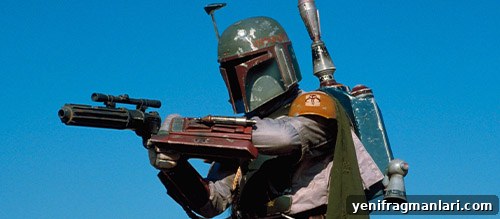
A clear example of this tension appears in the depiction of Boba Fett. First introduced in a television special and later seen briefly in The Empire Strikes Back, Fett’s mystique was amplified by transmedia storytelling. In Return of the Jedi his screen time in the rescue sequence is short and, critics argue, undignified: a confrontation that ends with his jetpack malfunctioning and him tumbling into the sarlaac’s pit, followed by a comic burp from the creature. That moment highlighted how merchandising and surface style sometimes outpaced deeper character development.
Fans and expanded-universe authors resisted that shallow depiction; transmedia narratives such as “A Barve Like That: The Tale of Boba Fett” and its follow-ups filled in the bounty hunter’s backstory and survival, providing psychological and emotional context that the film itself did not explore. These later stories show how franchise audiences often use ancillary media to deepen and complicate characters introduced mainly as visual icons.
Ultimately, the defining image of the rescue—Luke igniting his green lightsaber as the heroic theme swells—captures what made Star Wars enduring: a fusion of classical Hollywood elements and technological innovation. That fusion produced an epic cinematic experience that remains influential, even if the franchise’s commercial machinery and spectacle-driven instincts have invited criticism for favoring style over substance. Respecting the film’s ambition and craft does not preclude acknowledging its role as a highly effective commercial product designed to reach mass audiences across many platforms.
Bibliography
Audissino, Emilio. John Williams’s Film Music: Jaws, Star Wars, Raiders of the Lost Ark, and the Return of the Classical Hollywood Music Style. The University of Wisconsin Press, 2014.
Butler, Catherine. “Tolkien and Worldbuilding.” In J. R. R. Tolkien (New Casebooks), edited by Peter Hunt, Palgrave, 2013, pp. 106–120.
Salt, Barry. “Comments on Attention and Hollywood Films.” Film Style and Technology, 3rd ed., Starword, 2009. Cinemetrics, 2010.
Schatz, Thomas. “The New Hollywood.” In Movie Blockbusters, edited by Julian Stringer, Routledge, 2003, pp. 15–44.
Turnock, Julie. “The True Stars of Star Wars? Experimental Filmmakers in the 1970s and 1980s Special Effects Industry.” Film History, vol. 26, no. 4, 2014, pp. 120–145.