
This article was written exclusively for The Film Magazine by Gillian MacLeod.
For more than a decade, mainstream cinema has been dominated by the superhero film. From the early landmark of Superman: The Movie (1978) to the contemporary, high-budget blockbusters that define the industry today, the genre has grown into a multi-billion-dollar phenomenon.
Like other film categories, the superhero genre has followed a recognizable cycle of development. In his book The Comic Book Film Adaptation: Exploring Modern Hollywood’s Leading Genre, Liam Burke identifies four stages: formative, classical, revisionist, and parody. Between 1978 and 2000 the genre was in a formative phase, with studios experimenting to find the conventions that made these films work. When X-Men arrived in 2000 and helped solidify many of those conventions, the genre shifted into its classical period: a steady increase in production, repeated tropes such as secret identities and rescue-driven heroism, and a clearer commercial playbook.
That pattern was disrupted in 2008, a year that proved crucial for superhero cinema. Iron Man and The Dark Knight both premiered and redefined audience expectations—raising production values, deepening character focus, and demonstrating that superhero stories could break both box office and awards ground. The number of superhero releases that year was also notable, signaling a surge in industry commitment to the genre.
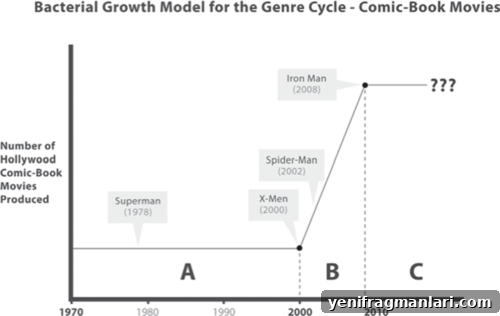
From that point, superhero films became a dominant commercial force. Productions multiplied, shared cinematic universes took shape, and tentpole movies began achieving milestones once reserved for rarer releases. This expansion brought both enormous financial returns and creative strain: as stakes rose, it became harder to top previous highs.

The year 2019 marked another watershed. Eleven superhero films reached screens, and Avengers: Endgame became the highest-grossing film of all time. Joaquin Phoenix’s lead performance in Joker also brought a rare Academy Award triumph for an actor in a comic-book-derived role. But peaks like these can carry a warning: once a genre sets such a high bar, surpassing it becomes exponentially more difficult. Endgame represented the culmination of over a decade of interconnected storytelling in a shared universe, delivering a sense of closure that made it easier for audiences to step away. That same sense of finality makes it hard for subsequent films to capture the same cultural and financial momentum.
Another important sign of tonal change in 2019 was the success of Todd Phillips’ Joker. Marketed and produced as a low-budget, character-driven drama rather than a CGI spectacle, it leaned into gritty realism and psychological depth. Phillips described the approach as a series of grounded, low-CGI comic-book films focused on character study. Whether Joker stands as a one-off experiment or as the start of a new creative cycle remains uncertain, but it clearly signaled a shift away from formulaic spectacle toward smaller, risk-averse productions that emphasize story and performance over effects-heavy set pieces.
Following the global pandemic, the release calendar for superhero films tightened. In 2020 only a handful of titles remained scheduled, and some releases were delayed or scaled back. With several upcoming films introducing unfamiliar characters—features such as Morbius and The Eternals—studios faced the challenge of selling new intellectual property without the built-in audience a long-established cinematic universe provides. That uncertainty increases financial risk and forces studios to reconsider investment strategies.
Even so, the current cycle has already secured the superhero genre a lasting place in the history of Hollywood. It has reshaped marketing, distribution, and franchise-building practices, and it has delivered some of the most commercially successful films ever made. While the peak moments of the past decade may be difficult to repeat, the genre’s evolution suggests it will continue to reinvent itself—sometimes by returning to its roots, sometimes by leaning into darker, more intimate storytelling, and sometimes by exploring entirely new creative directions.
Written by Gillian MacLeod
You can find out more about Gillian MacLeod at the following link:
LinkedIn – Gillian MacLeod