
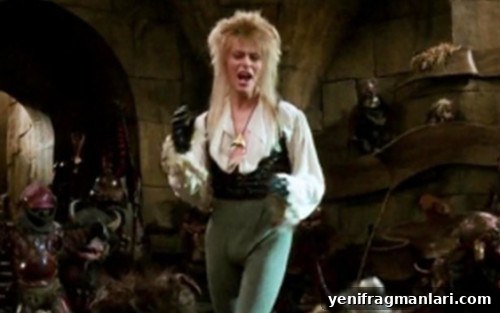
Widely discussed and often criticized, Jim Henson’s Labyrinth has long invited readings that extend beyond a simple children’s fairy tale. Chief among these is the film’s overt sexual subtext, most famously embodied by Jareth’s pronounced codpiece in scenes like the Magic Dance. That image has puzzled viewers since 1986: why place such an obvious phallic symbol in a movie aimed at younger audiences, and what does it reveal about Jareth’s role in Sarah’s story?
The film centers on Sarah (Jennifer Connelly), a teenage girl caught between childhood and adulthood. Frustrated with babysitting and resentful of her new family situation, she impulsively wishes her baby half-brother Toby away. The wish materializes when Jareth (David Bowie), the Goblin King, appears and carries Toby off. Sarah immediately regrets her words and accepts Jareth’s challenge: she has fourteen hours to solve his labyrinth and recover her brother before he is transformed into a goblin forever.
From the opening frames, Labyrinth hints that its central antagonist is not merely a fantasy creature but a projection of Sarah’s real-life anxieties. The film rewards careful viewers; close attention reveals elements in Sarah’s bedroom that tie the fantasy back to her home life. Her shelves are full of the toys and objects that later populate the labyrinth, and her scrapbook contains photographs and clippings that illuminate Jareth’s significance in her inner world.
One notable scrapbook image shows Sarah’s mother pictured with a glamorous man identified as a stage partner. The man’s resemblance to David Bowie—who portrays Jareth—allows a reading in which the Goblin King functions as an imaginative manifestation of the actor who influences Sarah’s life off-screen. That visual cue suggests the film intentionally blurs the boundary between Sarah’s waking reality and her dreamlike journey: the villain in her fantasy echoes a real-world figure connected to the adult relationships she resents and envies.
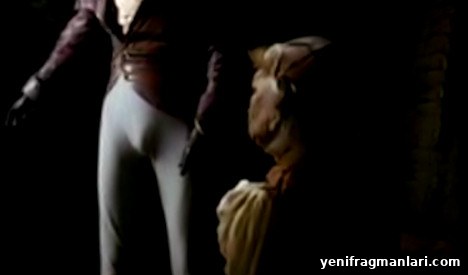
He’s going to have someone’s eye out with that thing.
This mirrored structure—reality reflected in fantasy—is typical of fairy tales when read through a mature lens. Where children’s viewers may see a whimsical adventure, adults often find a coming-of-age story that explores sexual awakening, jealousy, and the struggle for autonomy. Sarah is at an emotional crossroads: she has idealized adulthood as something glamorous and effortless, signified by her mother’s life onstage, yet she is also mourning the loss of maternal presence and resenting the changes in her household.
Jareth’s exaggerated costuming and overt sexual symbolism can be read as externalizations of that ambivalence. The film stages desire, intimidation, and temptation in highly theatrical terms—most notably during the masquerade ball, a Freudian tableau filled with masks, candlelight, and ritualized seduction. In that sequence, Sarah encounters Jareth as a real man rather than a puppet or creature, and the scene’s charged atmosphere makes explicit the tension between fear and curiosity that marks adolescent attraction.
Many viewers have cited the masquerade as a turning point: it strips away some of the movie’s playful artifice and presents a more dangerous, alluring adult presence. The mise-en-scène translates the film’s central conflict into psychological terms—Sarah must confront the appeal of a seductive figure who promises power, escape, or acceptance, and determine whether she will yield to that temptation.
Interpreting Jareth as both father-figure and abusive suitor captures the film’s emotional complexity. He alternates between dominance and enticement, offering Sarah a Faustian bargain: submit and be cared for, or resist and retain agency. Her eventual defiant declaration—“You have no power over me”—marks her moment of self-definition. The signifier that once seemed mighty and frightening is revealed to be performative: Jareth’s grandeur is an inflated ego, not an absolute force.
Viewed this way, the infamous codpiece functions less as gratuitous provocation and more as a symbol of exaggerated masculinity and coercive charisma. It signals the specific kind of threat Sarah must learn to see through: not merely a sexual object, but a social power that seeks to overwhelm her autonomy. The lesson of Labyrinth is not prudish censorship but personal growth—recognizing seductive authority for what it is and choosing one’s own path.
Over the decades, critics and fans have debated whether the film’s adult themes are appropriate for younger audiences. What remains clear is that Jim Henson and his collaborators crafted a multilayered work. On its surface, Labyrinth entertains with puppetry, music, and spectacle; beneath that surface it stages a classic coming-of-age conflict in which a young woman must confront—and ultimately reject—the false promises of a charismatic, domineering figure.
In that light, the codpiece becomes a memorable visual shorthand: provocative, campy, and deliberately oversized so the viewer understands what is at stake. Jareth’s ostentatious masculinity is not simply there to shock; it is a device that dramatizes Sarah’s emotional journey toward self-possession. When she claims her power, the spell dissolves, and the movie closes as a meditation on empowerment, choice, and the difficult work of growing up.