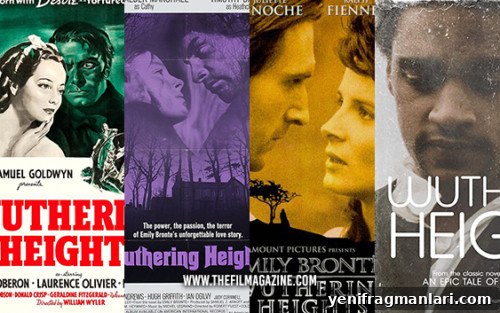
“Wuthering Heights” by Emily Brontë has inspired countless adaptations across film, television, theatre and even music — most famously Kate Bush’s 1978 song “Wuthering Heights.” The novel’s turbulent story of Heathcliff and Catherine on the bleak Yorkshire moors continues to be a rich source for filmmakers. Of the many versions, four English-language feature films stand out for comparison.
In this edition of Ranked, we evaluate the four major English-language feature-film adaptations of Wuthering Heights, ranking them from least to most successful based on artistic merit and critical/popular consensus. This list is not an assessment of fidelity to the novel but of each film’s cinematic achievement and impact.
Follow @thefilmagazine on X (Twitter).
4. Emily Brontë’s Wuthering Heights (1992)
Emily Brontë’s Wuthering Heights (1992) embraces a theatrical, highly stylized approach that places it firmly in its era. The film opens with Sinead O’Connor appearing as Emily Brontë, a framing device that signals the production’s deliberate artifice and dramatic tone. Ralph Fiennes makes his feature-film debut as Heathcliff, and Juliette Binoche takes on Cathy; both performances lean into heightened moods that often undermine emotional authenticity rather than enhance it.
Fiennes’s Heathcliff is driven and frequently unlikable, a character defined by wrath and destruction. Binoche’s portrayal of Cathy—performed with a strained regional affectation despite her French background—feels fragile beside Fiennes’s intense presence. The chemistry the story requires is largely missing: the film suggests passion through proximity and lingering looks, but rarely builds convincing emotional depth.
Stylistic choices further distance the film from realism. Adult actors play the teenage roles, which weakens the narrative’s passage of time: when Heathcliff returns after years away, the lack of a convincing physical transformation robs the reunion of impact. Binoche also plays both Cathy (mother) and Catherine (daughter), a doubling that might have underscored resemblance but instead contributes to the film’s campier aspects.
Overall, this 1992 adaptation is a melodramatic and sometimes overwrought take on Brontë’s novel. Its boldness and theatricality may appeal to some viewers, but its inconsistent tone, implausible accents and shaky central chemistry ultimately limit its effectiveness.
3. Wuthering Heights (1939)
William Wyler’s 1939 adaptation relocates the story to a later point in the 19th century and adopts a stately, classic-Hollywood sensibility. Lavish interiors, ballroom scenes and an emphasis on manners give this version an Austen-adjacent atmosphere; it often feels like the tale of Wuthering Heights seen through Hollywood’s polished lens rather than the moody Yorkshire setting of the novel.
Production choices — including location filming in California and some anachronistic costume and musical cues — can distract viewers seeking period authenticity. Yet the film’s technical achievements remain noteworthy. Cinematographer Gregg Toland’s use of contrast and shadow creates a candlelit, gothic mood that amplifies the melodramatic emotional stakes. Toland’s lighting choices introduce a striking visual depth that enhances the story’s darker currents.
On the performances front, chemistry between the leads is limited. Reports of poor relations between Merle Oberon (Cathy) and Laurence Olivier (Heathcliff) have long circulated, and a lack of palpable rapport weakens the central love story. The film tends to foreground longing looks and restrained gestures common to classical Hollywood romance, but those conventions do not fully translate the novel’s fierce, elemental passion.
Wyler’s Wuthering Heights remains a visually accomplished and fascinating film to study for its cinematography and studio-era approach. However, the emotional disconnect between its protagonists keeps it from ranking higher among adaptations.
2. Wuthering Heights (2011)
Andrea Arnold’s 2011 Wuthering Heights is a raw, naturalistic reimagining of Brontë’s novel, trading gothic melodrama for an unvarnished, physical portrayal of love and class on the Yorkshire moors. Shot in a near-square 1.31:1 aspect ratio, Robbie Ryan’s cinematography brings a visceral intimacy to the landscape and performances, making the environment itself a powerful character.
Where Arnold’s film truly excels is in its first half, focusing on the childhood bond between Solomon Glave’s Heathcliff and Shannon Beer’s Cathy. Their chemistry feels immediate and believable: their relationship is depicted as a fierce, ambiguous union that often blurs familial boundaries and romantic longing. The choice to cast different actors for the adult roles is purposeful; when Heathcliff reappears as an adult, the physical and emotional distance is palpable, reflecting the passage of time.
Despite the film’s strengths — exceptional cinematography, strong youthful performances and a refreshing refusal to glamorize the moors — the second half falters. James Howson and Kaya Scodelario, portraying adult Heathcliff and Cathy, struggle to recreate the intensity established earlier. The shift in tone and the diminished chemistry between the older characters make the film feel uneven overall.
Still, Arnold’s adaptation is daring and visually striking, and it offers a contemporary, visceral take on a classic tale. For viewers drawn to realism and atmospheric filmmaking, the 2011 Wuthering Heights is a compelling and memorable interpretation.
1. Wuthering Heights (1970)
Robert Fuest’s 1970 adaptation earns the top spot primarily because it most convincingly captures the emotional core of Brontë’s novel: the fierce, reciprocal passion between Heathcliff and Cathy, and the sense of Yorkshire identity that anchors their story. The actors sound and feel Northern, which matters in a story so rooted in place.
Timothy Dalton’s Heathcliff and Anna Calder-Marshall’s Cathy share a palpable chemistry and balance. Cathy does not appear diminished beside Heathcliff; rather, the pair exist as equals in a volatile, consuming relationship. The film’s narrative choices help clarify motives—Cathy’s decision to marry Edgar is framed in terms that make more emotional sense, and Hindley’s influence is clearly depicted—so the couple’s choices feel comprehensible even when they are self-destructive.
One controversial implication in this version is a suggestion that Heathcliff may be Mr Earnshaw’s illegitimate son, complicating the relationship’s moral framework. The film leans into gothic elements while ultimately delivering a satisfying, emotionally resonant conclusion that stands apart from the other adaptations.
In short, the 1970 Wuthering Heights combines believable performances, a strong sense of place and an ending that honors the story’s dark romanticism — qualities that make it the most complete and rewarding cinematic adaptation among these four.
Which adaptation do you prefer? Would you arrange the films differently? Share your thoughts in the comments or on X (Twitter).