
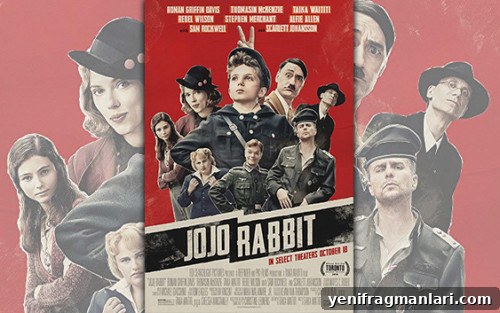

Jojo Rabbit (2019)
Director: Taika Waititi
Screenwriter: Taika Waititi
Starring: Roman Griffin Davis, Thomasin McKenzie, Sam Rockwell, Scarlett Johansson, Taika Waititi, Rebel Wilson, Stephen Merchant, Alfie Allen, Archie Yates
Taika Waititi’s Jojo Rabbit is a daring satirical take on Nazi Germany that manages to blend sharp comedy with genuine emotional weight. Satire in film has long pushed boundaries—from Stanley Kubrick’s Dr. Strangelove to contemporary political comedies—and Waititi’s film follows that tradition by using absurdity and humour to illuminate cruelty, fear and the power of compassion.
The story follows Johannes “Jojo” Betzler (Roman Griffin Davis), a young boy who idolizes Hitler and dreams of becoming a soldier. After refusing to kill a rabbit his nickname becomes “Jojo Rabbit,” a label that underscores his internal conflict between innocence and indoctrination. Jojo lives with his single mother, Rosie (Scarlett Johansson), who secretly shelters Elsa Korr (Thomasin McKenzie), a Jewish teenager hiding in their home. Jojo’s worldview is complicated further by an imaginary version of Adolf Hitler—played by Waititi himself—who serves as the boy’s absurd and misguided conscience. Supporting characters include the bumbling Captain Klenzendorf (Sam Rockwell), the zealous Fräulein Rahm (Rebel Wilson), and Jojo’s sweet friend Yorkie (Archie Yates).
The cast delivers consistently strong performances. Thomasin McKenzie stands out as Elsa, bringing a layered portrayal of resilience and vulnerability that anchors the film’s emotional core. Her performance is quietly powerful, providing a necessary counterbalance to Jojo’s naiveté. Roman Griffin Davis, in the title role, navigates a difficult tonal balance: he makes Jojo sympathetic while showing the character’s growth from blind fanaticism toward empathy. Archie Yates offers memorable charm as Jojo’s friend, contributing sincere moments of levity.
Sam Rockwell provides much of the film’s comic relief as the flawed Captain Klenzendorf, but he also shines in scenes that require emotional depth. Scarlett Johansson is luminous as Rosie, portraying a mother’s fierce love and moral courage in the face of danger. Taika Waititi’s depiction of an imaginary Hitler reduces the figure to comic absurdity, and his performance underscores the film’s approach: exposing hateful ideology through ridicule rather than reverence.
Waititi’s strengths as both writer and director are apparent throughout. The screenplay balances biting satire with heartfelt human drama, and the direction keeps the film visually lively even as it tackles darker themes. The tonal shifts—often from broad comedy to sudden, poignant tragedy—can feel abrupt, but they serve the story’s purpose by refusing to let the audience remain comfortably detached from the historical realities behind the humour.
Technically, Jojo Rabbit is impressive. The soundtrack makes bold choices, reimagining familiar songs in German to create unsettling and memorable contrasts. Production and costume design are meticulously crafted, using a highly stylized colour palette that enhances the film’s emotional arc: bright, saturated hues accompany lighter, more innocent moments, while desaturated, murkier tones mark the film’s descent into darker territory. This careful use of colour, coupled with inventive mise-en-scène, gives the film a distinct visual identity that complements its thematic ambitions.
At its heart, Jojo Rabbit is a film about the corrosive effect of hate and the redemptive power of human connection. It treats its subject matter with an unusual combination of irreverence and tenderness, reminding viewers that satire can be both scathingly funny and deeply humane. The film’s willingness to expose prejudice through laughter, then undercut that laughter with genuine sorrow, makes it a memorable and thought-provoking entry in modern cinema.
While the film’s tonal leaps may divide some viewers, the overall accomplishment is notable: a movie that uses comedy to confront cruelty while ultimately affirming empathy. Jojo Rabbit stands as a bold, emotionally resonant satire that highlights Taika Waititi’s distinct voice as a filmmaker and showcases a cast that elevates the material at every turn.
Score: 20/24
Review by Bradley Weir
You can support Bradley Weir in the following places:
Twitter: @bradderzz98
Blog: Brad Watching Film