
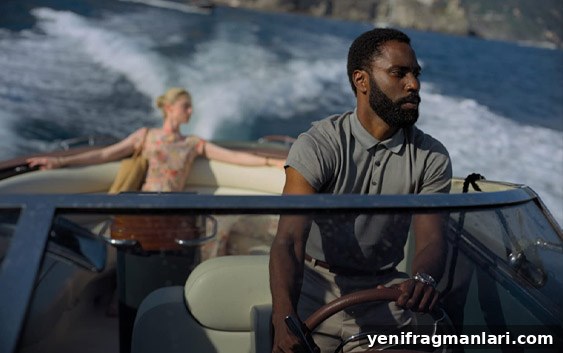

Tenet (2020)
Director: Christopher Nolan
Screenwriter: Christopher Nolan
Starring: John David Washington, Robert Pattinson, Elizabeth Debicki, Kenneth Branagh, Michael Caine, Clémence Poésy, Himesh Patel, Aaron Taylor-Johnson
Time is a central force in Christopher Nolan’s Tenet, a high-concept, time-bending spy thriller that returns the director to large-scale, original filmmaking. Nolan invites audiences back into the cinema with a confident blend of blockbuster spectacle and intellectual daring. The film channels classic globe-trotting espionage in a fresh form while delivering the visceral pleasures of modern action filmmaking: sweeping locations, ambitious stunts, precise cinematography and a propulsive score that together create an immersive theatrical experience.
Nolan has openly described his aim to update the 1960s spy-thriller template—films like James Bond and The Ipcress Files—for contemporary audiences. He keeps the core pleasures of that tradition—the urgency of a mission, the global scale, the stylish execution—while layering in an original science-fiction conceit that reorients how narrative cause and effect operate. At its heart Tenet is a macguffin-driven chase, but the macguffin itself reshapes the rules of the world: actions can fold backward through time in ways that challenge conventional suspense. The result is a thriller that feels both familiar and novel, a film that deliberately goes backward to move forward.
The movie overcomes a deliberately dense, exposition-heavy opening to build momentum into a relentlessly kinetic middle and satisfying climax. For viewers willing to engage with the film’s internal logic rather than demand literal scientific justification at every turn, Tenet offers one of Nolan’s most exciting action sequences and a series of set pieces that rival the best of contemporary blockbuster craft. The blend of practical stunts, location work and effects is often breathtaking, and the picture’s production values underscore Nolan’s intention to make cinema itself part of the story.
Critics and audience members have debated the film’s internal logic and the plausibility of its scientific premises. Those arguments are understandable—Tenet asks you to accept a fictional mechanism that redefines causality—but assessing the film solely on that basis can miss the point. Genre films often demand a degree of surrender: they build rules that serve narrative and emotional needs. Much like longstanding debates over details in other celebrated films, nitpicks about mechanics usually miss the broader purpose of the storytelling. Tenet is best appreciated for how it deploys its premise to generate suspense, character stakes and emotional resonance.
This is not a film for viewers who prefer simplified narratives with every plot point spelled out on-screen. Tenet resembles Nolan’s more speculative work—closer in tone to Interstellar than to the dream-layered puzzles of Inception—in that it asks audiences to trust the internal rules and to ride the experience rather than decode it in real time. For viewers prepared to make that leap, Nolan rewards with repeated thrills, striking action choreography and an emotional core that gains power as the story unfolds.
The film also functions as a showcase for many cinematic crafts. Ludwig Göransson’s score drives urgency and atmosphere, while Hoyte van Hoytema’s cinematography captures the scale and texture of each locale with clarity and intensity. Jennifer Lame’s editing knits together temporal complexity into sequences that remain legible amid the chaos. Performances are anchored by John David Washington’s determined lead and supported by Robert Pattinson’s enigmatic foil; Elizabeth Debicki delivers a quietly powerful turn as the emotional center of the story, portraying a character marked by trauma and resilience.
At 2 hours and 40 minutes, Tenet could be leaner in parts, and more time spent on the film’s emotional through-line might have strengthened some of its quieter beats. Still, Nolan’s control of tone and design means few minutes feel wasted; the film maintains forward momentum and compels repeat viewings to catch missed details and deeper thematic resonances.
Ultimately, Tenet is an ambitious, highly crafted film that blends science fiction, spy thriller and blockbuster spectacle into a distinctive cinematic experience. It rewards viewers who seek both adrenaline and ideas, offering sequences that thrill, moments that surprise and an imaginative premise that lingers after the credits. For fans of high-concept filmmaking and grand, theatrical execution, Tenet is a vivid reminder of how cinema can manipulate time and expectation to generate wonder.
20/24