
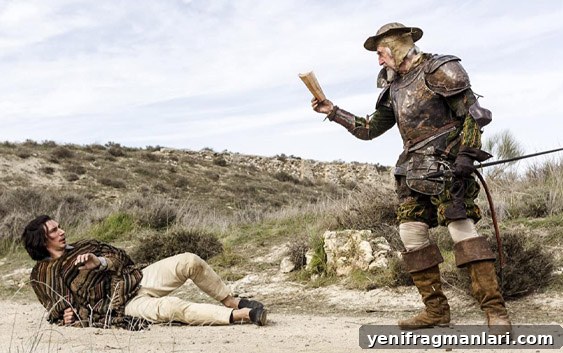
The Man Who Killed Don Quixote (2018)
Director: Terry Gilliam
Screenwriters: Terry Gilliam, Tony Grisoni
Starring: Adam Driver, Jonathan Pryce, Olga Kurylenko, Joana Ribeiro, Stellan Skarsgård, Jordi Mollà, Jason Watkins, Hovik Keuchkerian
Terry Gilliam’s long-gestating passion project, The Man Who Killed Don Quixote, arrived after nearly three decades of false starts, setbacks and a famously failed production chronicled in the documentary Lost in La Mancha. That history has turned the film into an almost mythical item in cinema lore: an auteur’s obsession finally realised. The result is a visually imaginative film that alternates between charm and frustration, and which ultimately struggles to justify the legend that built up around it.
The film follows Toby, a gifted but unstable young filmmaker played by Adam Driver, who returns to a Spanish village where, years earlier, he made a student film featuring an elderly cobbler who believed himself to be Don Quixote. The cobbler — now fully convinced he is Cervantes’ knight — is portrayed by Jonathan Pryce. When Toby and Quixote are thrust back together, their journey collapses the boundaries between fantasy and reality, producing moments of comedy, pathos and visual daring.
Gilliam’s strengths are on full display: the film is frequently striking to look at. Gorgeous Spanish landscapes become a playground for Gilliam’s imagination, and when production design and costumes are given free rein they populate the screen with richly textured, slightly off-kilter detail. There are sequences of real visual invention where Gilliam’s trademark blend of the grotesque and the whimsical creates lasting images.
But the film is not without serious flaws. Having been steeped in the director’s visual sensibility for so long, viewers might expect a fully formed narrative to have been honed over the years. Instead, the screenplay often feels episodic and loosely connected. Scenes accumulate like vignettes rather than building toward a cohesive emotional arc for the principal characters. That fragmentation suits the delusional state of Pryce’s Quixote, but it leaves the surrounding ensemble under-served; motivations for the film’s secondary characters are frequently thin or unclear.
One recurring weakness is the treatment of female characters. Gilliam has occasionally underwritten women in past films, and here the pattern persists. Olga Kurylenko and Joana Ribeiro are capable performers who bring life to their roles, but the script largely confines them to reactive positions — objects of desire or obstacles in the men’s narratives — rather than granting them full interiority or independent agency. The result is frustrating in a film that otherwise explores imagination and identity with empathy.
The movie also contains moments that feel uncomfortably dated in their portrayal of ethnicity and cultural difference. A subplot in which Toby assumes the worst about strangers based on surface cues ends with clarification, but the initial instincts and the way they are presented feel lazy and needlessly cruel at times. These choices read like remnants of an earlier draft of the script and weaken the film’s moral compass.
Performances are uneven but occasionally compelling. Adam Driver brings his usual intensity to Toby, portraying a man whose creative brilliance is shadowed by selfishness and cowardice. Jonathan Pryce delivers the film’s most affecting work, grounding Quixote’s madness in a dignity that can be moving. Supporting players sometimes veer into broadness, a tendency that can feel like an echo of Gilliam’s earlier, more exaggerated comedic instincts.
Despite its issues, the film provides pleasures for those who appreciate Gilliam’s singular voice. The production design, costume work and photography often elevate scenes that otherwise lack structural depth. There are moments of genuine lyricism and outrageously imaginative set pieces that recall the director’s best work, even if they do not cohere into the unassailable masterpiece some fans hoped for.
After such a protracted and mythic production history, The Man Who Killed Don Quixote may fall short of the ultimate expectations placed on it. It is, however, a vivid testament to Gilliam’s persistence and visual inventiveness. The film is devoted to the memory of actors Jean Rochefort and John Hurt, who were once attached to earlier incarnations of the project, and that dedication underscores the emotional weight of a film born from decades of striving.
In the end, this is a visually striking, occasionally moving film that suffers from slack character development and structural inconsistency. It offers rewarding moments for admirers of Gilliam’s aesthetic, but it rarely reaches the level of the director’s most tightly crafted works.
8/24