
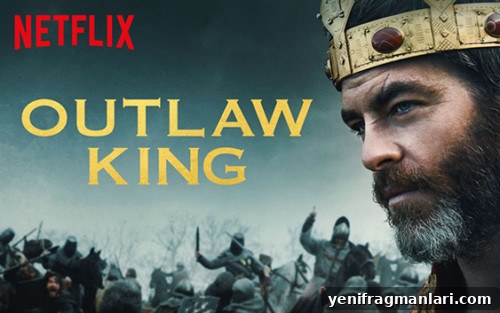
Outlaw King (2018)
Director: David Mackenzie
Screenwriters: Bathsheba Doran, David Mackenzie, James MacInnes
Starring: Chris Pine, Florence Pugh, Aaron Taylor-Johnson, Stephen Dillane, Billy Howle
David Mackenzie, known for films such as Starred Up and Hell or High Water, made his Netflix debut with Outlaw King, a historical epic that follows Robert the Bruce’s struggle against English domination in early 14th-century Scotland. The film draws on familiar elements from popular depictions of the period—most notably the cultural memory of William Wallace—but it sets out to tell a focused story about leadership, honor, and the costs of resistance.
Outlaw King opens in the immediate aftermath of William Wallace’s capture, using that event to establish the political and emotional landscape in which Robert the Bruce must act. Rather than replicating a broad, myth-making sweep, Mackenzie’s approach leans toward a slower, tension-driven unfolding. The film builds suspense steadily, allowing violence and conflict to function as a background current that intensifies as the story progresses.
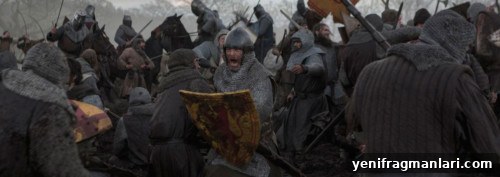
The picture employs many of the conventional trappings of historical epics—large-scale battles, period costumes, expansive landscapes and carefully constructed sets—but those elements serve a restrained, character-focused narrative. At its core, Outlaw King is the study of a man forced into a decisive stand when compromise is no longer possible. That personal center is what differentiates this film from a crowd-driven spectacle and gives it an intimate moral weight.
The screenplay occasionally feels uneven. Some subplots and side characters receive limited development, which can make certain incidents—violent deaths or brief vignettes—seem more like historical touches than fully integrated narrative beats. This unevenness concentrates attention on Robert the Bruce himself, which benefits the film when the lead character is compelling but leaves less room for other figures to resonate.
Chris Pine takes on the role of Robert the Bruce and is given space to shape the character’s arc. Pine adapts his performance to the period, adopting a Scottish accent that generally serves the film without calling attention to itself. He shares a notable chemistry with Florence Pugh’s Elizabeth, and the relationship scenes add human warmth amid the film’s darker sequences. Pine’s performance often emphasizes restraint and emotional subtlety rather than explosive fury, which suits parts of the narrative while at times making the character’s inner torment feel slightly underplayed.
One recurring issue is tonal inconsistency. Outlaw King aims for a serious, harsh portrait of medieval conflict, yet it occasionally slips into moments that undercut that sobriety — brief comic touches or scenes that feel like fan service rather than narrative necessity. These choices can disrupt immersion and diminish the impact of the film’s more brutal or tragic moments. Still, when the film commits to its darker impulses, it delivers a visceral sense of danger and consequence.
Visually, Outlaw King is exceptional. Cinematographer Barry Ackroyd—whose work is associated with directors such as Paul Greengrass and Kathryn Bigelow—lends the film a cinematic sweep that often recalls a Western in scale and composition. Long, immersive takes and well-composed landscape shots give the wartime sequences a lived-in authenticity. The camera frequently lingers to capture the spatial and emotional stakes of scenes, and those choices enhance the film’s epic intent while grounding it in tangible reality.
The score, composed by Jim Sutherland and Tony Doogan, complements the film’s visual language. Rather than opting for bombastic, overtly patriotic themes, the music leans into darker textures and restraint, supporting the film’s somber tone and emphasizing tension over triumphalism. The soundtrack reinforces the film’s mood and works well alongside Ackroyd’s cinematography to create a fully realized period atmosphere.
Outlaw King does not reach the iconic heights of some of the genre’s most celebrated titles, but it stakes a solid claim as a memorable historical drama. It is compelling in its visual ambition and effective in depicting the brutality and moral complexity of war. Fans of slow-burning, character-driven period pieces will find much to appreciate, while viewers expecting a more conventional, fast-paced epic may feel alienated by the film’s deliberate rhythm and occasional tonal lapses.
Ultimately, Outlaw King is a worthy addition to the modern historical epic: flawed, ambitious, and visually impressive. It demonstrates Netflix’s willingness to invest in large-scale filmmaking that relies less on CGI spectacle and more on location-based cinematography and practical production design. For those who value atmospheric storytelling and a grounded portrayal of medieval struggle, the film offers a rewarding, if imperfect, experience.
17/24