
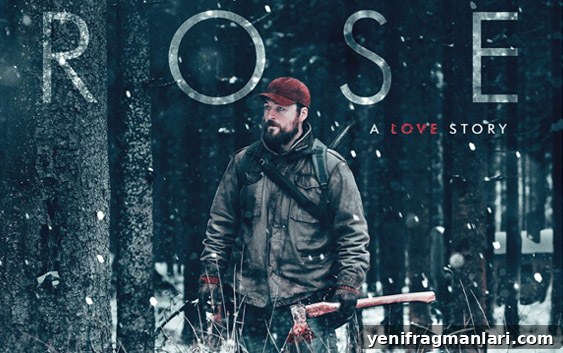
Rose: A Love Story (2020)
Director: Jennifer Sheridan
Screenwriter: Matt Stokoe
Starring: Sophie Rundle, Matt Stokoe, Olive Gray
Rose (Sophie Rundle, known from Peaky Blinders) and her husband Sam (Matt Stokoe) live a deliberately isolated life in a remote cabin on the windswept moors of northern England. Rose is confined by a chronic illness that prevents her from leaving their home, so she spends her days writing a novel she hopes will one day be published. Sam leaves each day to hunt and gather the supplies that keep them alive, a routine born of both necessity and an instinct to protect the life they have built together.
Their fragile equilibrium is upset when a scheduled petrol delivery fails to arrive. The absence of that routine supply reveals Sam’s simmering anger and deep anxiety about their vulnerability. A tense scene in an empty, dimly lit pub makes clear the ever-present danger Sam imagines—someone may know where they are hiding. That fear shapes his reactions and the decisions he makes when strangers encroach on their world.
When they find Amber (Olive Gray) trapped in one of Sam’s rodent snares, they take her in, offering food, shelter and a glimpse of their secluded life. Amber’s arrival alters the couple’s private ecosystem: her presence challenges Sam’s suspicion and forces both him and Rose to confront the risks of extending trust beyond their two-person unit. The way the film handles Amber’s introduction and the consequences that follow underscores how fragile safety can be when it depends on secrecy and isolation.
At its heart, Rose: A Love Story is a portrait of devotion. The relationship between Rose and Sam is both tender and haunting. Their connection reads as authentic on screen, aided by the real-life partnership between the two lead actors, which lends an intimacy and immediacy to their performances. Matt Stokoe’s script captures an obsessive protective instinct and a willingness to go to extraordinary lengths to shield a loved one, while Sophie Rundle brings a quiet, dignified resilience to Rose that anchors the film’s emotional center.
The film’s tone is carefully calibrated—part psychological drama, part quiet thriller. Jennifer Sheridan’s direction uses silence as a strategic tool: the film often strips away musical scoring, letting ambient sound and the actors’ performances build tension. Those moments without music intensify the viewer’s focus and create a patient, uneasy atmosphere. Visually, the cinematography leans into contrasts: the stark whites of snow and the vivid reds of blood become striking visual elements, contributing to a sense that Sam and Rose inhabit a world removed from ordinary life.
Indoor scenes are frequently shot in low light, where darkness swallows the frame and reflects the pared-back, survivalist nature of the couple’s existence. The landscape sequences, by contrast, are expansive and hauntingly beautiful, emphasizing both the isolation and the harsh, elemental environment that defines their daily reality. These visual choices help to make the film feel simultaneously brutal and lyrical, a story about love tested by extreme circumstances.
Although Rose is not a conventional horror film, it borrows several techniques from the genre—careful sound design, deliberate pacing and an escalating sense of dread—to sustain suspense throughout. As Jennifer Sheridan’s debut feature, the film displays a confident directorial hand, attentive to small details that enhance character and mood. The result is a compact, affecting drama that sits comfortably alongside recent British thrillers for its restraint and emotional intensity.
The performances are a major strength: Rundle and Stokoe convey a believable, complex bond, and Olive Gray’s Amber introduces a disruptive but compelling energy that shifts the film’s dynamics. Matt Stokoe’s screenplay balances ambiguity with clarity, leaving certain questions unresolved while making the emotional stakes abundantly clear. This ambiguity is part of the film’s power—it keeps viewers engaged and guessing without resorting to sensationalism.
Overall, Rose: A Love Story is a quietly powerful film that combines strong performances, careful direction and evocative visuals to tell an intimate story about devotion, vulnerability and the extremes of protection. Its eerie, ambiguous atmosphere and measured storytelling make it a memorable debut for its director and a worthwhile watch for audiences who appreciate character-driven, suspenseful cinema.
17/24