
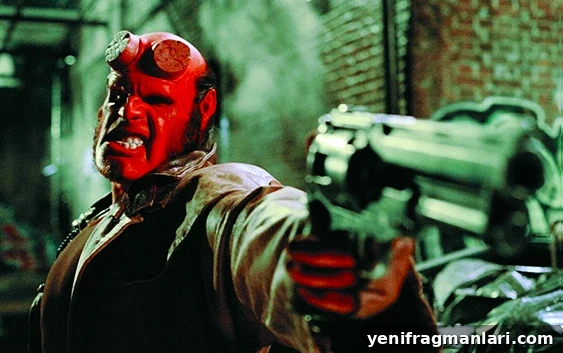

Hellboy (2004)
Director: Guillermo del Toro
Screenwriter: Guillermo del Toro
Starring: Ron Perlman, Selma Blair, Doug Jones, John Hurt, Rupert Evans, Karel Roden, Jeffrey Tambor, Brian Steele, Ladislav Beran, Biddy Hodson, Corey Johnson, Kevin Trainor
Guillermo del Toro’s 2004 adaptation of Mike Mignola’s Hellboy arrived after a varied period in the director’s career. Having established himself with original Spanish-language films such as Cronos and The Devil’s Backbone, and then directing studio features like Mimic and Blade II, del Toro chose to bring one of his favorite comic-book creations to the screen. Hellboy’s blend of Gothic atmosphere, folklore, and Lovecraftian menace presented a distinct challenge: how to translate Mignola’s shadowy, mythic aesthetic into a mainstream feature without losing its soul. In del Toro he found a filmmaker uniquely suited to the task.
The film opens during the final months of World War II, when a team of American soldiers and paranormal researcher Professor Trevor Bruttenholm thwart a Nazi ritual meant to open a gateway to otherworldly power. Through the portal comes a demon child, whom Bruttenholm adopts and raises as his own. Sixty years later, the grown Hellboy serves the Bureau for Paranormal Research and Defense (B.P.R.D.), carrying out missions that blend detective work and supernatural combat. The central conflict pits Hellboy and his allies against a resurrected Grigori Rasputin, who seeks to unleash ancient, world-ending entities.
“There are things that go bump in the night… and we are the ones who bump back!”
John Hurt’s Professor Bruttenholm functions as the warm, explanatory voice that eases audiences into del Toro’s dark, whimsical world. Hurt, playing a character older than his years, lends an affectionate gravitas that anchors Hellboy’s mythic origins. Rupert Evans portrays FBI agent John Myers, a conventional point-of-view character whose outsider status helps viewers discover the B.P.R.D. and its unusual inhabitants. Ron Perlman, a dependable presence in del Toro’s films, finds range in Hellboy’s balance of gruffness and vulnerability, inhabiting the role with charisma and pathos. The supporting cast supplies a parade of memorable, pulp-inflected antagonists and monstrous allies that give the film its distinct tonal flavor.
Visually, Hellboy benefits greatly from the collaboration between del Toro and cinematographer Guillermo Navarro. The film’s photography—especially the stormy, ritualistic opening and several set-piece confrontations—combines moody lighting with dynamic composition to create sequences that are both cinematic and dreamlike. Production design plays a crucial role; sets and practical creature effects have a tactile, handcrafted quality that amplifies the film’s eerie charm. In an era increasingly dominated by fully digital effects, Hellboy stands out for how much it relies on practical techniques to achieve a grounded, textural look.
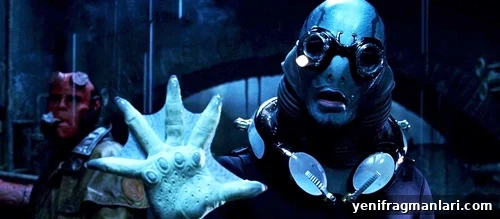
Del Toro’s affection for monsters is evident throughout. From Hellboy himself to Abe Sapien, the amphibious empath played by Doug Jones, and the pyrokinetic Liz Sherman, played by Selma Blair, del Toro stages each creature with sensitivity and imagination. Even the film’s darker creations—the Nazi assassin Kroenen, a psychotic figure with clockwork precision—are rendered with a designer’s eye for detail. The result is a gallery of beings that feel lived-in and sympathetic rather than merely antagonistic.
Amid the monstrous spectacle, del Toro reveals a romantic sensibility. Hellboy, despite his demonic origins and imposing appearance, often behaves like an awkward, lovesick adolescent. A memorable scene where he receives blunt relationship advice from a child on a rooftop underscores the film’s blend of humor, tenderness, and melancholy. As Mignola noted about del Toro’s interpretation, this Hellboy retains a boyish emotional core; apocalypse or no, much of the story’s heart stems from simple, human struggles: communicating with a parental figure or confessing feelings to a lover.
Marco Beltrami’s score contributes substantially to the film’s atmosphere. Moody and propulsive, the music supports the film’s darker moments while giving Hellboy a distinctive sonic identity. Had the film reached a wider mainstream audience, the theme might have become as iconic as other franchise motifs, although del Toro would later hand the musical reins to another composer for the sequel.
Structurally, Hellboy adheres to the familiar origin-story template: setup, initiation into the world, and a sequence of escalating confrontations culminating in a major showdown. Yet del Toro leans into horror and suspense more than genre spectacle, giving the film memorable set pieces—Abe’s underwater search that turns into a desperate escape, and the eerie revival scenes in the morgue among them. These moments underline the director’s strength: blending genre elements to produce scenes that linger in the memory.
One of the film’s virtues is its reliance on practical effects. Animatronics, makeup, prosthetics, and wirework dominate, with CGI used sparingly to enhance rather than replace physical craftsmanship. While some effects now show their age compared to modern standards, the commitment to tangible creatures gives Hellboy a tactile authenticity often missing from contemporary comic-book films. The decision to shoot primarily in Eastern Europe, particularly Prague, offered atmospheric locations but occasionally drew criticism for not always convincingly standing in for New York.
In the context of Guillermo del Toro’s filmography, Hellboy may be a mid-tier work, but it still outshines many comic-book adaptations through imagination and craftsmanship. It performed modestly at the box office and may have been too idiosyncratic for mainstream superhero audiences, yet it provided a successful foundation for a sequel and helped solidify del Toro’s position as Hollywood’s go-to genre auteur. Fans of mythology and monsters will find much to admire in del Toro’s interpretation of Mike Mignola’s world: a richly designed, emotionally resonant film that balances spectacle with heart.
Score: 18/24
Rating: ⭐ ⭐ ⭐
Rating: 3 out of 5.