
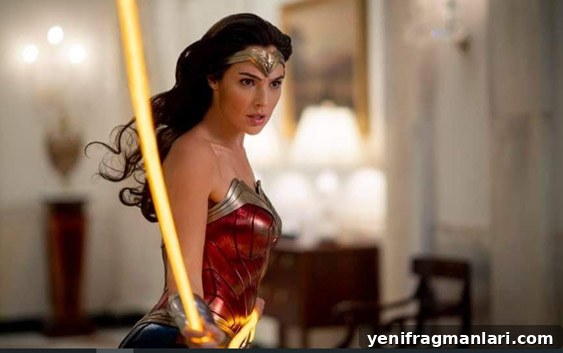
Wonder Woman 1984 (2020)
Director: Patty Jenkins
Screenwriters: Patty Jenkins, Geoff Johns, Dave Callaham
Starring: Gal Gadot, Chris Pine, Kristen Wiig, Pedro Pascal
When Patty Jenkins’ Wonder Woman arrived in 2017 it felt like a turning point: a major studio superhero film centered on a woman and made by a woman, one that embraced the character’s feminist roots while proving that a comic-book blockbuster could succeed without sidelining gender. That debut raised expectations for a follow-up, and Wonder Woman 1984 arrives determined to expand Diana’s world—both in scale and emotional stakes—but with mixed results.
The sequel throws Diana Prince into the flashy, high-energy world of the 1980s. Jenkins leans into the era’s neon palette, big hair and shoulder pads, setting much of the action in Washington, D.C., where Diana now works as an archaeologist at the Smithsonian. The film opens with two distinct, effective set-pieces that promise something bolder: a young Diana competing in a majestic athletic tournament on Themyscira, where we see her taste defeat for the first time; and a contemporary caper in an eighties-style mall, where Diana foils a jewelry heist while trying to protect her civilian identity. Those early scenes suggest a filmmaker willing to loosen the reins and let Diana move through larger, more playful spaces.
Back in the United States, Diana is no longer simply a warrior—she’s someone who feels loneliness and longs for deeper human connection. That emotional thread brings her to Barbara Minerva, a socially awkward coworker played by Kristen Wiig, who seeks Diana’s help with an ancient relic said to grant wishes. The relic’s promise draws the ambitious Maxwell Lord, a charismatic but desperate businessman played by Pedro Pascal. He has spent years chasing the relic’s myth and believes he understands its rules; Barbara and Diana, by contrast, are unprepared for the cost that wishing entails.
Barbara’s arc is one of envy and yearning: humiliated and insecure, she wishes to be more like Diana, unaware of the price attached to that transformation. Diana, meanwhile, is given her heart’s desire when Steve Trevor (Chris Pine) inexplicably returns, alive and very much a man out of time. Steve’s reappearance allows for tender moments and strong chemistry between Gadot and Pine, but it also complicates Diana’s growth by anchoring her emotional journey in a romance that admittedly stretches plausibility. Themyscira, Diana’s mother and sister Amazons, and other formative elements from her past receive little attention here, which makes parts of Diana’s motivation feel undernourished.
Patty Jenkins and co-writers Geoff Johns and Dave Callaham aim for a story with moral weight: the film centers on the consequences of desire and the perils of greed. The plot echoes the old cautionary tale of wishes gone wrong—think “be careful what you wish for”—and stretches that premise to global proportions. That choice gives the movie ambition, but it also forces the writers to juggle several large ideas at once. With Maxwell Lord’s escalating schemes and Barbara’s transformation into a dangerous force, Diana sometimes recedes from the center of her own film. Pedro Pascal nails the role of the charismatic, power-obsessed antagonist and often dominates scenes, while Wiig delivers a surprising, high-energy turn as Barbara that taps into insecurity, sexuality and menace.
There are pleasures here: the film’s period detail and costume design capture the decade’s exuberance, and some set pieces—especially early on—are lively and inventive. Chris Pine’s fish-out-of-water reactions to 1980s culture supply easy laughs, and Gadot remains a commanding presence in action and quieter emotional beats. Yet the screenplay repeatedly leans on familiar tropes and predictable beats. The central “wish” device has been used many times before, and Jenkins doesn’t always find a fresh angle for it, which makes the moral at the film’s core feel familiar rather than revelatory.
Worse, the story strains credulity in places and relies on overused CGI spectacle during its later sequences, which undermines emotional payoff. A disconnected Egyptian subplot reduces some characters to one-dimensional roles, and certain decisions—such as the portrayal of regional characters and the film’s geopolitical implications—are clumsy and ill-considered. These missteps combine with a mismatched tonal palette to weaken the film’s overall impact.
The finale shifts to earnestness, with Diana appealing directly to the audience’s better nature in a plea for kindness and selflessness. It’s sincere but awkward, and the sentiment never quite integrates smoothly with the film’s earlier comic-book bravado. Ultimately, Wonder Woman 1984 is an ambitious, occasionally joyous film that struggles to balance its ideas. Strong performances—especially from Pascal and Wiig—and memorable moments can’t entirely compensate for narrative clutter and inconsistent tone. The result is a mixed sequel that aims high but doesn’t always land.
10/24