
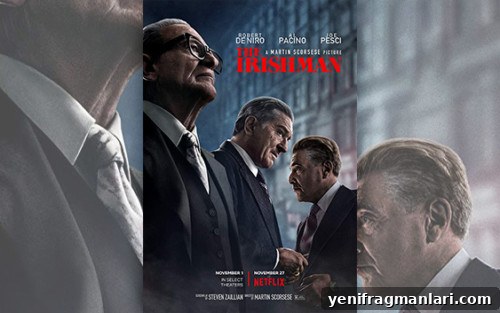

The Irishman (2019)
Director: Martin Scorsese
Screenwriter: Steven Zaillian
Starring: Robert De Niro, Joe Pesci, Al Pacino, Stephen Graham, Anna Paquin, Ray Romano, Jesse Plemons, Harvey Keitel, Bobby Cannavale, Jack Huston
Martin Scorsese’s The Irishman arrives as a sweeping, reflective entry in his long-running engagement with the American gangster film. Adapted from Charles Brandt’s book I Heard You Paint Houses, the film unfolds as a vast, decades-spanning narrative that balances intimate portraiture with broad historical commentary. With a runtime that allows the story to breathe, Scorsese guides an intricate plot through clear, purposeful direction, producing one of the most memorable American films of 2019.
Scorsese returns to a genre he helped redefine, following in the footsteps of his earlier classics such as Mean Streets, Goodfellas and The Departed. The Irishman functions as both a formal revisitation and a personal reflection: it reunites Scorsese with longtime collaborators Robert De Niro and Joe Pesci while also featuring a powerful supporting turn from Al Pacino. The film reads like a late-career statement — a farewell of sorts — to the people and themes that have shaped Scorsese’s cinema.
Unlike grand, thematic scores that defined other crime epics, The Irishman relies on a subtler musical approach; yet it shares with films like Once Upon a Time in America an expansive, time-hopping ambition. Scorsese structures the story around three major phases of Frank Sheeran’s (De Niro) life, using flashbacks and time shifts to unravel a career in organized crime alongside the larger tapestry of mid-20th-century America. Along the way the film touches on momentous events, including the public controversies surrounding Jimmy Hoffa, and invites reflection on power, loyalty and the costs of violence.
At its core, The Irishman is less an action-packed gangster saga than a meditation on aging, memory and regret. Scorsese presents a tone of quiet dread and elegy: life’s details recede, relationships fray, and old decisions demand accounting. The film insists on the human consequences of a violent life, not by glorifying criminality but by examining its emotional and existential toll. In that sense it belongs to a small group of films that use the conventions of genre to explore universal questions about time and mortality.
A major talking point at the time of release was the film’s extensive use of digital de-aging. Rather than casting younger actors for earlier periods, Scorsese chose to digitally adjust the faces of his principal cast to span decades, preserving the actors’ performances and chemistry. The process can initially feel uncanny — especially in reflections and in the eyes — but rapidly settles into the film’s texture. When successful, the visual work becomes invisible, allowing the audience to remain focused on character and performance. Several sequences demonstrate sophisticated digital artistry; used thoughtfully here, the technique supports the film’s themes of memory and identity.
Robert De Niro anchors the film as its narrator and moral center, delivering a measured, interior performance that absorbs the viewer. Joe Pesci, returning to a Scorsese set after many years, brings the same simmering intensity that made his earlier collaborations so memorable. Al Pacino’s role is smaller but significant, offering moments of theatrical bravado balanced by surprising subtlety. Together they form a formidable trio whose performances justify the film’s long runtime and invite repeated viewings.
On a production level, The Irishman is ambitious: reportedly built on a substantial budget and supported by Netflix, the film represents a major studio-level investment in artful, auteur-driven cinema. That scale allows Scorsese to realize his careful pacing and detailed period recreation without compromise. The result is a film that feels both cinematic and intimate — a rare combination in contemporary mainstream cinema.
Ultimately, The Irishman stands as a milestone in Scorsese’s career and a powerful example of what the gangster genre can achieve when used as a vehicle for reflection rather than spectacle. It is a film about the erosion of time, the erosion of memory, and the quiet consequences of a life lived at the margins of the law. For viewers drawn to character-driven storytelling and thoughtful filmmaking, The Irishman delivers a richly textured, emotionally resonant experience.
21/24