
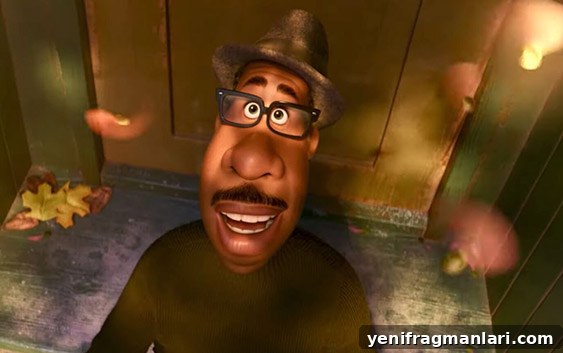
Spoiler Warning: This article discusses the ending of Soul. Continue only if you’ve already seen the film.
For decades Pixar Animation Studios has earned praise for making films that tackle large, philosophical themes with a simplicity that works for children while resonating deeply with adults. Pete Docter’s Soul takes that ambition further, delivering the studio’s most contemplative and challenging picture to date. Rather than crafting a lesson aimed primarily at kids, Soul speaks directly to grown-ups—inviting viewers to reconsider what gives life meaning.
We meet Joe Gardner, a passionate middle-school band teacher whose life orbits around one clear goal: becoming a professional jazz pianist. When Joe receives a call that finally offers him a chance to play with Dorothea Williams’s jazz quartet, his excitement is palpable. But once the opportunity is confirmed, Joe’s focus tightens so intensely that he ignores the world around him—and nearly pays for it. After a string of close calls, he accidentally falls into a manhole and faces the Great Beyond: a conveyor belt shrouded in white light that leads into oblivion.
In the Great Beyond and the adjacent Great Before, Joe encounters other souls and the bureaucracy of the afterlife. Unwilling to accept his fate, he steals a mentor badge and tries to sneak back to Earth using another soul’s “Earth Pass.” That mentee, a soul named 22, resists being sent to life on Earth. 22 is cynical, unsure she can ever find her “spark,” while Joe is certain his spark is playing piano. He believes reclaiming his life and his dream is the only way to be fulfilled.
But Joe’s attempts to return force both characters into an unexpected exchange. A mishap leaves Joe trapped in the body of a therapy cat while 22 inhabits Joe’s human body. This body-swap sequence supplies the film’s humor, but it also provides the emotional engine. Experiencing life firsthand, 22 discovers wonder in everyday details: the taste of pizza, the rhythm of a subway musician, a conversation in a barbershop, and the simple beauty of a fallen leaf. Unjaded by disappointment or unfulfilled ambitions, 22 is open to small miracles that Joe has long overlooked.
Through 22’s newfound curiosity, Joe begins to see how small changes in attention and behavior reshape relationships and expand perspective—how being present can deepen one’s connection to others. He notices the humanity of his barber, the potential in a student, and, in a quiet act of courage, he reaches out to his mother in a new way.
In the film’s pivotal third act, Joe finally gets what he thought he wanted: the chance to perform with Dorothea Williams’s quartet. He plays brilliantly and is offered a permanent spot. Yet after the performance he confesses to Dorothea that, despite waiting his whole life for this moment, it didn’t make him feel transformed. Dorothea replies with a simple story about a young fish searching for the ocean, suggesting that Joe has been living inside what he sought without recognizing it.
Back in his apartment, Joe finds the small objects 22 collected while inhabiting his life—a pizza crust, a spool of thread, a lollipop, a leaf. These ordinary items become profound reminders of life’s small joys. With a widened perspective, Joe returns to the Great Beyond to rescue 22 from becoming a lost soul. He reminds her of those tiny miracles and, uniquely, manages to restore her spark. For this act of empathy and growth, Joe is given another chance at life.
The film intentionally stops short of showing exactly how Joe lives after his epiphany or what becomes of 22 once she reaches Earth. By leaving those details open, Soul mirrors real life: we rarely know precisely how learning will change our daily routines. What the film makes clear is that Joe now understands how he wants to live—more aware, curious, and present—and that living this way is a daily choice. His final line, “I’m going to live every minute of it,” serves as both a personal vow and an invitation to viewers.
Soul pushes viewers to separate the idea of a “spark” from the idea of a life’s “purpose.” The film defines a spark as that deep inspiration or attraction—the thing that lights us up—whereas purpose refers to how we choose to live once we’re here. Passion alone does not exhaustively define who we are; instead, having passion and allowing curiosity, compassion, and presence to shape our days may be the truer measure of purpose.
The film’s openness produces varied responses. Some viewers find the ambiguity frustrating; others find it liberating. To explore how the film’s ending resonates differently with people, I asked several acquaintances to finish the sentence, “Soul says the purpose of life is…” Their answers included:
“…to live and bask in the moment.”
“…to find joy and fulfillment in a variety of experiences.”p>
“…just to enjoy life.”
“…simply to exist and enjoy the time you were graced with, rather than wasting life searching for your purpose.”
“…to live life to the fullest!!!”
“…to live with unapologetic curiosity.”p>
“…to be compassionate and find passions that can help us create meaning and connection in the short time we have.”
“…to live every day knowing your passion is not your purpose.”
Those responses underline a key strength of Soul: its ambiguity invites each viewer to take away a version of the lesson most relevant to them. Whether the takeaway is “bask in the moment,” “be unapologetically curious,” or “recognize that passion isn’t the same as purpose,” the film nudges us toward paying attention to life’s small wonders and integrating that attention into how we live.
The film offers comfort for those who feel uncertain about belonging or worth: your spark isn’t your entire purpose, and it doesn’t have to be fully formed before you live. Our existence here is a signal that we were ready for life—however imperfectly—and that spark remains inside us. Soul’s final challenge is simple and pressing: decide, each day, to notice the ocean you’re already in.
Written by Peter Charney
You can support Peter Charney in the following places:
Twitter – @PCharnz
Instagram – @PCharnz
Website – petercharney.com