

The Dig (2021)
Director: Simon Stone
Screenwriters: Moira Buffini, John Preston
Starring: Ralph Fiennes, Carey Mulligan, Lily James, Johnny Flynn, Ken Stott, Ben Chaplin, Monica Dolan
With so much recent time for reflection, many people have been reconsidering their actions, relationships and the legacies they will leave behind. Simon Stone’s 2021 Netflix film The Dig taps directly into those concerns. Set on the eve of World War II, this British period drama—based on real events—becomes less about sensational discovery and more about mortality, memory and the small, human acts that shape how we are remembered.
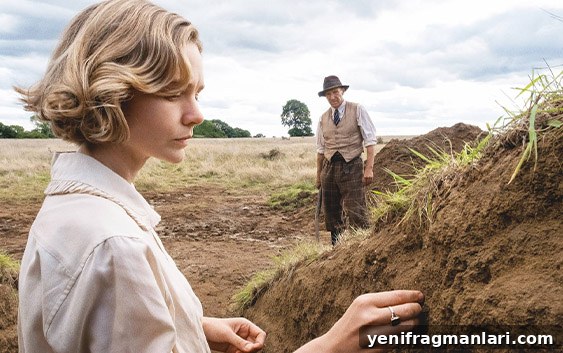
Ralph Fiennes and Carey Mulligan lead an ensemble cast that includes Lily James and Johnny Flynn. Fiennes plays Basil Brown, a self-taught excavator working on unusual mounds found on land owned by Mulligan’s character, Edith Pretty. The film centers on the relationship between these two: a quiet, mutual respect that grows without much fanfare but carries the weight of two people who recognize the importance of each other’s contributions. Their bond becomes the emotional core of the story as the excavation yields findings that speak to a far larger past than either character initially imagines.
Fiennes delivers a restrained, carefully observed performance. His physicality—an arched neck, slightly hunched shoulders and a measured, pendulum-like stride—creates the illusion of a man shaped by long years of labor and by a deep connection to the land. He speaks with a soft Suffolk cadence that reinforces the humility and patience of his character. Small gestures—a clenched jaw, the lighting of a pipe, spitting on the ground—are treated as meaningful acts rather than mere affectation, grounded in the character’s relationship with the earth he studies.
The film treats death and legacy as central themes: from the act of unearthing, to the looming war, to the personal illnesses and anxieties the characters face. Yet Stone resists turning this into a bleak or anxiety-driven picture. Instead, The Dig celebrates life and the human impulse to preserve and honor the past. Cinematographer Mike Eley favors wide lenses and natural light, often embracing golden hour backlight and sun flares to highlight beauty in ordinary moments—a bike ride down a gravel path, a walk across fields, the long sweep of a Suffolk sky. The look is contemplative and occasionally echoes the visual language of existential filmmakers, but the film remains grounded in articulated, intimate dialogue rather than abstract voiceover.
Editing choices emphasize continuity between words and images: conversations flow into subsequent shots, which subtly suggests how our words and actions ripple beyond the moment. That formal decision supports the film’s thematic insistence that small, deliberate acts can leave enduring marks on a community and on history.
The Dig also raises questions about recognition and who gets credit for discoveries. In the film, major archaeological finds are often connected to women—either in direction or discovery—suggesting that women’s contributions to history are only beginning to be acknowledged. That is an important motif, but the film does not fully interrogate the broader historical silence that has buried many women’s achievements. While Edith Pretty is central to initiating the excavation, the narrative still orients much of its emotional weight around Basil Brown, and the film sometimes feels reluctant to challenge the traditional, male-centered view of legacy more forcefully. The result is moments of insight about women’s place in history that nevertheless stop short of a sustained critique.
The Dig asks a direct question at one point: if a thousand years were to vanish in an instant, what would remain of us? If the film itself were our sole surviving record, it proposes an answer focused on small, meaningful human connections—a shared appreciation for everyday beauty and the love we offer one another. It is not an epic excavation of history’s largest mysteries, nor does it dig radically beneath the conventions of the “based on true events” period drama. But its gentle melancholia, thoughtful performances and philosophical leanings make it a satisfying, reflective watch—especially on a quiet afternoon.
15/24