
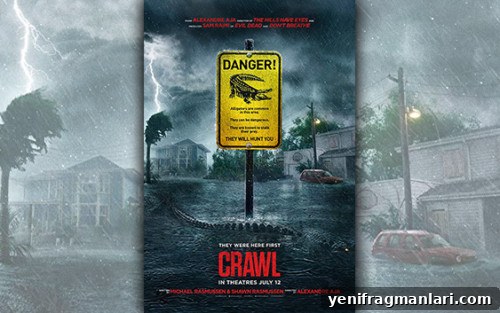
Crawl (2019)
Director: Alexandre Aja
Screenwriters: Michael Rasmussen, Shawn Rasmussen
Starring: Kaya Scodelario, Barry Pepper
Horror films often promise suspense but deliver predictable jolts. Many lean on ghostly tropes—doors creaking, sudden noises, and musical stings—rather than building genuine dread. They may frighten the characters on screen, but viewers who don’t believe in the supernatural are frequently left unshaken. Even modern creature features can feel closer to action blockbusters than true horror; I recently found Godzilla: King of the Monsters more spectacle than sustained fear. Crawl (2019), directed by Alexandre Aja, manages to buck that trend in important ways.
Based on the trailers, which leaned into Sam Raimi’s involvement, I expected Crawl to be a silly mash-up of disaster movie clichés and monster movie set-pieces. The premise sounds simple—an adult daughter and her father trapped in a house during a category 5 hurricane, forced to survive against marauding alligators—and some trailer moments do look over-the-top, such as the scene where a gator is coaxed into a bathtub. Still, the finished film delivers genuine tension despite weak dialogue, occasional logical stretches, and a deliberately spare narrative.
Aja’s direction and the cinematography are the film’s greatest strengths. Unlike much of the modern horror landscape, which relies on sudden loud noises to trigger a scare, Crawl uses framing, light, and space to create dread. The production makes the most of a primary location that is at once expansive and claustrophobic: a house with a network of crawl spaces, flooded rooms, and dark nooks. The camera privileges the unknown—what might be lurking under a floorboard, behind a door, or in the murky water—so that even when the film telegraphs an upcoming scare, the payoff still lands hard. Moments of reveal and concealment are handled with real craft, and the editing keeps the tension taut through several extended sequences.
Another notable achievement is how the direction elevates the performances. The characters are sketched thinly on the page—their most developed trait is a strained father-daughter relationship—so the actors must do much of the heavy lifting during physical, stressful scenes. Kaya Scodelario and Barry Pepper commit fully to the film’s demands: they sell exhaustion, panic, and the visceral physical toll of fighting for survival in rising water. The dialogue often drifts into cliché and backstory chatter, but both leads bring authenticity to their reactions, making it easy to empathize when the danger becomes immediate.
That said, Crawl asks viewers to accept several implausible moments. The film opens with Scodelario’s character as a college swimmer, and the story treats that detail as dramatically meaningful. But the notion that a swimmer can reliably outrun an alligator is a stretch. The movie even insists repeatedly that the protagonist is faster than the animals hunting her, which strains credibility. The hurricane setup also strains plausibility: the storm is portrayed as immense and enveloping, yet the evacuation choices and timing feel inconsistent. These contrivances hitch the momentum at points, pulling attention away from the more effective elements of suspense and practical horror.
Structurally, the film doesn’t try to be more than a compact, lean thriller. At roughly one hour and twenty-seven minutes, it avoids filler and keeps the pace brisk. That economy works in its favor—when the film aims to be tense, it often succeeds—but it also leaves little room for deeper character development or exploration of thematic material. If you’re looking for complex motivations or an emotional arc beyond survival and reconciliation, Crawl won’t satisfy. If your priority is a taut, atmospheric creature feature, it delivers.
Where Crawl truly earns its scares is in the staging of its set pieces. The film stages close-quarters conflict with an eye for the terrifying possibilities of the environment: water that hides predators, narrow passages that limit movement, and sudden, brutal encounters that leave both characters and viewers gasping. The production design and sound design work together to create an immersive, oppressive atmosphere that keeps you on edge.
In short, Crawl is not a flawless movie, but it is an effective one in the key ways that matter for a horror-thriller. Strong direction and committed performances overcome a thin script and some implausible details. If you’re sensitive to claustrophobia or have an aversion to alligators, the film will likely be especially unsettling. For fans of compact, well-executed creature horror, Crawl is worth watching.
13/24