
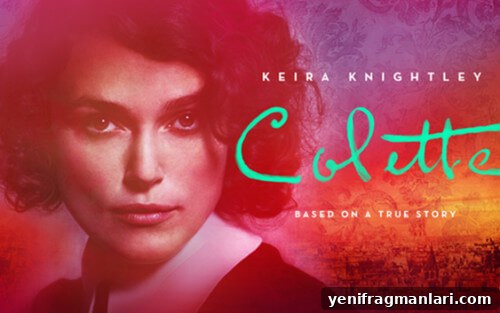
Colette (2019)
Director: Wash Westmoreland
Screenwriters: Richard Glatzer, Rebecca D. Lenkiewicz, Wash Westmoreland
Starring: Keira Knightley, Dominic West, Fiona Shaw, Robert Pugh, Sloan Thompson, Arabella Weir, Mate Haumann, Ray Panthaki, Al Weaver, Dickie Beau
Wash Westmoreland, the director of Still Alice, approaches the late 19th and early 20th-century world of the French novelist Colette in this restrained period drama. The film centers on the writer who, historically, fought to reclaim her work and voice after being eclipsed by her husband. While the movie aims to examine sexism in the literary and media industries, as well as gender and sexual politics, its formal choices sometimes blunt the emotional force of Colette’s story.
Keira Knightley delivers a lively, committed performance as Colette. She inhabits the character’s wit, curiosity and restless energy, giving the film its most magnetic moments. Dominic West plays the popularizing husband with swagger and self-interest, attempting to balance charm and callousness as the man who benefits from Colette’s creations. Fiona Shaw and the supporting cast add texture to the ensemble, but the screenplay’s focus on chronological events rather than inner transformation limits how much these performances can develop dramatic momentum.
One of the film’s recurring problems is its reliance on reportage over exploration. Scenes unfold in a careful, often literal sequence—this happened, then that happened—without always probing why characters act as they do or what drives their choices. For viewers hoping for a deeper psychological portrait of Colette, the film can feel episodic: it records victories and humiliations but rarely invites us to inhabit the emotional shifts that link them. As a result, some pivotal developments arrive more because history dictates them than because the narrative has earned them through character growth.
That said, the movie succeeds visually. Cinematographer Giles Nuttgens frames Parisian interiors and provincial salons with elegance; the production design, costumes and period detail convey a convincing sense of time and place. The film looks like a classic period drama, with composed wide shots and intimate close-ups that often register small, telling gestures. Those images consistently demonstrate the film’s craft, even when the dramatic engine stumbles.
Thomas Adès’s score looms prominently, and its presence is a matter of taste. At times the music amplifies a moment’s intimacy or melancholy, but in other instances it pushes the emotion in a way that feels prescriptive rather than emergent. When the score insists on signaling poignancy or crisis, the underlying scenes do not always sustain that intensity, creating a dissonance between sound and story.
Thematically, Colette raises important questions about authorship, ownership and the erasure of female voices. The film draws attention to how Colette’s talent was marketed and controlled, and how her personal life—her marriages, her affairs, her public persona—interacted with her creative work. Those themes are relevant to contemporary conversations about gender and the cultural industries, and the film’s decision to foreground them gives it topical weight. Still, the attempt to make a sweeping biographical portrait sometimes sacrifices the nuance that would make the film’s critique feel more urgent and personal.
Overall, Colette is a visually polished period piece anchored by a strong lead performance. Its strengths lie in production values, costume work and Knightley’s energetic portrayal. Its weaknesses stem from a tendency toward surface narration and an avoidance of deeper character excavation. The film will appeal to viewers who appreciate well-crafted historical dramas and to those interested in Colette’s life as a significant cultural episode, but audiences seeking a psychologically probing or radically inventive biopic may find it frustratingly restrained.
9/24