
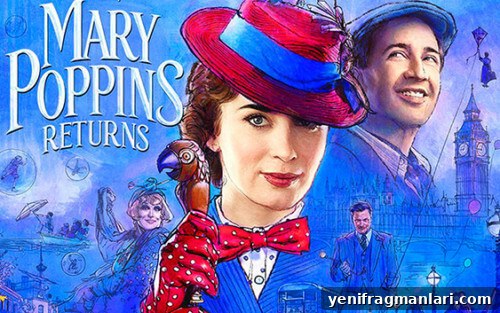
Mary Poppins Returns (2018)
Director: Rob Marshall
Screenwriter: David Magee
Starring: Emily Blunt, Lin-Manuel Miranda, Ben Whishaw, Emily Mortimer, Pixie Davies, Nathanael Saleh, Joel Dawson, Julie Walters, Meryl Streep, Colin Firth
Rob Marshall’s Disney-produced sequel, arriving 54 years after the original Mary Poppins, set out to recapture the whimsy and warmth that made the 1964 classic so enduring. Framed as a “many years later” continuation of the Banks family story, Mary Poppins Returns leans into nostalgia while offering its own gentle charms. The film trades on a familiar sense of wonder—supernatural caretaking, buoyant musical numbers, and a moral core that elevates kindness, imagination, and the small pleasures of life.
Set in a London that feels like a softened memory of the past, the film finds the grown Banks children confronting adult responsibilities and grief. That everyday struggle — the precarious balance between duty and delight — is rendered in a way that most viewers will find relatable. The narrative emphasizes a simple, enduring message: hold on to the creativity, acceptance, and love you knew as a child. In its best moments, Mary Poppins Returns reminds us that no act of kindness is meaningless, no piece of art is wasted, and no person is without value.
Emily Blunt shoulders the lead with poise and comic precision, offering a portrayal that honors Julie Andrews’ original while staking out its own playful territory. Blunt’s Mary Poppins combines authority with warmth—stern when needed, mischievous when the moment calls for it, and always in control of the scene. The supporting cast provides strong counterpoints: Lin-Manuel Miranda brings brightness and an infectious energy to his role, Ben Whishaw and Emily Mortimer contribute grounded sensitivity, and Julie Walters and Meryl Streep add delightful, character-driven touches. The child actors largely avoid the shrillness that can plague juvenile performances, anchoring the film emotionally and allowing the family dynamics to resonate.
Musically, the film revisits the classic entertainment formula of catchy, character-focused songs that push story and emotion forward. The new tunes are crafted in a deliberately old-fashioned style, designed to fit seamlessly into the franchise’s established musical identity. Visually, Mary Poppins Returns mixes practical sets, choreography, and a touch of traditional 2D animation, which will be welcome to those who appreciate a varied cinematic palette. While a few sequences feel longer than necessary and some visual effects occasionally call attention to themselves, the overall production demonstrates care and craftsmanship.
One of the movie’s strengths is its timing. Released during a period of social anxiety and political uncertainty, the film functions as a brief, restorative escape. It doesn’t pretend to solve real-world problems, but it offers a two-hour respite—a reminder that cinema can be consoling, uplifting, and honest about the value of memory and human connection. That escapism is not mindless; it’s explicitly moral in its insistence that remembering childhood wonder and practicing small acts of decency have real worth.
Fans of the original will find much to appreciate: respectful homages, moments of playful continuity, and the comforting structure of a musical family film that refuses to cynically trade sentiment for spectacle. New viewers can enjoy it on its own merits as a lovingly assembled period fantasy with strong performances and a clear heart. The film may not eclipse the original classic in cultural stature, but it succeeds as a thoughtful, tender sequel—one that reintroduces Mary Poppins to a new generation while nudging older viewers to reconnect with lost optimism.
So, bring a sense of curiosity, an oversized bag of imagination, and a willingness to be led into a gentler world. Mary Poppins Returns offers a rare modern cinematic sentimentality that feels earned rather than manufactured: a warm, well-acted reminder that happiness, like memory, can be rediscovered if we allow ourselves to look.
19/24