
This article was originally published to SSP Thinks Film by Sam Sewell-Peterson.

The Silence of the Lambs (1991)
Director: Jonathan Demme
Screenwriter: Ted Tally
Starring: Jodie Foster, Anthony Hopkins, Ted Levine, Scott Glenn, Brooke Smith, Frankie Faison, Anthony Heald, Kasi Lemmons, Diane Baker, Stuart Rudin
Thomas Harris, who created Hannibal Lecter, admitted in a 2000 foreword to a new edition of his novel Red Dragon that Lecter still unnerved him and exerted an almost supernatural hold on his imagination. Lecter’s return in The Silence of the Lambs was dramatized most memorably by Jonathan Demme’s 1991 film adaptation, which has become the definitive cultural representation of the character for many viewers.
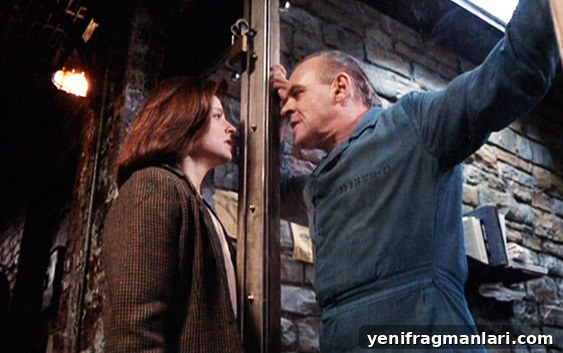
The film’s premise is stark and cunning: to capture a meticulous and depraved serial killer, the FBI enlists the mind of another meticulous and depraved criminal. Trainee Agent Clarice Starling (Jodie Foster) enters the Baltimore State Hospital for the Criminally Insane to question Dr. Hannibal “The Cannibal” Lecter (Anthony Hopkins). What begins as an interview becomes a tense psychological game: Clarice must draw on Lecter’s insights into criminal psychology to locate the elusive Buffalo Bill while refusing to let him invade her own mind.
Point of view is a vital element in The Silence of the Lambs. The film is not structured as a classic whodunit—audiences learn early on who the killer is—so its drama comes from watching Clarice assemble the evidence and from wondering whether she will arrive in time. Demme’s camera often adopts Clarice’s eye level and frames other characters addressing her directly, which places the viewer in a close, almost complicit perspective. This visual approach mirrors Thomas Harris’s way of telling the story and immerses the audience in Clarice’s investigation and psychological landscape.
Clarice is introduced as someone the system underestimates: in the opening scene Foster’s relatively small stature is emphasized as she stands among larger male colleagues in an elevator. The film tracks how she has learned to navigate expectations about her gender and stature—using them to her advantage while enduring patronizing treatment. From sympathetic yet self-interested FBI figures like Scott Glenn’s Jack Crawford to the officious and lecherous Dr. Chilton (Anthony Heald), Clarice faces continuous dismissal and condescension. She counters this with resilience, intelligence and an ability to remain composed under pressure—qualities that help her stay a step ahead, until she encounters sociopaths who are less predictable and infinitely more dangerous.
Demme’s film is rightly celebrated for its tension-laden, conversation-driven set pieces rather than for conventional action sequences. The core of the movie is the verbal sparring between Clarice and Lecter: short but electrically charged scenes in which Jodie Foster and Anthony Hopkins bring Thomas Harris’s language to vivid life. Lecter’s subdued but chilling revelations, combined with the physical barrier that often separates the two characters, produce some of the film’s most memorable and economical character studies. These exchanges reveal far more about both figures than any amount of exposition could.
“It rubs the lotion on its skin or else it gets the hose again.”
The depiction of Buffalo Bill (Ted Levine) remains controversial. The movie’s portrayal has been criticized for reinforcing harmful stereotypes about transgender people at a time when representation was already scarce and often problematic. Harris’s novel originally included material that attempted to distance the killer from the broader trans community, a nuance the film largely omits. Without that context, the character can be—and has been—misread as representing an entire group rather than an isolated, deeply disturbed individual. That lack of nuance has had cultural consequences and remains an important topic when evaluating the film today.
Anthony Hopkins’s performance is unforgettable because of the unsettling intelligence behind his gaze. While the film encourages empathy for Clarice and even offers a degree of pity for Buffalo Bill, it leaves Lecter as someone we fear above all else. Lecter stands as a figure who marks a boundary the audience is not meant to cross: beguiling, enigmatic and terrifying from his introduction through his escape and beyond.
Demme and editor Craig McKay use misdirection and cross-cutting to powerful effect, especially in the film’s final act. The sudden, stomach‑dropping edit that leaves Clarice unexpectedly isolated and vulnerable is still shocking. Earlier foreshadowing—Clarice’s fragmented childhood memories woven into the present—blurs transitions of time and place and aligns the viewer with her subjective perception, strengthening the suspense when timelines converge.
For all of Hopkins’s concentrated and showy screen time, The Silence of the Lambs is ultimately Clarice’s film. The movie’s success rests on the dynamic between her and Lecter: Lecter is most compelling when matched against an opponent who can hold her own. In later sequels, the balance is lost because Lecter is often given the spotlight without a comparable adversary. Here, Foster’s determined, nuanced performance anchors the narrative and turns a taut procedural into a deeply memorable psychological thriller.
Score: 22/24
Recommended for you: “Hannibal” at 20 – Review