
Moxie (2021)
Director: Amy Poehler
Screenwriters: Tamara Chestna, Dylan Meyer
Starring: Hadley Robinson, Lauren Tsai, Alycia Pascual-Peña, Patrick Schwarzenegger, Nico Hiraga, Josephine Langford, Ike Barinholtz, Amy Poehler, Marcia Gay Harden
Moxie is set at East Rockport High, a school where misogyny is not only tolerated but woven into everyday life. The film opens by making that culture unmistakable: the boys trade crude lists rating girls by appearance, sexualizing their classmates without apparent consequence, and the school’s adults largely shrug off complaints. When Lucy (Alycia Pascual-Peña) confronts the principal after being reduced to an obscene ranking, she is met with dismissal. That moment kicks off the film’s central premise—how one anonymous voice can spark a larger response.
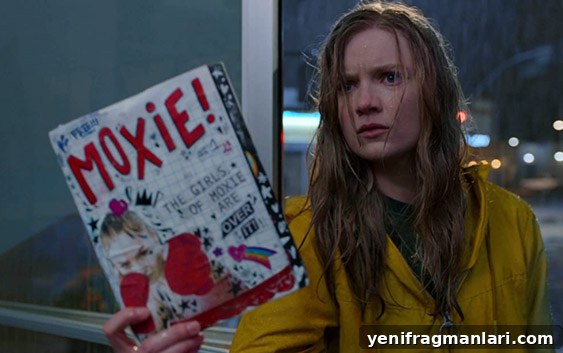
Vivian (Hadley Robinson), a quiet student who has felt alienated by the school’s apathy, decides to act. Inspired by her mother’s past involvement in Riot Grrrl culture, she creates an anonymous zine called “Moxie” that challenges the sexist status quo and calls for collective action. The zine galvanizes a group of girls across different backgrounds to organize, protest, and demand change inside East Rockport High. That setup promises an energizing, teen-driven exploration of modern feminism.
Unfortunately, the film rarely reaches the depth it aims for. Thematically, Moxie wants to be an accessible, empowering teen feminist drama, but it too often settles for surface-level gestures rather than meaningful exploration. Many of the supporting characters exist primarily to represent a checklist of contemporary issues—race, sexuality, gender identity, disability—without being developed beyond that single identifying trait. When representation is treated as a box to tick instead of a narrative responsibility, the film’s claims about intersectional feminism feel hollow.
Examples of missed opportunities are frequent. A trans character played by Josie Totah is introduced but given almost no chance for a deeper, specific portrayal of her experience; her identity is acknowledged mainly in broad, general terms. A brief kiss between two female characters is presented and then disappears from the story, left unexplored. A character who uses a wheelchair is reduced to that one aspect of identity, with limited agency beyond it. And the film positions a Black classmate as the explainer of feminism to the white protagonist, reinforcing an unequal dynamic rather than disrupting it. Any one of these arcs could have been the emotional center of the film; instead they remain fragments.
Part of the problem is that characters are written as archetypes rather than full people. Claudia (Lauren Tsai), Vivian’s best friend, is portrayed as a first-generation student under academic pressure, but the film falls back on a familiar trope—her mother sacrificed for a better life and the daughter must succeed to repay that debt. That cliché feels dated and simplistic, especially in a film that otherwise claims to depict a modern generation. Similarly, certain scenes read as if someone tried to capture the “quirkiness” of teenagers without truly understanding contemporary teen culture: a date at a funeral home plays for eccentricity rather than character insight, and the cast’s minimal use of social media is oddly anachronistic for a story about activist teens.
Stylistically, Amy Poehler’s comedic sensibilities do yield genuine laughs. The movie contains bright, funny moments and a warmth that comes through in small interactions. Yet the humor often functions like sketch-comedy inserts—enjoyable in the moment but disconnected from the film’s dramatic stakes. Jokes and light beats appear sporadically, sometimes feeling appended rather than organically arising from the characters’ arcs.
More troubling is how Moxie handles serious subjects. The film gestures toward the #MeToo movement early on, and a later subplot involving sexual assault aims to raise the stakes. However, the treatment feels rushed and underdeveloped: a heavy issue is introduced, managed by adults in a way that sidelines the survivors’ perspectives, and then largely resolved without the film engaging with the complexity and lasting impact of such violence. That kind of quick fix undermines trust in the story’s commitment to address harm responsibly.
Where Moxie succeeds is in moments of solidarity and the visual energy of a group of young people discovering their voice. Those sequences hint at the film’s potential and show why teen-led activism onscreen can be compelling. But the movie repeatedly pulls back from fully committing to the messy, difficult conversations that would make its message resonate. Instead of allowing one or two marginalized characters the space to be three-dimensional protagonists, the film spreads its attention thinly across many causes and identities, sacrificing depth for breadth.
In sum, Moxie is well-meaning and occasionally charming, and it may serve as an accessible entry point to feminist ideas for some viewers. Yet for a film that aims to portray intersectional, contemporary activism, it too often relies on shorthand and surface-level representation. Its diverse cast is a strength in principle, but most characters are not allowed the complexity their situations deserve, which weakens the film’s call for real change.
9/24