
This article was written exclusively for The Film Magazine by Gala Woolley.
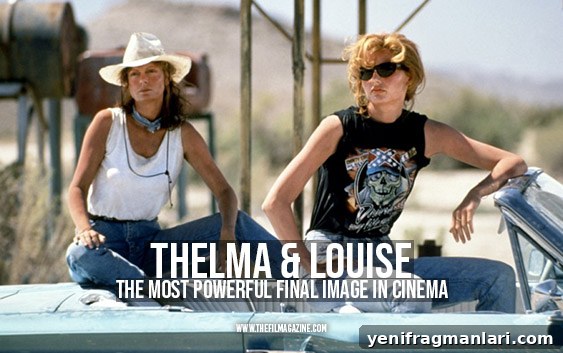
Thelma & Louise was the film that sparked my feminist awakening, and even thirty years later it remains a landmark for how women are portrayed on screen. The film’s final image—Thelma and Louise driving toward the canyon and frozen mid-flight—has been called “both tragic and idealistic” by critic Marita Sturken, and it continues to divide viewers. For me, that final frame is one of cinema’s most powerful and enduring moments.
Director Ridley Scott explained the ending by saying it “just seemed appropriate that they continue the journey.” That idea—that the image should be read figuratively—turns the characters’ plunge into something like an ascent. By freezing the shot at the moment of their leap, Scott immortalises Thelma and Louise: they are not presented as victims of a conventional fate but as figures who have chosen their own destiny. Before they go over the edge, Thelma urges, “Let’s not get caught. Let’s keep going,” a line that reinforces the film’s theme of refusal to be contained.
The vastness of the Grand Canyon functions as more than a dramatic backdrop; it represents the culmination of their transformation. Having broken away from the limited identities of housewife and waitress, the characters have reached the highest point of their arc. The Canyon’s open sky and immense scale visually communicate an ascent—a final, literal flight that signifies escape from the constraints that defined their earlier lives.
Hollywood’s standard happy ending traditionally equates a woman’s fulfillment with marriage. From early Walt Disney features to countless studio romances, popular films have often suggested that a woman’s story concludes with romantic union. Edward Ross has argued that Disney’s heroines—from Snow White onward—are frequently framed as damsels awaiting rescue, their ultimate goal being marriage. In Snow White, the heroine waits passively for her prince; the film ends with a literal “happily ever after” and narrative closure. By contrast, Thelma & Louise refuses that kind of tidy finality.
Thelma & Louise is subversive not only because its protagonists reject patriarchal expectations, but because the film denies the audience conventional closure. Rather than inviting us to imagine life after the ending, the movie stops mid-flight, offering a single, transcendent image. Read figuratively, the freeze-frame suggests continuance rather than death: the women are forever suspended in an act of liberation, a visual “forever” that resists being resolved into ordinary narrative fate.
Screenwriter Callie Khouri has said she wanted nothing to be able to touch the women after all they had endured. Their final act is meant to make them untouchable. Critic Manohla Dargis has argued that the story’s destination matters less than the bond between Thelma and Louise; what the film reinvents for the American screen is sisterhood and mutual loyalty. The camera lingers on their faces and on their clasped hands, turning their relationship into the central achievement of the film rather than subordinating it to romantic closure.
The soundtrack reinforces the film’s emphasis on solidarity. Glenn Frey’s “Part of Me, Part of You” includes lines such as “you and I will always be together, from this day on you’ll never walk alone,” which underline the film’s core message of loyalty and companionship. That song captures the “tragic but idealistic” tone that many critics have observed: the journey ends, but the relationship forged between the two women endures.
While Thelma & Louise differs from a traditional fairy tale, it borrows the idea of a satisfying resolution and reshapes it. Instead of a naïve, heteronormative “happily ever after,” the film offers an adult version of emancipation: freedom achieved through resistance to the roles society assigns the protagonists. Their refusal to submit becomes the film’s true happy ending—one not measured by marriage or rescue but by autonomy and shared defiance.
Because the film stops before showing any final physical consequence, Thelma and Louise are effectively mythologised. Laura Shapiro described the ending as two women whose clasped hands become their most powerful weapon. Their decision is neither a violent surrender nor a resigned defeat; it is a conscious act that transforms them into icons of resistance.
Thelma & Louise reshapes expectations of what a Hollywood ending can be. It rejects patriarchal closure in favor of liberation and platonic devotion. By having its protagonists seize their own fate, the film asserts that women can rescue themselves—an idea that remains as provocative and vital now as it was when the film first premiered. The final still leaves us with a defiant, impossible “forever,” one that continues to inspire debate and admiration.
Written by Gala Woolley
Laura Shapiro, “Women who kill too much” in Newsweek, 1991.
Gala Woolley, “The Road to Female Empowerment: Resisting Gender Conventions of Hollywood Cinema in Thelma & Louise.”
You can support Gala Woolley in the following places:
Twitter – @GalaWoolley
Blog – screenqueens.co.uk