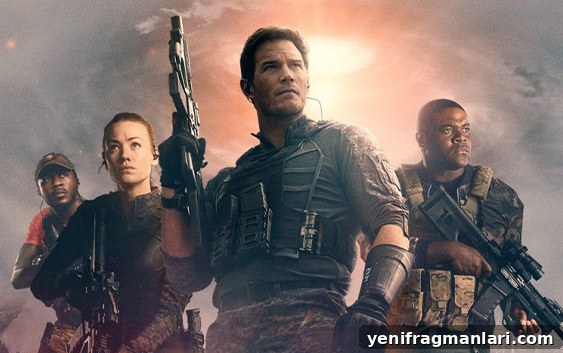

The Tomorrow War (2021)
Director: Chris McKay
Screenwriter: Zach Dean
Starring: Chris Pratt, Yvonne Strahovski, J.K. Simmons, Ryan Kiera Armstrong, Betty Gilpin, Sam Richardson
The Tomorrow War aims to blend time travel with military science fiction, but ultimately feels like a collage of ideas borrowed from better films. The story sends soldiers and civilians from the present into a bleak future where humanity fights a losing war against alien creatures. The film tries to combine family drama, large-scale action, and speculative science, yet the result is an uneven, sometimes clumsy mix that rarely reaches its potential.
Plot-wise, the premise is straightforward: in the future, humanity is nearly extinguished by a relentless alien species. Scientists develop a time-transport program that recruits people from the past to reinforce their depleted forces. Among those drafted is Dan Forester (Chris Pratt), a former soldier turned high-school biology teacher who is desperate to protect his young daughter, Muri (Ryan Kiera Armstrong). The emotional heart of the film rests on Dan’s motivation to save his family, and Armstrong’s performance as Muri stands out as one of the movie’s strongest assets. Her natural charisma and convincing emotional range give the film moments of genuine warmth.
Chris Pratt delivers the expected action-hero turn, balancing gruffness and vulnerability, and the supporting cast provides solid work in smaller moments. Betty Gilpin and J.K. Simmons bring credibility and depth to their roles, while Sam Richardson injects levity. Despite these competent performances, the screenplay often undercuts character development by prioritizing spectacle over meaningful beats. The film repeatedly emphasizes Dan’s devotion to his daughter but largely sidelines his relationship with his wife, leaving some emotional arcs feeling underused.
On the production side, Chris McKay’s direction often relies on mechanical techniques rather than imaginative choices. The film favors pushing in on faces during dialogue and using quick-cut action editing, which can make intense scenes feel frenetic and hollow. Visual effects drive much of the movie, yet many sequences come across as formulaic: heavy gunfire, CGI creatures, and explosions designed to generate immediate impact but lacking distinctive creative vision.
One of the more significant issues concerns the film’s handling of time-travel logic. Key plot devices—such as sending biological agents into the past to prevent the rise of the aliens—raise paradox questions that the screenplay does not address. These unresolved contradictions undermine the stakes and make some narrative decisions feel careless. A tighter approach to the film’s speculative mechanics or at least a concise on-screen explanation would have strengthened the story’s internal consistency.
Stylistically, the score often overwhelms scenes with an aggressive, bombastic tone that attempts to force emotional reactions. When music must constantly tell the audience how to feel, it can suggest a lack of confidence in the material. The sound design and mixing occasionally drown dialogue under heavy cues, which reduces the impact of performances and weakens the film’s more intimate moments.
There are moments where the film tips its hat to classic science-fiction cinema—elements reminiscent of earlier alien and survival movies appear throughout—but those homages rarely become original statements. Production design and creature concepts borrow familiar shapes and visual motifs without offering enough new resonance to justify the reuse. As a result, the movie can feel derivative rather than reverent.
Despite its flaws, The Tomorrow War is not without merit. It delivers intermittent thrills, and a few scenes achieve emotional clarity, largely due to the cast’s commitment—especially the performances by Ryan Kiera Armstrong and supporting players. For viewers seeking a bombastic action-sci-fi experience with a family-driven core, the film can be entertaining in short bursts. For audiences hoping for a rigorous, inventive time-travel thriller or a fresh take on alien invasion, the movie will likely disappoint.
Overall, The Tomorrow War feels like a well-intentioned but flawed entry in modern science-fiction cinema. Strong acting moments and a human family center are not enough to outweigh a scattershot script, inconsistent direction, and underdeveloped speculative ideas. The film’s ambition to mix emotional stakes with big sci-fi concepts is clear, but the execution leaves many questions unanswered and many opportunities unexplored.
Rating: 5/24