This article was originally published to SSP Thinks Film by Sam Sewell-Peterson.
Ex Machina (2014)
Director: Alex Garland
Screenwriter: Alex Garland
Starring: Alicia Vikander, Domhnall Gleeson, Oscar Isaac, Sonoya Mizuno
For years audiences waited for a film that would genuinely deliver an intelligent, gripping AI thriller. While memorable scenes from classics like 2001: A Space Odyssey touch on the dangers of artificial intelligence, those films rarely concentrate exclusively on the philosophical and psychological tightrope that comes with creating consciousness. Many attempts have leaned toward action or spectacle—the Terminator and Matrix franchises, for example—or sacrificed depth for star power, as seen in films that traded nuance for blockbuster appeal. Alex Garland, known for his sharp screenwriting on films such as 28 Days Later and Sunshine, made a striking directorial debut with Ex Machina, delivering a compact, thoughtful exploration of AI that balances tension, beauty, and unsettling ideas.
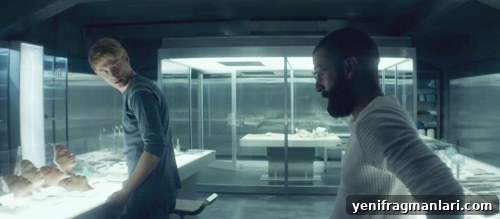
The film follows Caleb (Domhnall Gleeson), a young programmer who unexpectedly wins a corporate contest to spend a week at the secluded estate of Nathan (Oscar Isaac), the reclusive founder of the company where Caleb works. What begins as an odd but flattering invitation soon reveals itself as an experiment: Nathan asks Caleb to run a series of Turing-style tests on Ava (Alicia Vikander), an advanced humanoid AI, to determine whether she can be perceived as conscious by a human observer. Over the week, the dynamics between the three characters evolve into a tense psychological game where observation and control sit at the center of every interaction.
Beyond the familiar philosophical questions—free will, personhood, and what it means to be human—Ex Machina focuses sharply on surveillance, power, and manipulation. From Caleb’s first arrival, the film establishes that no one is free from observation: Nathan watches his visitors and his creation, Caleb studies Nathan and Ava for signs of motive, and Ava learns to read and respond to subtle human cues. Each character exerts influence in different ways, and the film becomes a quiet, ever-shifting chess match of wills and intentions. The stakes are psychological and moral rather than explosive, making the slow buildup of tension all the more effective.
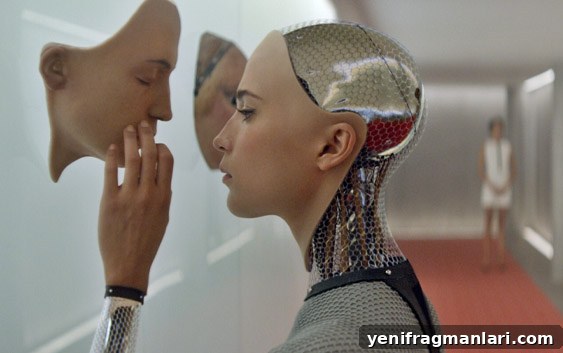
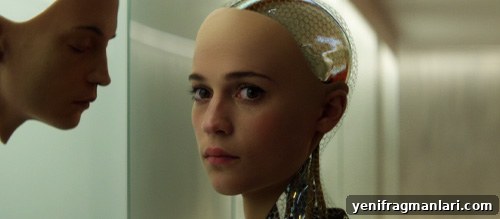
The film’s success rests heavily on the performances, and the central trio delivers. Domhnall Gleeson plays Caleb with a believable mix of curiosity and vulnerability, while Oscar Isaac imbues Nathan with charismatic menace—he’s brilliant, volatile, and unsettlingly confident. Alicia Vikander’s performance as Ava is the film’s cornerstone. Rather than opting for overtly mechanical movement, Vikander creates a convincingly human presence interrupted by subtle, uncanny moments that remind you she is not human. That restrained approach—naturalistic yet slightly off—makes Ava’s onscreen presence haunting and unforgettable.
Visually and tonally, Ex Machina is restrained but striking. Garland’s direction avoids flashy effects in favor of carefully composed images and an atmosphere that alternates between serene beauty and creeping dread. One especially memorable sequence introduces Ava in a wide shot: she walks into view against a bright window, and the light reveals the structure of her synthetic body. The film later explains why those mechanical details are concealed, a narrative choice that both respects the production’s modest resources and enhances the impact of the moments when Ava’s artificiality is fully exposed.
Garland’s screenplay is economical and intelligent. Dialogue is used sparingly yet precisely, delivering complex ideas in concise, resonant lines rather than lengthy exposition. The script balances philosophical inquiry with character-driven conflict, and it builds steadily toward a final act that is equal parts chilling and inevitable. There are unexpected narrative turns that reward close attention and invite repeated viewings and discussion.
Because Ex Machina centers on discovery and surprise, the film is best experienced with minimal prior knowledge. It benefits from being seen cold: the fewer preconceived expectations, the stronger the impact of its ideas and revelations. For viewers who have already seen it, the film rewards revisiting—small details, thematic layers, and performance choices gain depth on subsequent viewings and spark rich debate about ethics, autonomy, and the nature of consciousness.
23/24
Recommended reading: Alex Garland Directed Films Ranked