
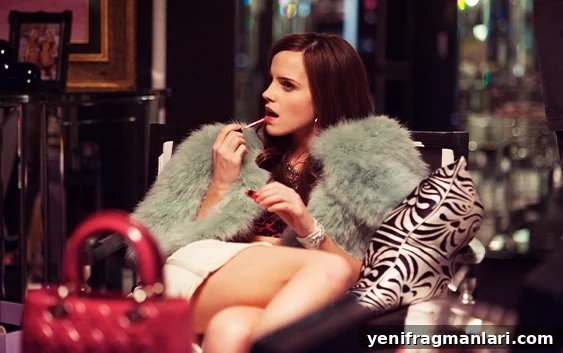

The Bling Ring (2013)
Director: Sofia Coppola
Screenwriters: Sofia Coppola, Nancy Jo Sales
Starring: Katie Chang, Israel Broussard, Emma Watson, Claire Julien, Taissa Farmiga, Georgia Rock, Leslie Mann
A decade after its release, Sofia Coppola’s satirical crime drama The Bling Ring (2013) remains a strikingly relevant portrait of celebrity obsession and social media-driven identity. While the platforms and habits that define our online lives have evolved since the film’s debut, the core themes Coppola explores—fame worship, performative consumption, and the hunger for external validation—feel even more timely in today’s influencer culture.
Set in the affluent suburbs of Calabasas, California, the film dramatizes the true events of a group of teenagers who burglarized the homes of celebrities, including Paris Hilton and Lindsay Lohan. Coppola adapts real interviews and material from journalist Nancy Jo Sales’ reporting, weaving fictionalized performances with documentary-style interludes. The film follows characters such as Marc (Israel Broussard) and Rebecca (Katie Chang) as they treat celebrity possessions like trophies—items that confer status simply because they once belonged to someone famous.
From the opening line—“let’s go shopping”—the movie plunges viewers into a world where brand names and celebrity ownership eclipse intrinsic value. These teens are not driven by need; many could plausibly afford luxury items on their own. Their thefts are motivated by a desire to claim association with fame rather than by the material worth of the goods. Coppola underscores this point with a carefully staged long take of Rebecca reverently trying on Lindsay Lohan’s perfume: the fragrance’s allure is not sensory but symbolic.
That symbolic function of celebrity possessions is amplified today by social media. Where celebrities once alone curated desirable lifestyles, influencers now mediate what is aspirational for massive audiences. A garment becomes culturally valuable not because of its design or quality but because a public figure was photographed wearing it. The film foreshadows this shift, showing the characters obsessed with documenting their transgressions—flash photography and Polaroid-like snaps become proof of identity.
The teens’ compulsive documentation is their undoing. Photographs uploaded to social media mirror the contemporary impulse to perform one’s life for an audience. In Coppola’s film, these images become evidence, allowing law enforcement to trace stolen items back to the perpetrators. This dynamic is a prescient commentary on how the desire for visibility can backfire, converting private transgression into public exposure.
Coppola explores this hunger for validation most directly through Marc, whose early candid interview reveals deep insecurity beneath a confident facade. A memorable scene shows him alone in his room, lip-syncing to a song while recording himself on a laptop—an intimate moment that anticipates the later popularity of short, self-staged videos on social networks. The scene captures how technology can inflate self-image, offering immediate but shallow feedback in the form of views and likes.

Musically, The Bling Ring is energized by a sharply chosen soundtrack that anchors the film in its moment. From the abrasive guitars of Sleigh Bells to the contemporary R&B textures of Frank Ocean, the music punctuates key emotional beats and escalates as the characters’ misdeeds intensify. Azealia Banks’ “212” marks a raucous sequence in which Emma Watson’s character abandons restraint and dances with unhinged glee, while Kanye West’s “POWER” amplifies a slow-motion scene that satirizes the teens’ ersatz sense of grandeur.
Coppola’s tone throughout the film is both critical and wry. She refrains from excusing the crimes while also interrogating the culture that makes such thefts seem desirable. Lines such as Nikki’s offhand question—“why does she need two?”—gesture toward questions about excess and distribution that remain central to contemporary conversations about wealth and celebrity. The film ultimately resists sympathy for its protagonists; their pursuit of fame feels instrumental and shallow, and their relationships lack genuine connection.
Critically, some viewers may find the film repetitive: nightclub sequences and cyclical displays of consumption occasionally feel indulgent themselves. Yet the repetition can also be read as intentional, reflecting the monotonous loop of conspicuous consumption and the sameness of performative nightlife. At a lean 86 minutes, the film maintains a brisk pace and relies on a youthful, committed cast to deliver darkly comic moments and unsettling honesty.
More than just a crime drama, The Bling Ring functions as a time capsule that anticipated an era in which ordinary people can manufacture visibility and brand association for themselves. Its critique of fame and consumerism feels less dated and more prophetic: the mechanisms of validation have multiplied, but the impulse to be seen and admired remains unchanged. For viewers interested in pop culture, media criticism, or the social dynamics of modern adolescence, Coppola’s film continues to provoke reflection.
Score: 18/24
Recommended reading: Sofia Coppola Movies Ranked
Written by Grace Laidler
Follow Grace Laidler on Twitter: @gracewillhuntin