
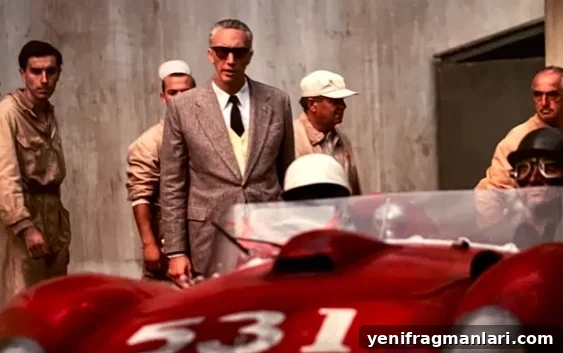

Ferrari (2023)
Director: Michael Mann
Screenwriters: Troy Kennedy Martin
Starring: Adam Driver, Penélope Cruz, Shailene Woodley, Sarah Gadon, Gabriel Leone, Jack O’Connell, Patrick Dempsey
The year 2023 continued the trend of high-profile biopics that aim to illuminate controversial, charismatic figures from history. Michael Mann’s long-gestating Ferrari arrives with an acclaimed director, a star-studded cast, and on-location production values, yet it struggles to function as a satisfying biographical film. Despite strong technical craftsmanship and memorable set pieces, the movie falls short in delivering the emotional clarity and character depth a biopic requires.
Set in 1957, the story follows Enzo Ferrari (Adam Driver) during a tense year for his company and his personal life. Ferrari prepares his racing team — including Piero Taruffi (Patrick Dempsey), Wolfgang von Trips (Wyatt Carnell), Peter Collins (Jack O’Connell), and Alfonso de Portago (Gabriel Leone) — for the grueling Mille Miglia, a thousand-mile endurance race. At the same time, the business is on the brink of financial collapse. Complicating matters, Enzo is estranged from his wife Laura (Penélope Cruz), who holds half the company’s shares, while he is involved in an affair with Lina Lardi (Shailene Woodley). The film toggles between boardroom pressure, family conflict, and the visceral intensity of racing.
One central weakness is the film’s surface-level treatment of its characters. Many of the racers feel underdeveloped; the screenplay does not furnish them with enough backstory or individual stakes for audiences to form meaningful attachments. Without that investment, the racing sequences—though visually thrilling—can feel like spectacle without suspense. Likewise, Enzo’s inner life and formative experiences receive little exploration. The film assumes an established brand and public persona rather than tracing the events that made Enzo the man he became, so viewers unfamiliar with his biography may come away with an incomplete picture.
Mann appears torn between portraying Enzo the entrepreneur and Enzo the private man, and the resulting imbalance leaves both aspects under-realized. The movie raises potentially compelling themes—ambition versus responsibility, public success versus private failure—but it rarely develops them into a cohesive portrait. As a consequence, the emotional payoff is muted: the narrative registers incidents and confrontations but seldom builds to a deeper understanding of motives or legacy.
Another problematic element is the film’s reliance on broad cultural shorthand. At times Ferrari leans into familiar Italian stereotypes—passionate temperaments, maternal attachments, and theatrical gestures—that risk reducing a varied culture to caricature. These portrayals are not fully interrogated or complicated, and when paired with inconsistent accents and international casting choices, they can feel like surface-level pastiche rather than authentic cultural immersion. This approach undermines the film’s ability to situate Enzo within a convincingly textured social and historical environment.

Despite these narrative shortcomings, the film demonstrates clear strengths in its filmmaking craft. Mann and his team populate scenes with convincing period detail, and the production design and costuming effectively evoke 1950s Italy. Most notably, the film’s race sequences are executed with cinematic rigor: the cinematography, editing rhythms, and immersive sound design combine to convey the physical peril and mechanical poetry of high-speed motorsport. A particular crash sequence stands out for its visceral impact, showing Mann’s aptitude for staging sequences that are both technically ambitious and emotionally arresting.
Thematically, Ferrari touches on recognizable cultural elements—opera, Catholic tradition, and national pride—that feel central to the subject and are handled with moments of honesty. Enzo’s devotion to perfection and obsession with competition are clearly established; the film communicates how sports and spectacle shaped his priorities and decisions. However, those thematic markers are not always woven into a fuller biographical argument about legacy, innovation, or the moral costs of success. The result is a film that excels at atmosphere but is less persuasive as a portrait of historical character.
Performance-wise, the ensemble brings charisma and commitment, and Adam Driver in the lead delivers many compelling moments. Still, strong individual performances cannot wholly compensate for the script’s reluctance to interrogate the defining arcs of its characters. For viewers already familiar with Ferrari’s life and mythos, the film may offer satisfying recreations of events and striking images of mid-century motorsport culture. For those seeking a deeper, more illuminating exploration of Enzo Ferrari’s motivations and impact, the movie provides only fragments of insight.
Score: 10/24
Rating: 2 out of 5.
Written by Clotilde Chinnici
Support the writer:
Portfolio: Clotilde Chinnici
Twitter: @filmswithcloe