
All of Us Strangers (2023)
Director: Andrew Haigh
Screenwriter: Andrew Haigh
Starring: Andrew Scott, Paul Mescal, Claire Foy, Jamie Bell
Andrew Haigh’s All of Us Strangers has become one of the most talked-about queer films of recent years, arriving in the UK to audiences who often leave screenings deeply moved. The film’s capacity to provoke tears raises a simple question: do intense emotional responses mean the film is any good? In this review, I argue that Haigh’s movie earns its feelings through careful craft—storytelling, performance, and a resonant use of music.
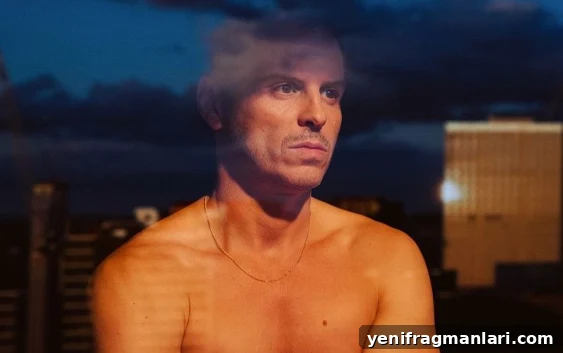
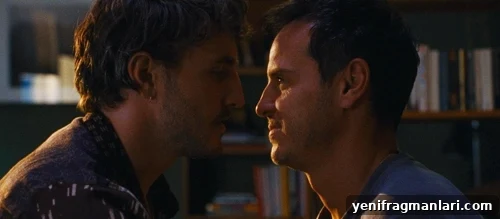
The story follows Adam (Andrew Scott), a floundering screenwriter who returns to the flat where he grew up to work through a screenplay about his parents, played by Claire Foy and Jamie Bell. When he arrives, Adam discovers that his parents seem to be living unchanged in the house on the day they died thirty years earlier. At the same time he begins a tentative romance with his enigmatic neighbour Harry (Paul Mescal). That relationship and Adam’s visit home entwine, carrying the film through memories, longing and the unresolved ache of loss.
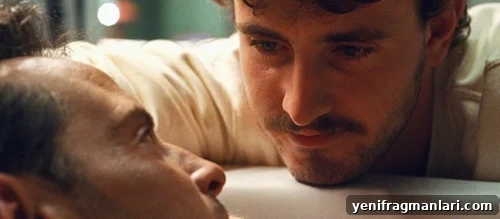
Haigh opens with a portrait of Adam’s inertia: he lounges on the sofa, struggles with his script and eats leftover meals—a man still trapped by his past. Adam’s modern apartment block feels empty, underscoring his isolation, until he meets Harry. Their first encounter occurs during a building fire drill; Harry arrives with a bottle of whiskey, oscillating between bravado and vulnerability. Paul Mescal brings a quiet charisma to the role: his performance is economical but magnetic, able to convey more in a glance than many actors do in pages of dialogue. Adam’s guarded responses—small smiles, uncomfortable silences—suggest how easily attraction and suspicion can coexist.
Musically, the film is anchored by the opening lines of Frankie Goes To Hollywood’s “The Power of Love.” The lyric “I’ll protect you from the hooded claw / Keep the vampires from your door” functions as a recurring motif, shifting meaning as the narrative unfolds. Early on the song highlights what is missing—emotional shelter, protection from loneliness—but as the characters’ stories deepen, the music accrues new emotional dimensions. Haigh’s repeated, evolving use of this song is a smart directorial choice; it ties scenes together and amplifies the film’s themes of love, protection and vulnerability.
Haigh handles ambitious, time-hopping material with a light touch. The film’s fantastical premise—parents frozen on the day they died, time folding in intimate ways—could have become either melodrama or confusing exposition. Instead, Haigh keeps the camera close to his four central characters: Adam, Harry and Adam’s parents. That intimacy makes the strange elements feel grounded. By paying attention to minute, human details—small gestures, shared glances, uneasy silences—the film makes the emotional stakes immediate and believable.
The cast elevates Haigh’s script. Andrew Scott is quietly brilliant as Adam: he embodies a man haunted but not inert, capable of sudden tenderness and brittle humor. Claire Foy and Jamie Bell create a powerful portrait of parental love: affectionate, evasive and complicated in equal measure. Their interactions with Scott’s Adam convey both warmth and the heavy residue of unspoken trauma that often lingers in families. Paul Mescal continues to impress, making the most of limited screen time to reveal layered longing and an unpredictable inner life. He never upstages his co-actors; instead, his restrained choices complement the ensemble.
When the film’s elements—writing, direction, performances and music—come together, All of Us Strangers achieves a rare emotional clarity. It is a film about longing and reconciliation, grief and the ways memory can both wound and heal. Haigh resists easy sentimentality; instead, he trusts the audience to feel the cumulative weight of small, precise moments. The result is a moving, unsettling love story that lingers long after the credits roll.
This is not a conventional romance or a simple ghost story: it is a nuanced meditation on memory, identity and the bonds that define us. Haigh’s film asks us to confront what it means to return to a place and people you thought were gone, and whether love can ever truly protect us from the past. Bring tissues, but also bring attention: the film rewards quiet observation.
Score: 22/24